
All Blog Posts



Heritage
Amrit Katha: Why Drops of Nectar Fell at 4 Sacred Places
K
Kumbh AdminSeptember 15, 20265 min readLearn the legend of Amrit Katha and why drops of divine nectar fell at Prayagraj, Haridwar, Ujjain, and Nashik, establishing the 4 sacred Kumbh sites.
Introduction: The Mystery Behind the 4 Kumbh Locations
After understanding the Samudra Manthan story, a deeper question naturally arises:
- Why is Kumbh Mela celebrated at only 4 places?
- How did drops of Amrit fall on Earth?
- What is the story behind Prayagraj, Haridwar, Ujjain, and Nashik?
The answers lie in the legendary Amrit Katha—the divine tale of the nectar of immortality.
According to the traditional mythology associated with Kumbh Mela, these four sacred places became connected with the Amrit Kalash during the cosmic struggle between the Devas and Asuras.
The Divine Chase: When Amrit Was Snatched
As soon as Dhanvantari emerged with the Amrit Kalash, the fragile alliance between the Devas and Asuras collapsed.
The Asuras attempted to seize the nectar, while the Devas tried to protect it.
👉 To safeguard the Amrit, Jayant, the son of Indra, is traditionally said to have carried the pot away.
What followed was a cosmic chase as the Devas and Asuras fought over possession of the nectar.
The 12-Day Divine Battle
According to the traditional account, the struggle over the Amrit continued for:
- 12 days in the divine realm
- Traditionally associated with 12 human years
This mythology is often connected with the 12-year Kumbh cycle.
During the chase:
- The Devas attempted to protect the Amrit
- The Asuras pursued them
- The Amrit Kalash was carried across different locations
And during this struggle:
👉 Drops of Amrit are believed to have fallen onto Earth.
These drops are traditionally associated with the four sacred locations of Kumbh Mela.
The 4 Sacred Places Where Amrit Fell
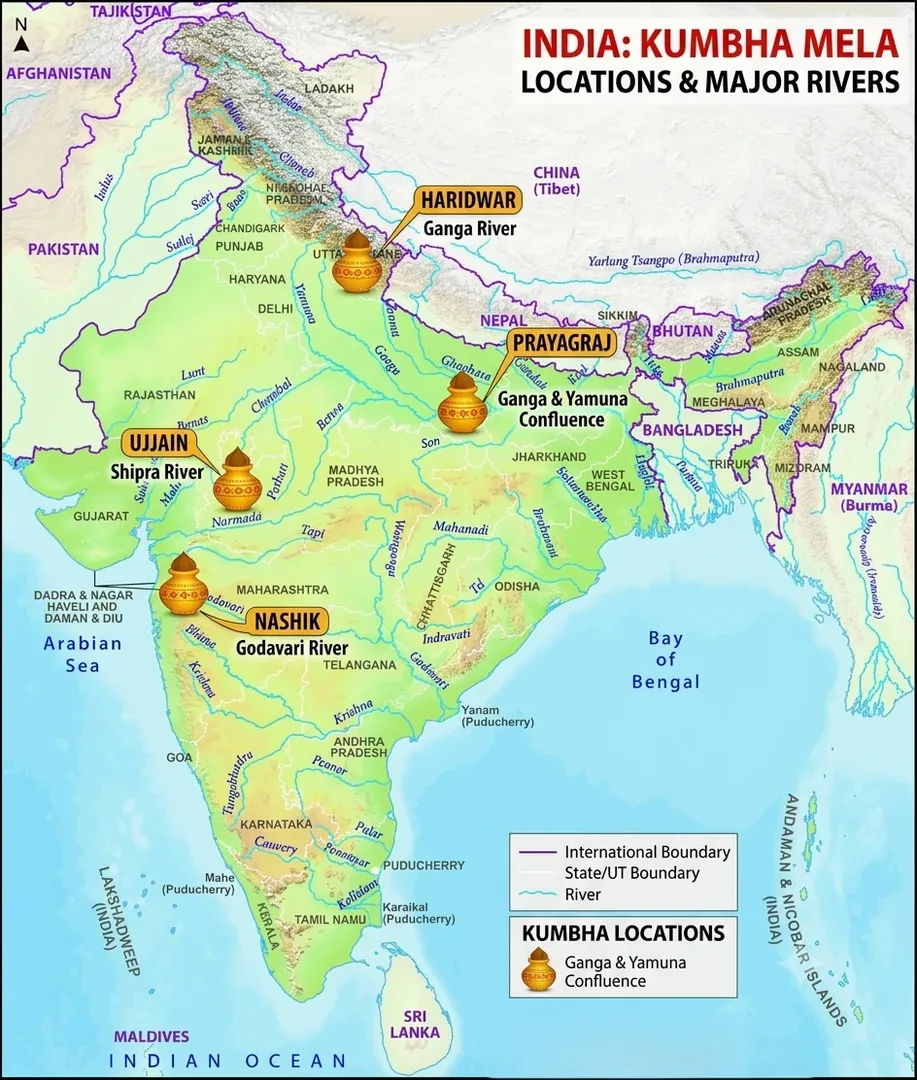
According to Kumbh tradition, the nectar fell at four locations, giving them a special place in India's sacred geography.
1. Prayagraj (Triveni Sangam)
Prayagraj is associated with the sacred Triveni Sangam, traditionally understood as the meeting point of:
- Ganga
- Yamuna
- Saraswati
It is regarded as one of the most important pilgrimage sites in the Kumbh tradition.
2. Haridwar
Haridwar is located on the banks of the Ganga, at the point where the river emerges from the Himalayan region and enters the plains.
Its name is associated with the idea of a gateway to the divine, and it is one of the four principal Kumbh locations.
3. Ujjain
Ujjain lies on the banks of the Shipra River and has a deep association with Shaiva traditions.
The Kumbh gathering at Ujjain is popularly known as Simhastha Kumbh.
4. Nashik
Nashik, located along the Godavari River, has strong connections with Hindu sacred traditions and the Ramayana.
It is one of the four locations where the Kumbh tradition is observed.
Divine Protection: How the Gods Safeguarded Amrit
The traditional story attributes important roles to several celestial forces during the struggle over the Amrit.
- Surya (Sun) is associated with protecting the pot from breaking.
- Chandra (Moon) is associated with preventing the nectar from spilling completely.
- Brihaspati (Guru/Jupiter) is associated with guiding and protecting the Devas.
Eventually, the conflict reached its decisive moment.
👉 Lord Vishnu appeared in the form of Mohini, a captivating divine form.
Mohini distracted the Asuras and obtained control of the Amrit.
The nectar was then distributed to the Devas, preventing the Asuras from gaining immortality.
Why Only These 4 Places Became Sacred
The four locations are considered significant within Kumbh mythology because of their association with the Amrit Kalash.
They represent:
- Divine protection and intervention
- Sacred geography connected with the Amrit
- Important pilgrimage centers
- The spiritual aspiration toward liberation and immortality
For devotees, the connection between these places and Amrit gives their sacred rivers and bathing sites a special spiritual significance.
During Kumbh, pilgrims therefore gather at these locations to perform Snan (ritual bathing) and participate in religious practices.
Scale of Faith: A Living Mythology
The mythology of the Amrit Kalash continues to shape the identity of Kumbh Mela.
Today, Kumbh is known for:
- Attracting tens of millions of pilgrims across major events
- Bringing together saints, Akharas, pilgrims, and spiritual seekers
- Receiving significant international attention
- Being recognized by UNESCO as an element of Intangible Cultural Heritage
The extraordinary scale of Kumbh demonstrates how an ancient sacred narrative continues to influence a living pilgrimage tradition.
Deeper Meaning: Beyond the Story
The Amrit Katha can also be understood symbolically.
The struggle between the Devas and Asuras can represent the constant conflict between wisdom and destructive impulses within human life.
The story may symbolize:
- The struggle between ego and wisdom
- The importance of discipline and divine guidance
- The protection of truth and spiritual values
- The idea that true immortality is connected with spiritual realization rather than physical existence
👉 In this interpretation, the “drops of Amrit” can represent moments of divine grace, spiritual awakening, and higher consciousness in human life.
Final Thoughts
The story of Amrit falling at four sacred places is not just a mythological episode—it forms an important part of the spiritual geography associated with Kumbh Mela.
The four sacred locations are:
- Prayagraj
- Haridwar
- Ujjain
- Nashik
According to the traditional Kumbh narrative, these places were touched by the sacred nectar during the cosmic struggle between the Devas and Asuras.
For millions of pilgrims, visiting these places during Kumbh is therefore more than a journey to a riverbank.
It is a journey into a living tradition shaped by mythology, faith, sacred geography, and the eternal search for spiritual awakening.
Enhance Your Pilgrimage Experience
Mobile App
Read Kumbh Guides on Mobile
Download the Divya Kripa to read all 19 guides offline, receive real-time snan alerts, and access GPS-enabled navigation on the ground.
Download AppAI Assistant
Personalized Planner & Chatbot
Access your Kumbh Planner AI Assistant to receive tailored ritual advice, customized itineraries, and instant answers to spiritual questions.
Try AI PlannerRelated Articles



Loading discussion & reviews...