All Blog Posts
Heritage
Role of Gods, Demons & Celestial Forces in Kumbh Mela (Mythological Perspective)
K
Kumbh AdminSeptember 18, 20267 min readExplore the cosmic conflict between Devas, Asuras, and celestial guardians (Sun, Moon, Jupiter) during the Samudra Manthan and its lasting legacy in Kumbh Mela.
Introduction: A Cosmic Story Behind a Sacred Gathering
Kumbh Mela is not just a festival—it is deeply connected with a mythological story of cosmic struggle, divine intervention, and the quest for Amrit.
But have you ever wondered:
- What role did gods and demons play in Kumbh Mela?
- Why are celestial forces linked to this festival?
- How did divine intervention shape the story of Amrit?
To understand the traditional mythology behind Kumbh, we need to return to the epic Samudra Manthan, where Devas, Asuras, and several divine forces played important roles.
The Devas vs Asuras: More Than Just a Battle
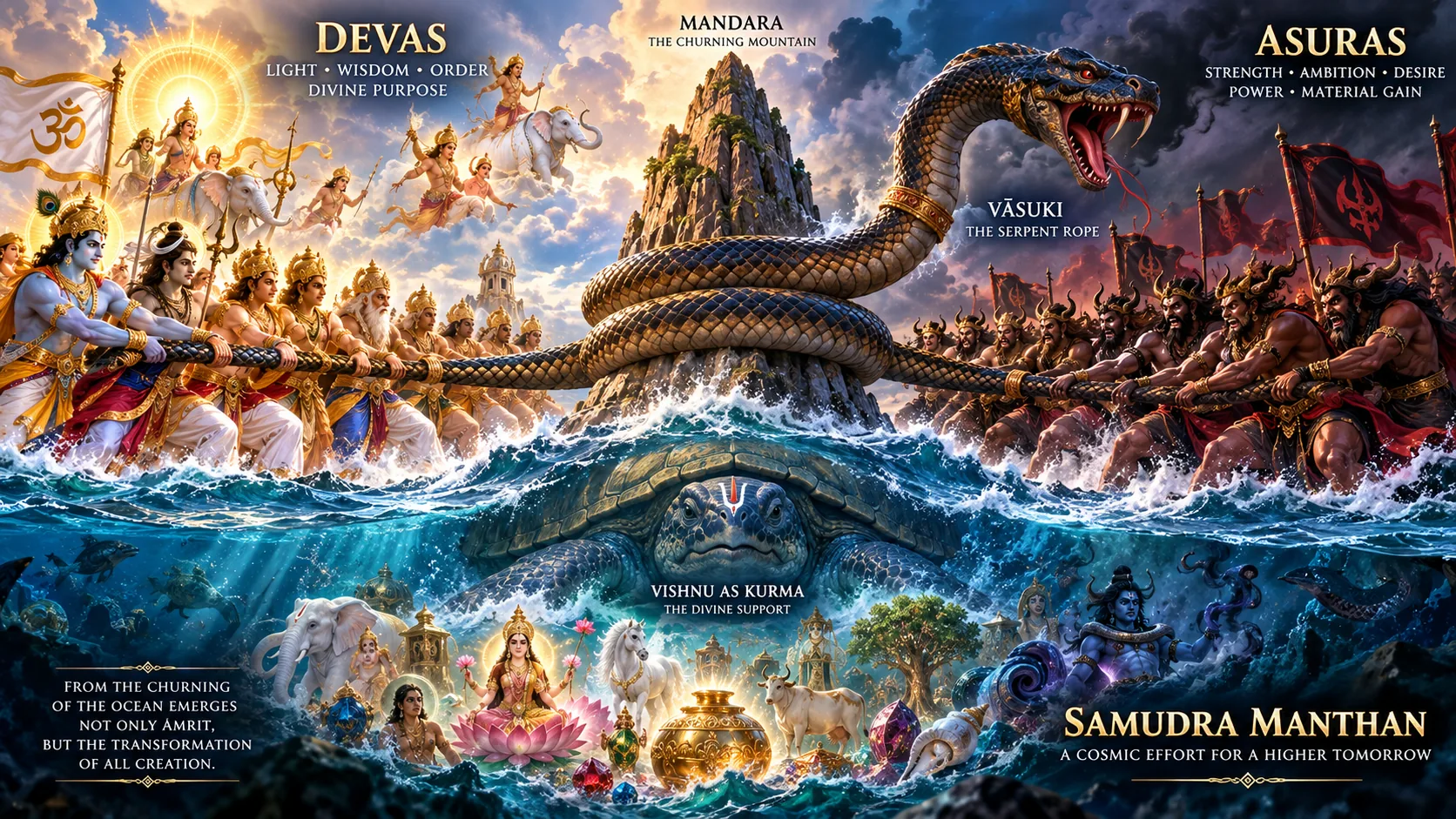
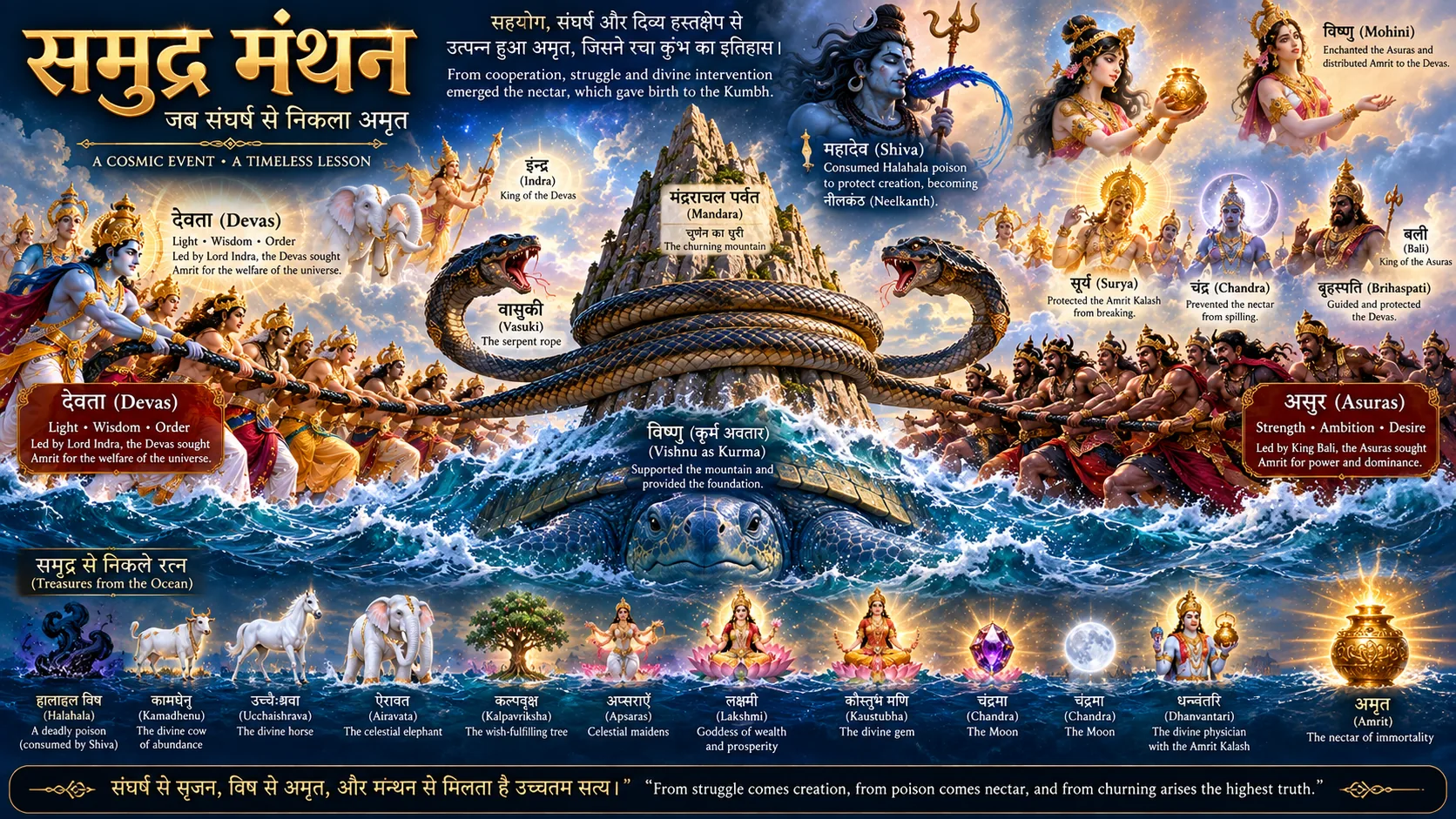
According to Hindu mythology, the Devas and Asuras worked together to churn the cosmic ocean in their quest for Amrit, the nectar of immortality.
In symbolic interpretations:
- Devas are associated with light, order, wisdom, and higher consciousness.
- Asuras are often associated with ambition, desire, power, and attachment.
Yet both were necessary for the Samudra Manthan.
👉 The story suggests that even opposing forces can contribute to a greater transformation.
Deeper Meaning
The cooperation between Devas and Asuras can symbolize:
- The role of effort and struggle in growth
- The tension between opposing forces
- The idea that transformation can emerge from conflict
- The challenges involved in the search for higher knowledge
The Roles Each Played in the Cosmic Event
Role of the Devas
The Devas played a central role in the quest for Amrit.
They:
- Sought the nectar of immortality
- Participated in the churning of the cosmic ocean
- Represented divine order within the traditional narrative
- Tried to prevent the Amrit from falling into the control of the Asuras
Role of the Asuras
The Asuras were equally important to the churning process.
They:
- Provided their strength for the enormous task
- Entered into an alliance with the Devas
- Sought to obtain the Amrit for themselves
- Represented ambition, desire, and the pursuit of power in symbolic interpretations
👉 Without the participation of both sides, the cosmic churning could not have taken place.
The story therefore presents the emergence of Amrit as the result of an enormous collective effort involving both cooperation and conflict.
Divine Intervention: Gods Who Shaped the Outcome
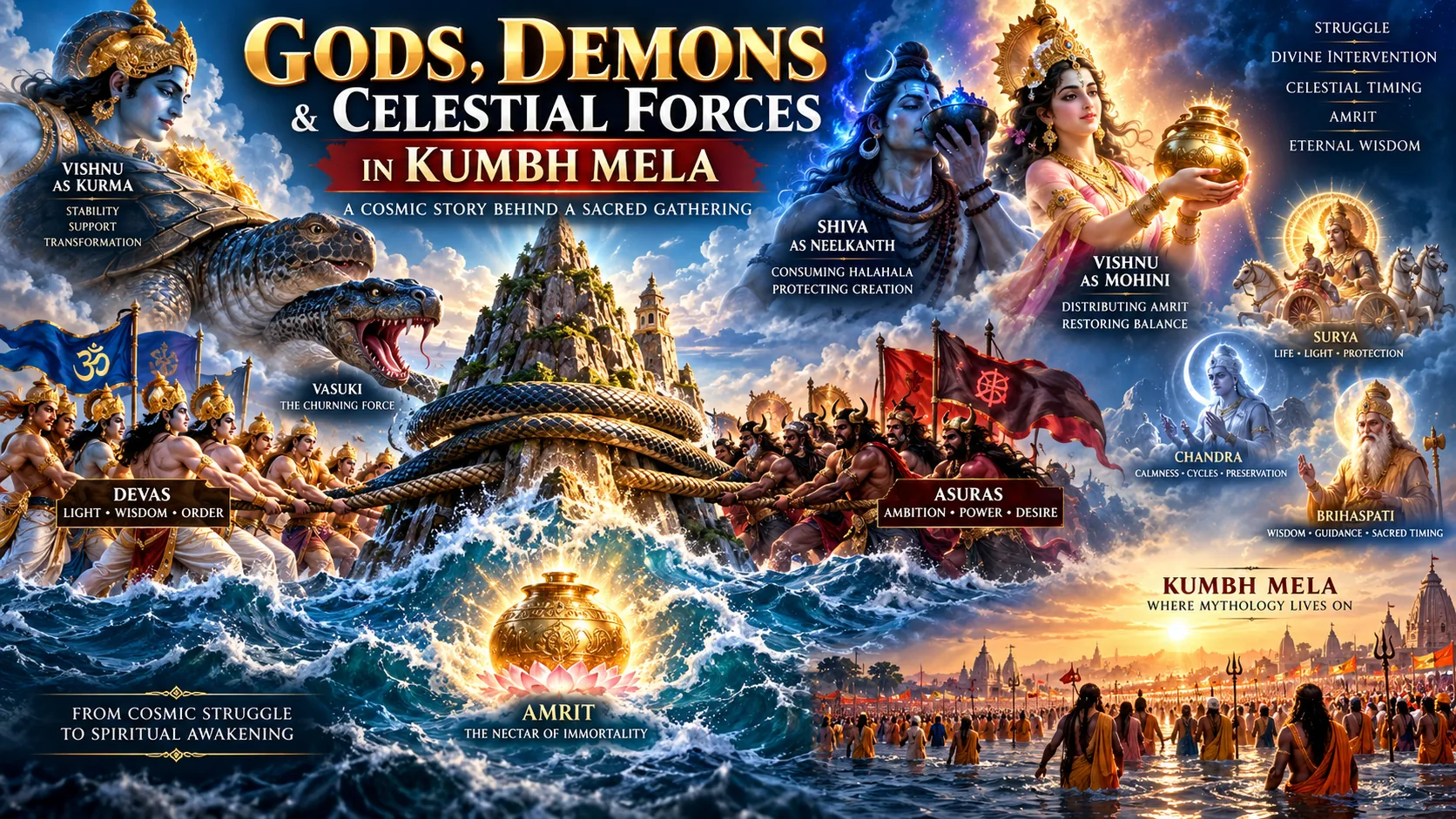
Several divine manifestations and deities played decisive roles during the Samudra Manthan.
Lord Vishnu as Kurma
When Mount Mandara became unstable during the churning, Lord Vishnu took the form of Kurma, the divine tortoise.
He supported the mountain and provided the foundation needed for the churning to continue.
Symbolically, Kurma represents:
- Stability
- Support
- Patience
- The foundation required for transformation
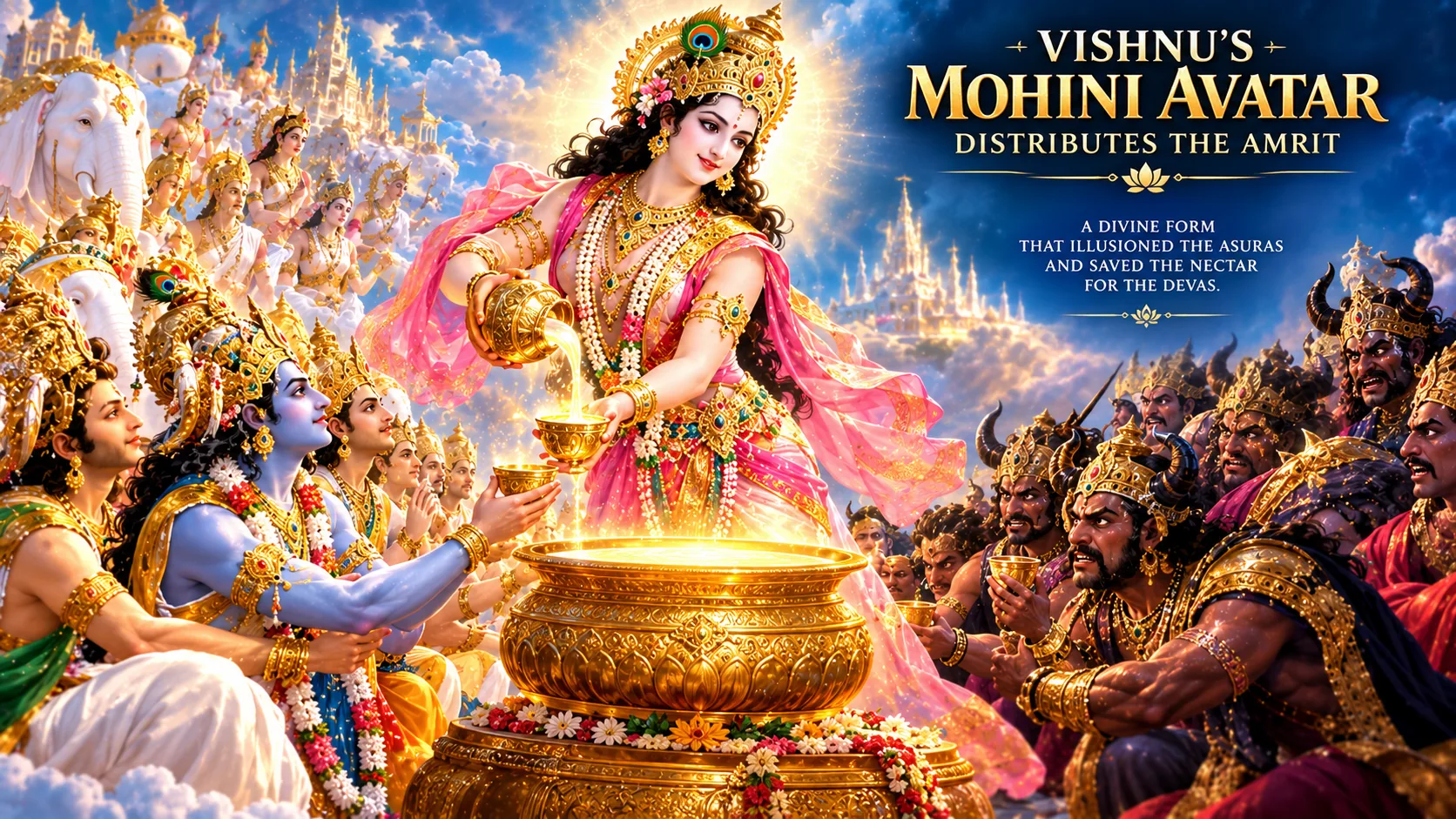
Lord Vishnu as Mohini
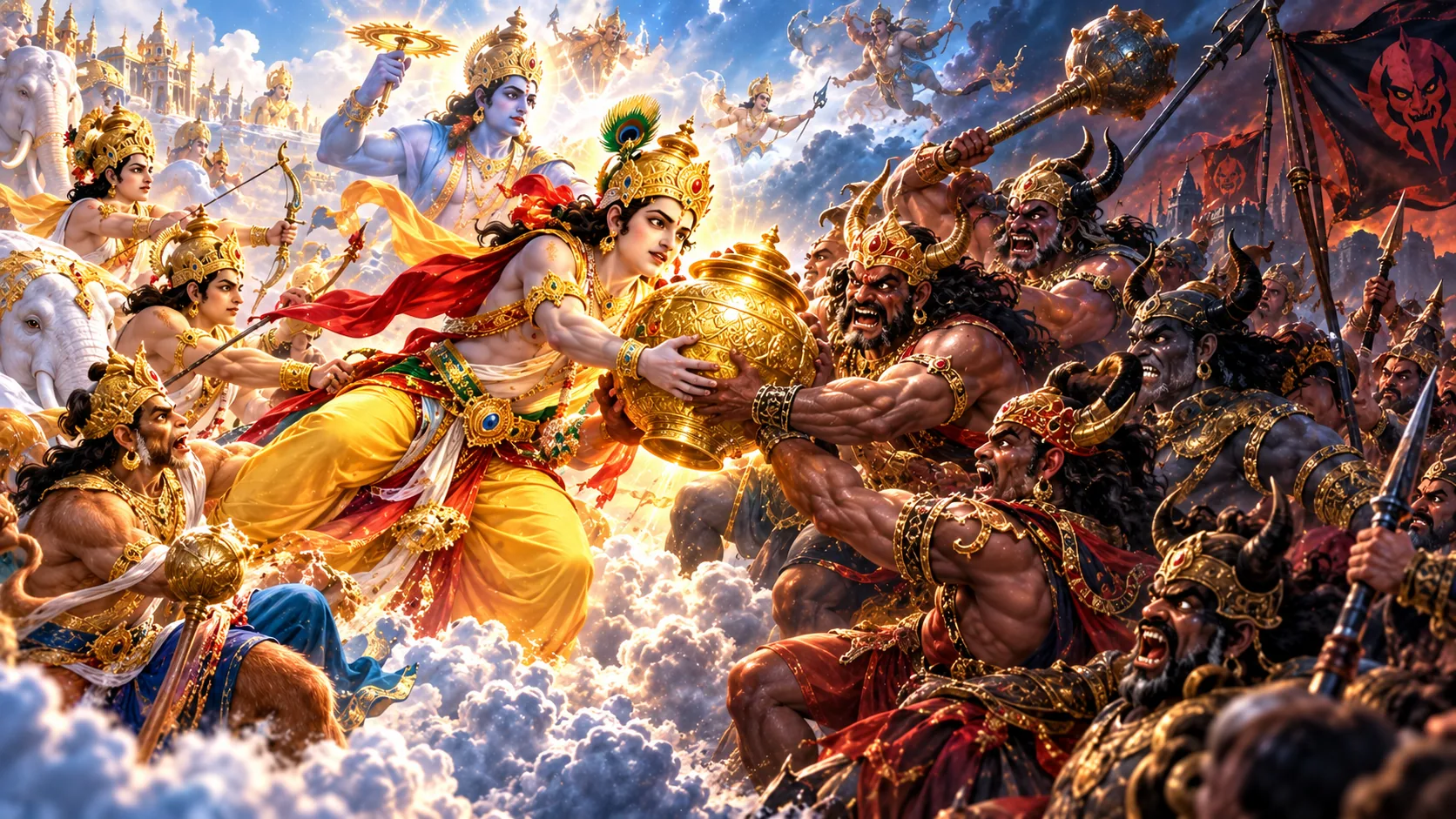
When the Amrit finally emerged, the Devas and Asuras fought over possession of the nectar.
Lord Vishnu then appeared as Mohini, a captivating divine form.
Mohini:
- Distracted the Asuras
- Gained control of the Amrit
- Distributed the nectar to the Devas
This episode represents the decisive intervention that determines the outcome of the struggle over immortality.
Lord Shiva as Neelkanth
Before Amrit emerged, the deadly poison Halahala appeared from the cosmic ocean.
The poison threatened creation.
👉 Lord Shiva consumed the Halahala to protect the universe.
The poison remained in his throat, turning it blue and giving him the name Neelkanth, meaning “the blue-throated one.”
This part of the story is often interpreted as a symbol of:
- Sacrifice
- Protection
- Absorbing destructive forces
- Transforming danger without allowing it to spread
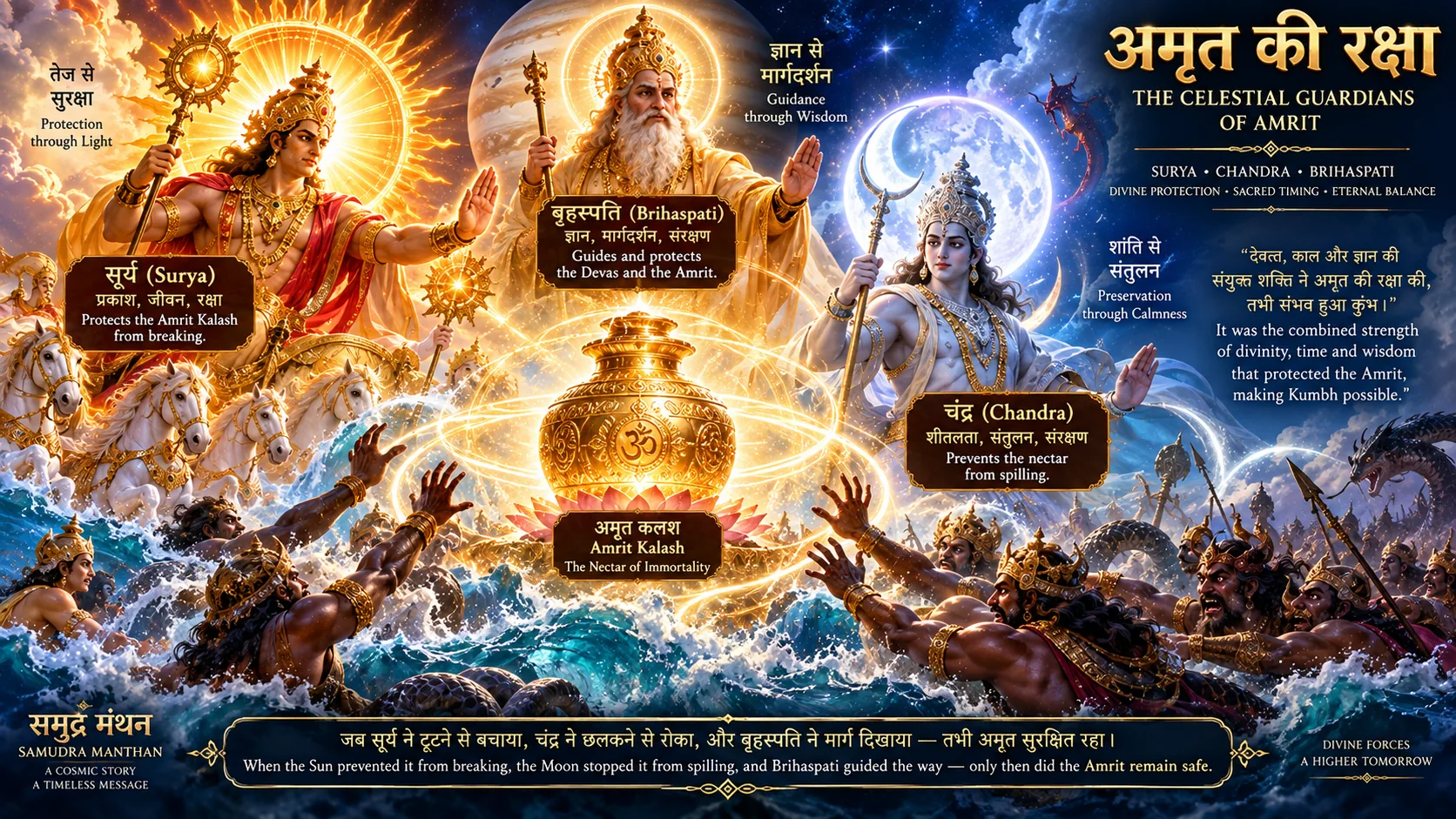
Celestial Forces: The Silent Protectors
The traditional Kumbh mythology also associates several celestial forces with the protection and timing of the Amrit.
☀️ Surya (Sun)
Surya is traditionally associated with protecting the Amrit Kalash from breaking during the celestial struggle.
The Sun also carries broader symbolic associations with:
- Life
- Light
- Vitality
- Cosmic order
🌙 Chandra (Moon)
Chandra is associated with protecting the nectar from spilling completely.
The Moon traditionally symbolizes:
- Calmness
- Cycles
- Reflection
- The rhythms of time
🪐 Brihaspati (Guru/Jupiter)
Brihaspati, identified with Jupiter, is traditionally associated with guiding and protecting the Devas during the struggle.
In Indian religious and astrological traditions, Jupiter is connected with:
- Wisdom
- Knowledge
- Guidance
- Spiritual learning
👉 Together, Surya, Chandra, and Brihaspati represent the connection between celestial forces, divine protection, and sacred timing within the Kumbh tradition.
The 12-Day Divine Conflict: Foundation of the Kumbh Cycle
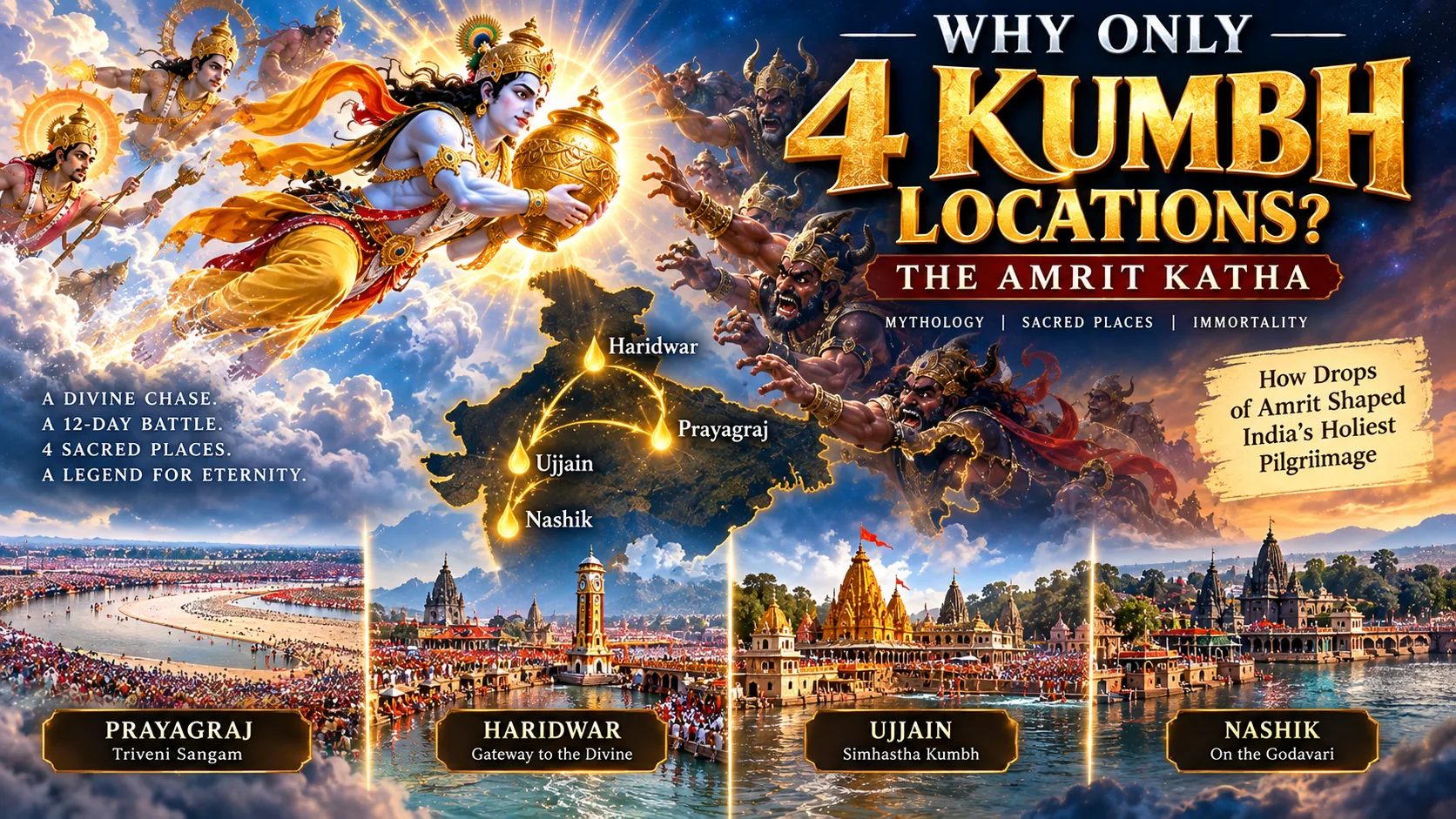
According to the traditional mythology surrounding the Amrit, the struggle between the Devas and Asuras continued for 12 divine days.
In the traditional explanation, these 12 divine days correspond to 12 human years.
This story is commonly connected with the 12-year Kumbh cycle.
The narrative therefore creates a symbolic relationship between:
Cosmic time → Celestial events → Sacred cycles → Kumbh tradition
What the Story Emphasizes
- Sacred events are connected with cosmic timing
- Celestial bodies play a role in the traditional narrative
- The pursuit of Amrit is connected with patience, struggle, and divine intervention
- Time itself becomes part of the mythology of Kumbh
Deeper Symbolism: What This Story Teaches Us
The mythology of gods, demons, and celestial forces can also be interpreted as an inner spiritual journey.
| Element | Symbolic Meaning |
|---|---|
| Devas | Higher tendencies and awareness |
| Asuras | Lower impulses, desires, and attachments |
| Samudra | Human mind and consciousness |
| Churning | Inner struggle and disciplined effort |
| Halahala | Negativity, ego, and destructive impulses |
| Amrit | Spiritual realization |
| Celestial forces | Divine guidance and cosmic order |
| Battle | Inner conflict and transformation |
👉 From this perspective, the story is not simply about gods fighting demons.
It is also a story about the constant struggle within human consciousness.
The journey from poison to Amrit represents the movement from confusion and conflict toward wisdom, balance, and spiritual realization.
A Mythology That Continues to Inspire
The mythology surrounding Kumbh continues to shape the identity of the festival.
During major Kumbh gatherings:
- Tens of millions of pilgrims participate
- Saints, sadhus, and Akharas gather together
- Sacred bathing rituals connect modern pilgrims with ancient traditions
- Mythological stories continue to influence how devotees understand the significance of Kumbh
The scale of the modern festival may be extraordinary, but its spiritual narrative remains rooted in the ancient story of Samudra Manthan and Amrit.
The Cosmic Story in Four Stages
The entire mythology can be understood through four major stages:
1. Churning
The Devas and Asuras come together to churn the cosmic ocean.
2. Struggle
The churning produces both poison and divine treasures.
3. Protection
Shiva contains the poison, while Vishnu and other divine forces help protect the cosmic order.
4. Amrit
The nectar of immortality finally emerges, leading to the struggle that becomes central to the traditional Kumbh narrative.
👉 The sequence is important:
Struggle → Transformation → Protection → Amrit
Final Reflection
The role of gods, demons, and celestial forces in Kumbh mythology goes far beyond a simple battle between good and evil.
The story reminds us that:
- Life involves a constant struggle between higher and lower tendencies
- Growth often requires effort and perseverance
- Destructive forces must be confronted and transformed
- Divine guidance plays an important role in traditional spiritual narratives
- True Amrit represents the possibility of wisdom, balance, and spiritual realization
The story of the Devas, Asuras, and celestial forces can therefore be read on two levels:
As a cosmic myth → the story of the struggle for Amrit.
As a spiritual metaphor → the story of the struggle within ourselves.
👉 In that sense, the mythology behind Kumbh is also a story about human consciousness, transformation, and the search for something eternal.
Enhance Your Pilgrimage Experience
Mobile App
Read Kumbh Guides on Mobile
Download the Divya Kripa to read all 19 guides offline, receive real-time snan alerts, and access GPS-enabled navigation on the ground.
Download AppAI Assistant
Personalized Planner & Chatbot
Access your Kumbh Planner AI Assistant to receive tailored ritual advice, customized itineraries, and instant answers to spiritual questions.
Try AI Planner