
All Blog Posts
Heritage
Samudra Manthan Story: The Mythological Origin of Kumbh Mela
K
Kumbh AdminSeptember 14, 20265 min readDiscover the ancient story of Samudra Manthan (Churning of the Ocean) and how the quest for the Amrit Kalash gave birth to the Kumbh Mela.
Introduction: Why is Kumbh Mela Celebrated?
Every few years, millions of devotees gather for Kumbh Mela, one of the world's largest spiritual congregations. But have you ever wondered:
- What is the origin of Kumbh Mela?
- What is the story behind Amrit and Samudra Manthan?
- Why is Kumbh associated with immortality?
The answers lie deep within one of the most fascinating stories in Hindu mythology—the Samudra Manthan (Churning of the Ocean).
The story describes a cosmic effort by the Devas and Asuras to obtain Amrit, the nectar of immortality. The sacred Kumbh, or pot, of Amrit later became central to the traditional mythology associated with the four Kumbh Mela locations.
The Beginning: Why Was the Ocean Churned?
According to ancient Hindu texts, the Devas (gods) had lost their strength and sought a way to regain their power and obtain the nectar of immortality.
They turned to Lord Vishnu, who advised them to churn the cosmic ocean, known as Kshira Sagar, to obtain Amrit.
However, the enormous task could not be accomplished by the Devas alone.
👉 The Devas therefore formed an alliance with the Asuras, their rivals, to churn the ocean together.
💡 Key Insight
The Samudra Manthan represents an extraordinary cosmic collaboration in which opposing forces temporarily worked together in pursuit of a common goal.
The Great Churning: How Did Samudra Manthan Happen?
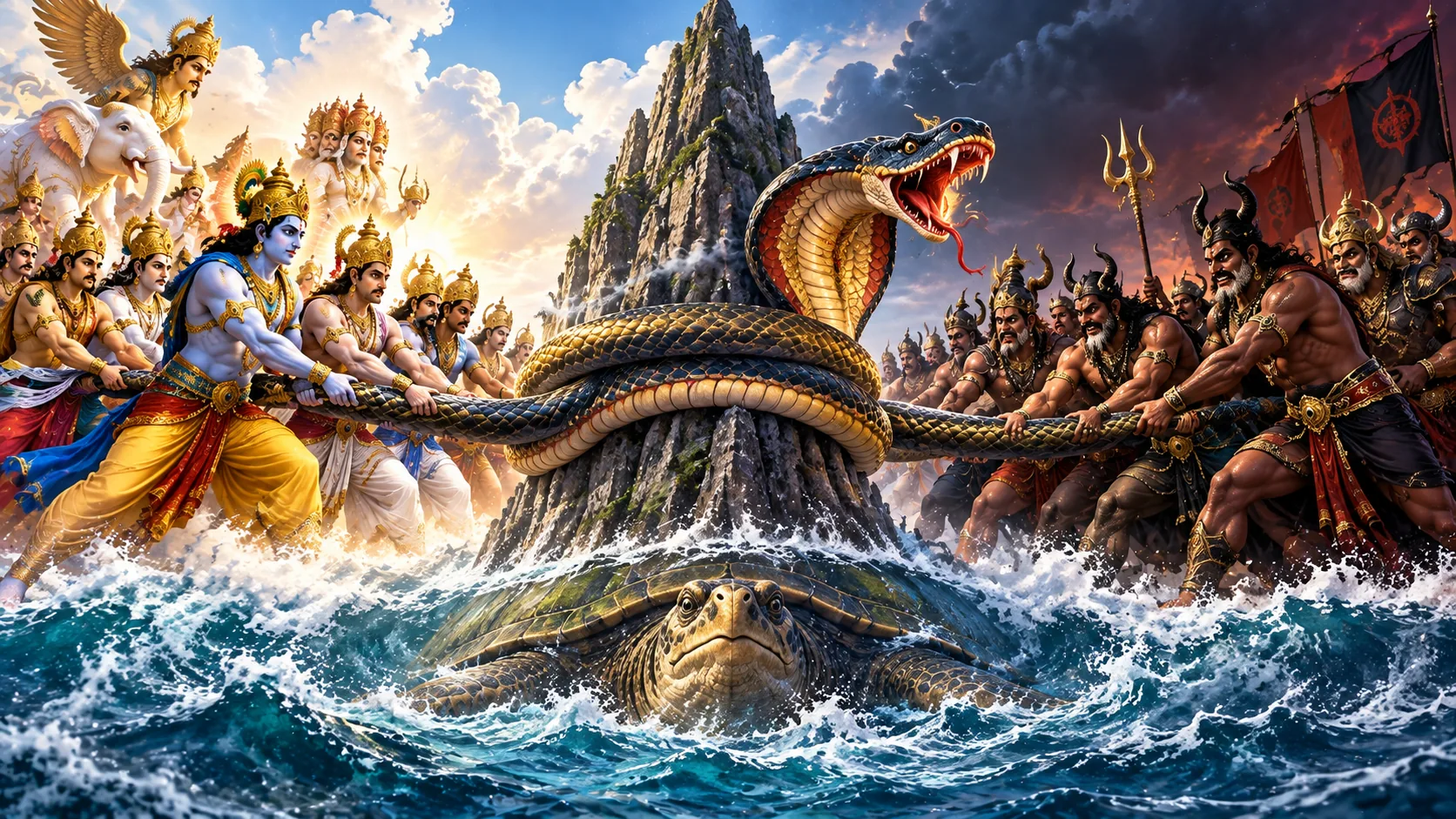
The cosmic churning required powerful divine elements:
- Mount Mandara became the churning rod.
- Vasuki, the serpent king, became the churning rope.
- Lord Vishnu took the form of Kurma, the tortoise avatar, to support Mount Mandara as it rested on the cosmic ocean floor.
With the Devas pulling from one side and the Asuras from the other, the great churning began.
As the ocean was churned, numerous extraordinary and divine treasures emerged.
The 14 Ratnas: Treasures from the Ocean
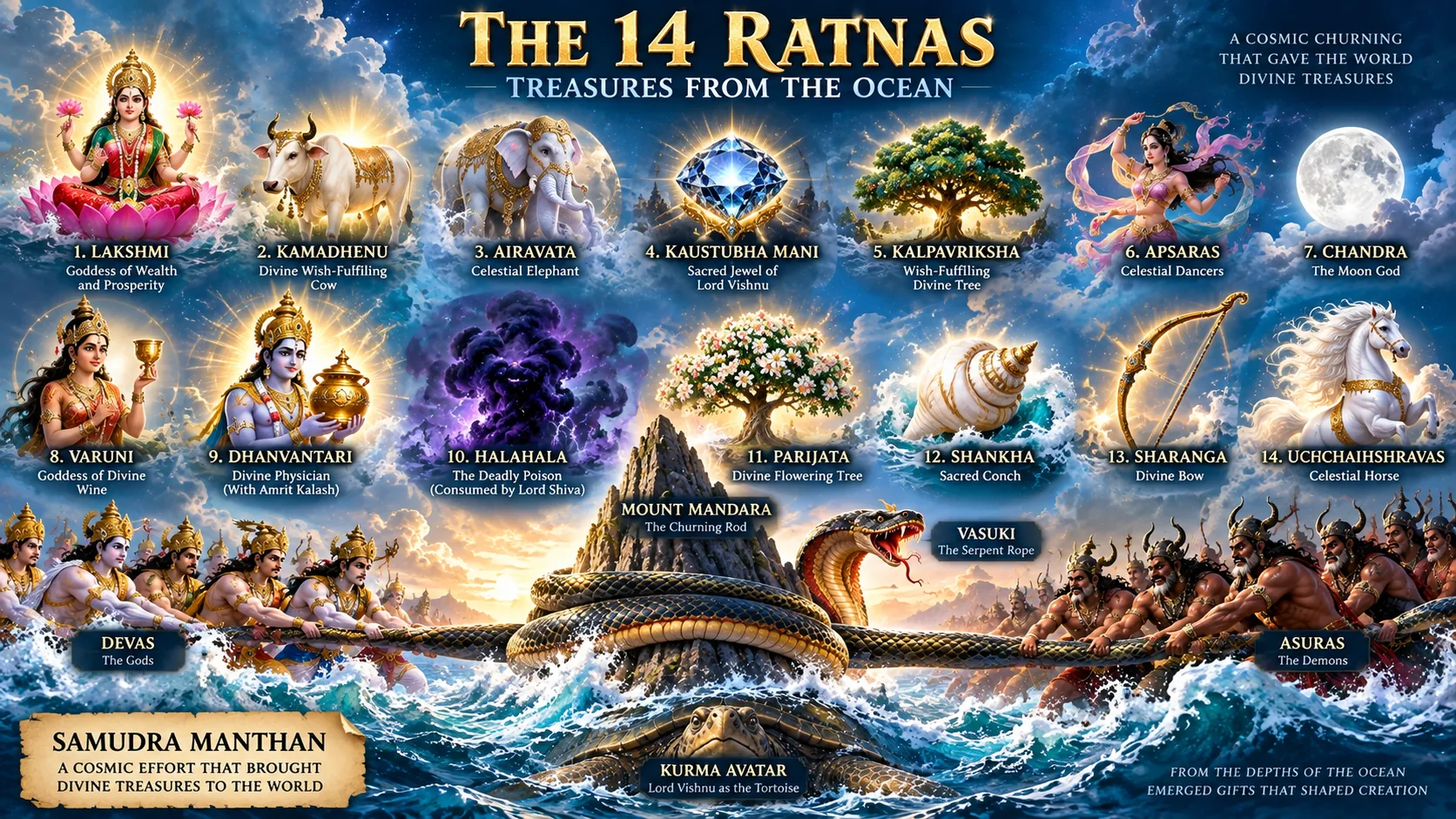
According to Hindu mythological traditions, 14 Ratnas (celestial treasures) emerged during the Samudra Manthan.
Among the best-known treasures are:
- Goddess Lakshmi — associated with wealth and prosperity
- Kamadhenu — the divine wish-fulfilling cow
- Airavata — the celestial elephant
- Kaustubha Mani — the sacred jewel associated with Lord Vishnu
- Halahala — the deadly cosmic poison
The Halahala Poison
The emergence of Halahala created a crisis because the powerful poison threatened the existence of the universe.
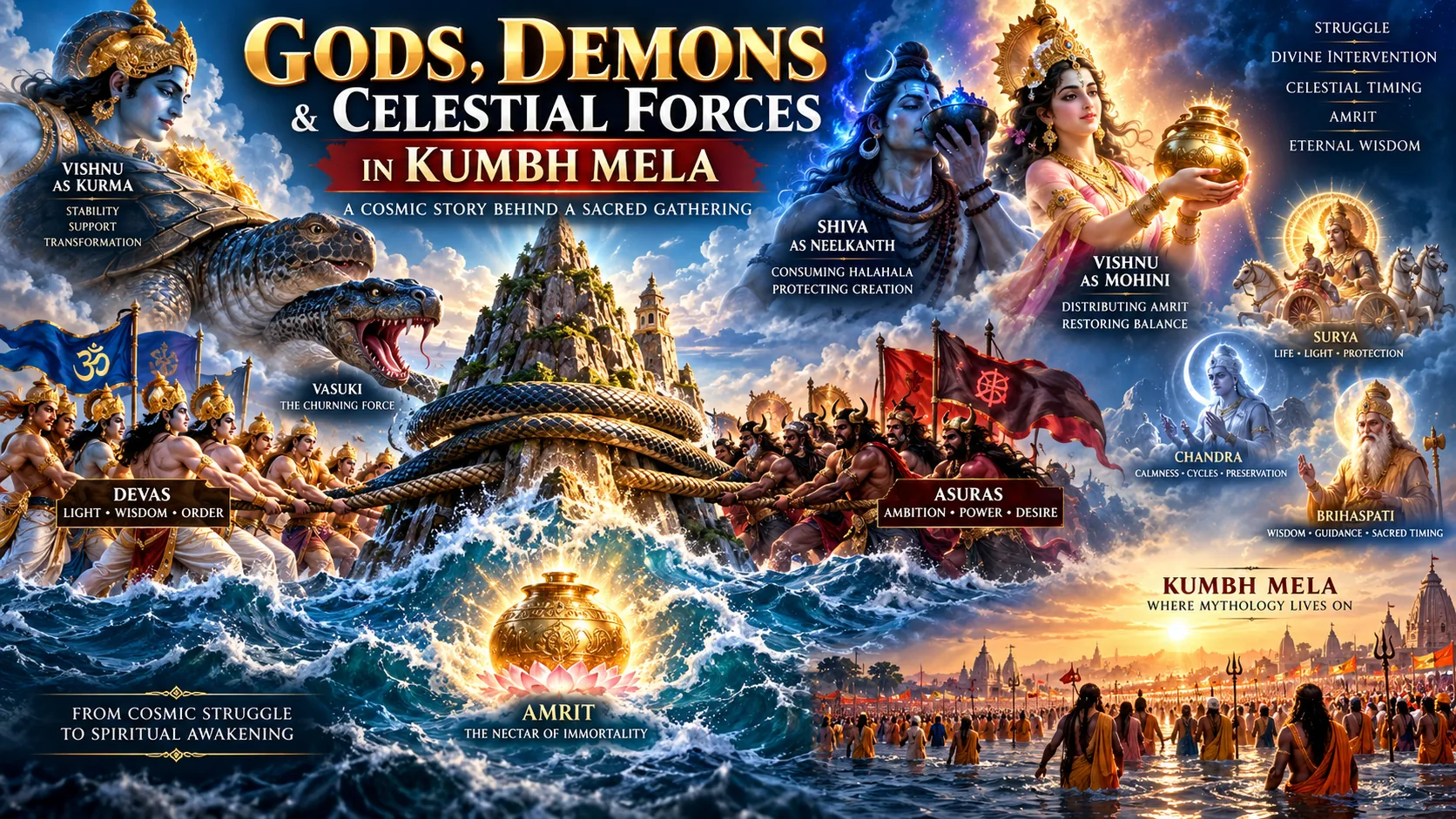
👉 Lord Shiva consumed the poison to protect creation.
According to the tradition, the poison remained in his throat, turning it blue and giving him the name Neelkanth, meaning “the blue-throated one.”
The episode is one of the most important moments of the Samudra Manthan narrative.
The Arrival of Amrit: The Turning Point
After the many treasures had emerged, the most sought-after treasure finally appeared.
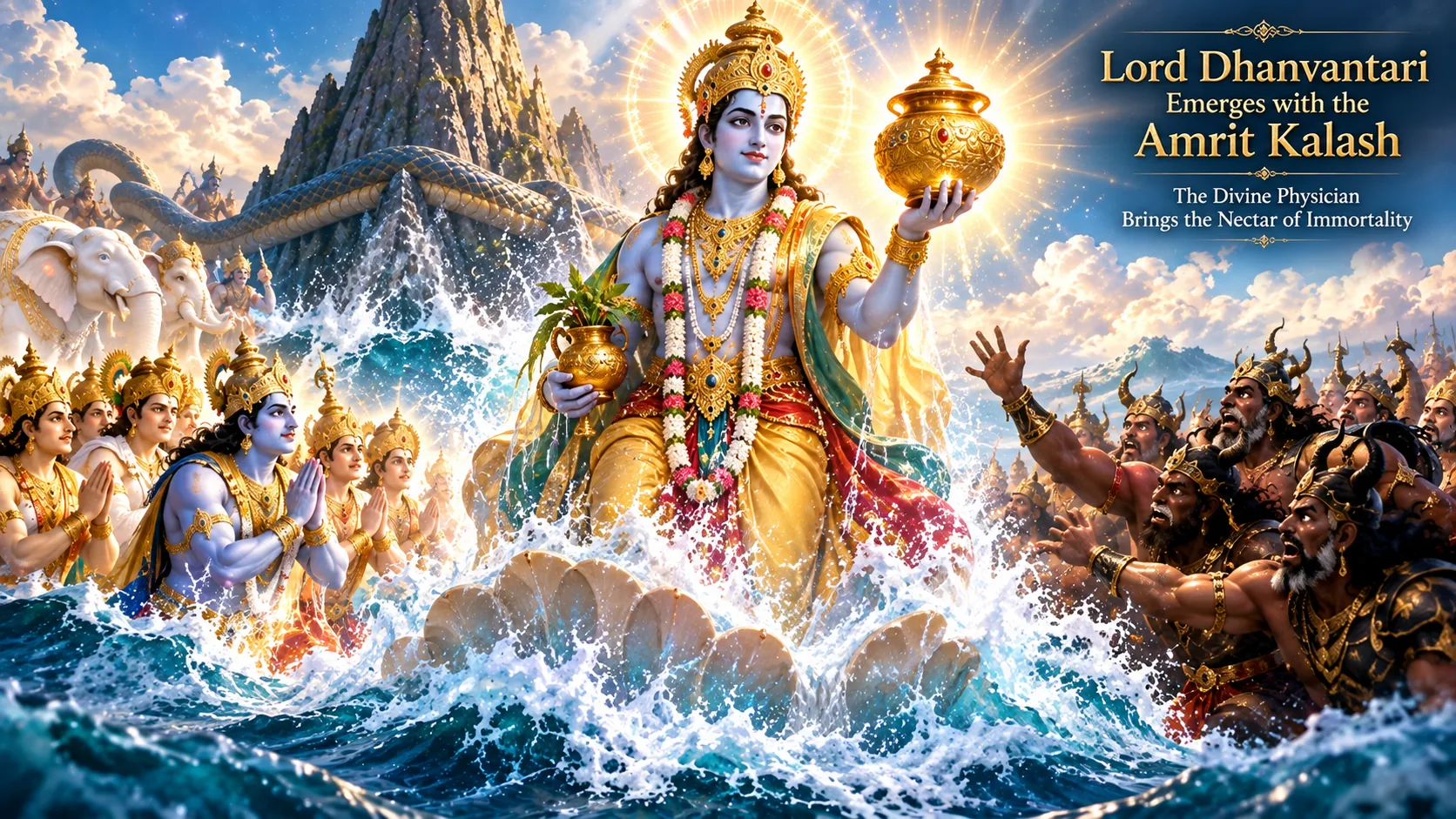
👉 Dhanvantari, traditionally regarded as the divine physician, emerged carrying the Amrit Kalash—the pot containing the nectar of immortality.
The arrival of the Amrit Kalash became the decisive moment in the cosmic struggle.
But the appearance of the nectar did not bring peace.
Instead, it triggered a conflict between the Devas and Asuras over who would possess it.
The Conflict: Battle for Immortality
As soon as the Amrit appeared:
- The Asuras attempted to seize the nectar.
- The Devas sought to protect it.
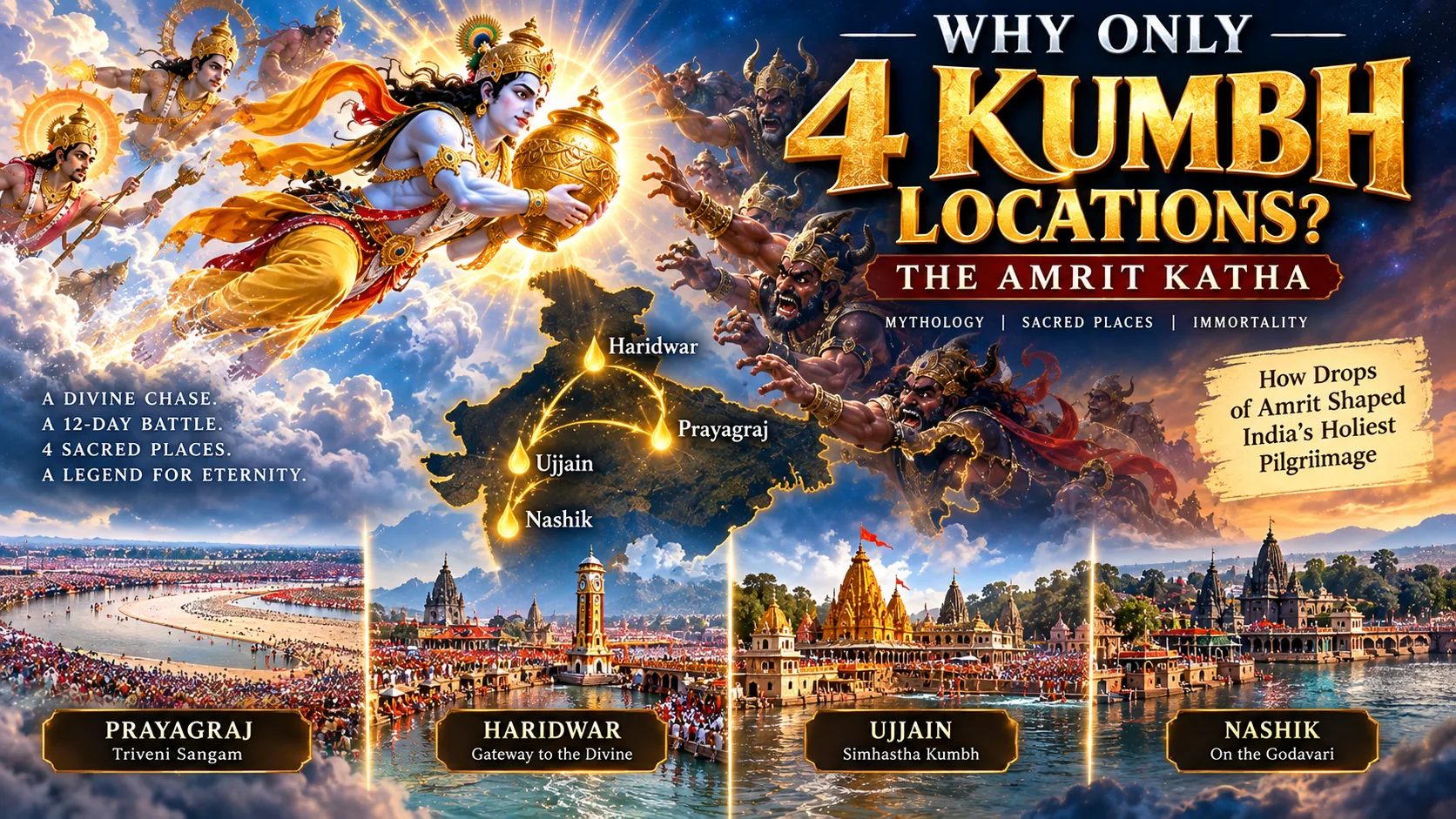
According to the traditional account associated with Kumbh Mela, the struggle over the Amrit continued for 12 divine days, corresponding symbolically to 12 human years.
During this struggle, the Amrit Kalash was carried across different locations.
👉 This part of the mythology provides the traditional connection between the Amrit Kalash and the four sacred places associated with Kumbh Mela.
How Samudra Manthan Connects to Kumbh Mela
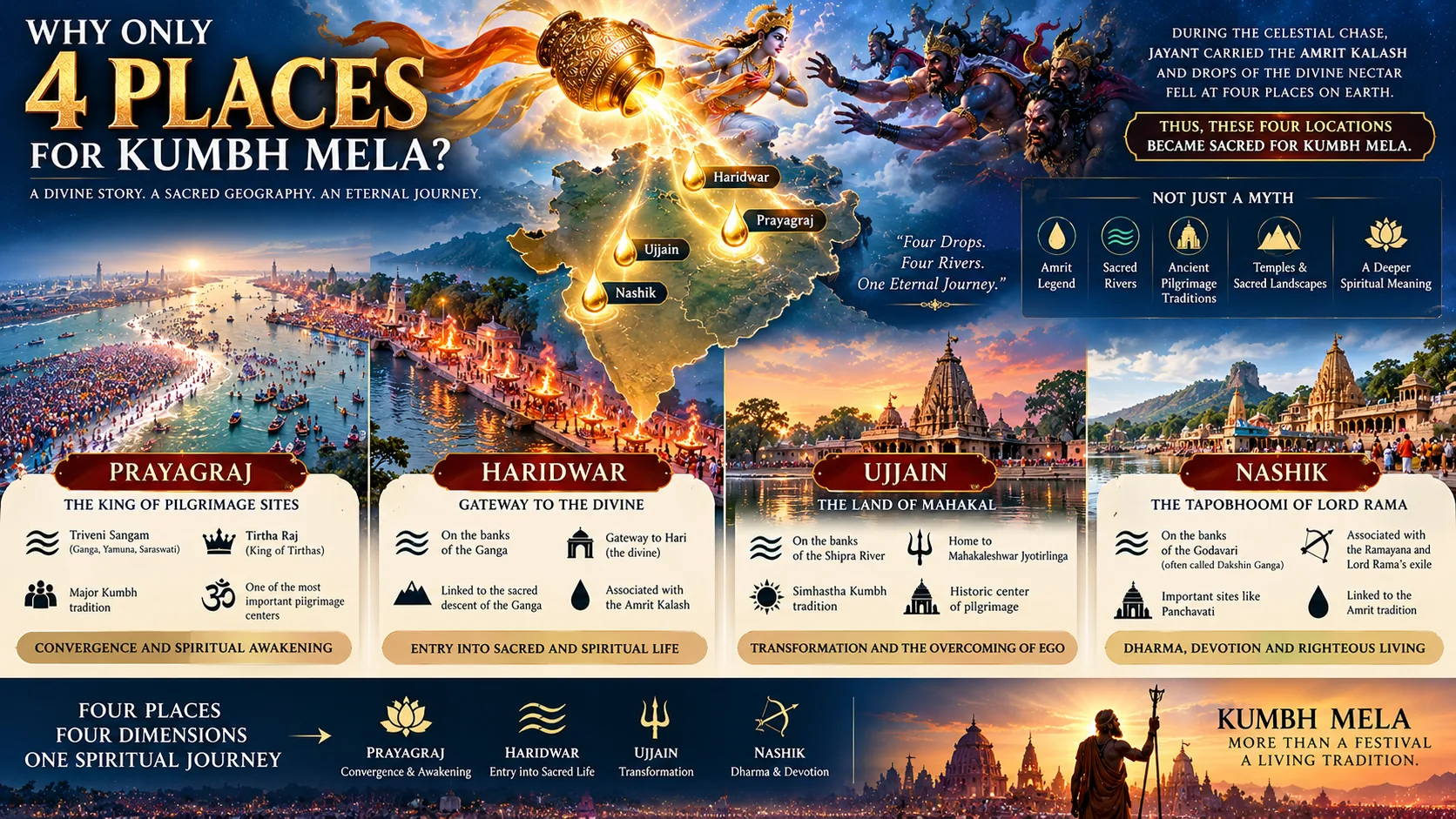
According to the Kumbh tradition, drops of Amrit fell at four places on Earth during the struggle over the nectar.
These sacred locations are:
- Prayagraj
- Haridwar
- Ujjain
- Nashik
These four places later became the principal locations associated with the Kumbh Mela cycle.
The Kumbh, meaning “pot” or “pitcher,” therefore holds a central symbolic place in the mythology of the festival.
The connection between the Amrit Kalash and these four pilgrimage centers helps explain why Kumbh Mela is traditionally associated with immortality, sacred bathing, and spiritual purification.
Spiritual Meaning Behind the Story
The Samudra Manthan can also be understood beyond its literal mythological narrative.
It is often interpreted as a metaphor for the inner struggle of human life.
The story can symbolize:
- The struggle between opposing forces
- The churning of the human mind
- The challenges involved in spiritual growth
- The journey toward self-realization and spiritual awakening
- The emergence of wisdom after sustained effort and discipline
👉 Just as Amrit emerged only after the immense churning of the cosmic ocean, spiritual wisdom can be understood as emerging through discipline, effort, patience, and inner transformation.
In this interpretation, the ocean becomes a metaphor for the human mind, while the Amrit represents the higher wisdom discovered through spiritual practice.
Final Thoughts
The Samudra Manthan story is deeply connected with the traditional mythology surrounding Kumbh Mela.
The image of the Amrit Kalash, carried during the cosmic struggle and associated with drops of nectar falling at four sacred places, provides the mythological foundation for the connection between the story and Kumbh.
Every sacred bath during Kumbh can therefore be viewed within a much larger spiritual narrative—one involving:
- The quest for immortality
- The struggle between opposing forces
- The power of divine intervention
- The purification of the individual
- The eternal journey toward spiritual awakening
For millions of pilgrims, Kumbh is not merely a gathering beside a river. It is an opportunity to participate in a living tradition whose stories reach back into India's ancient mythological imagination.
Enhance Your Pilgrimage Experience
Mobile App
Read Kumbh Guides on Mobile
Download the Divya Kripa to read all 19 guides offline, receive real-time snan alerts, and access GPS-enabled navigation on the ground.
Download AppAI Assistant
Personalized Planner & Chatbot
Access your Kumbh Planner AI Assistant to receive tailored ritual advice, customized itineraries, and instant answers to spiritual questions.
Try AI PlannerRelated Articles
Loading discussion & reviews...