All Blog Posts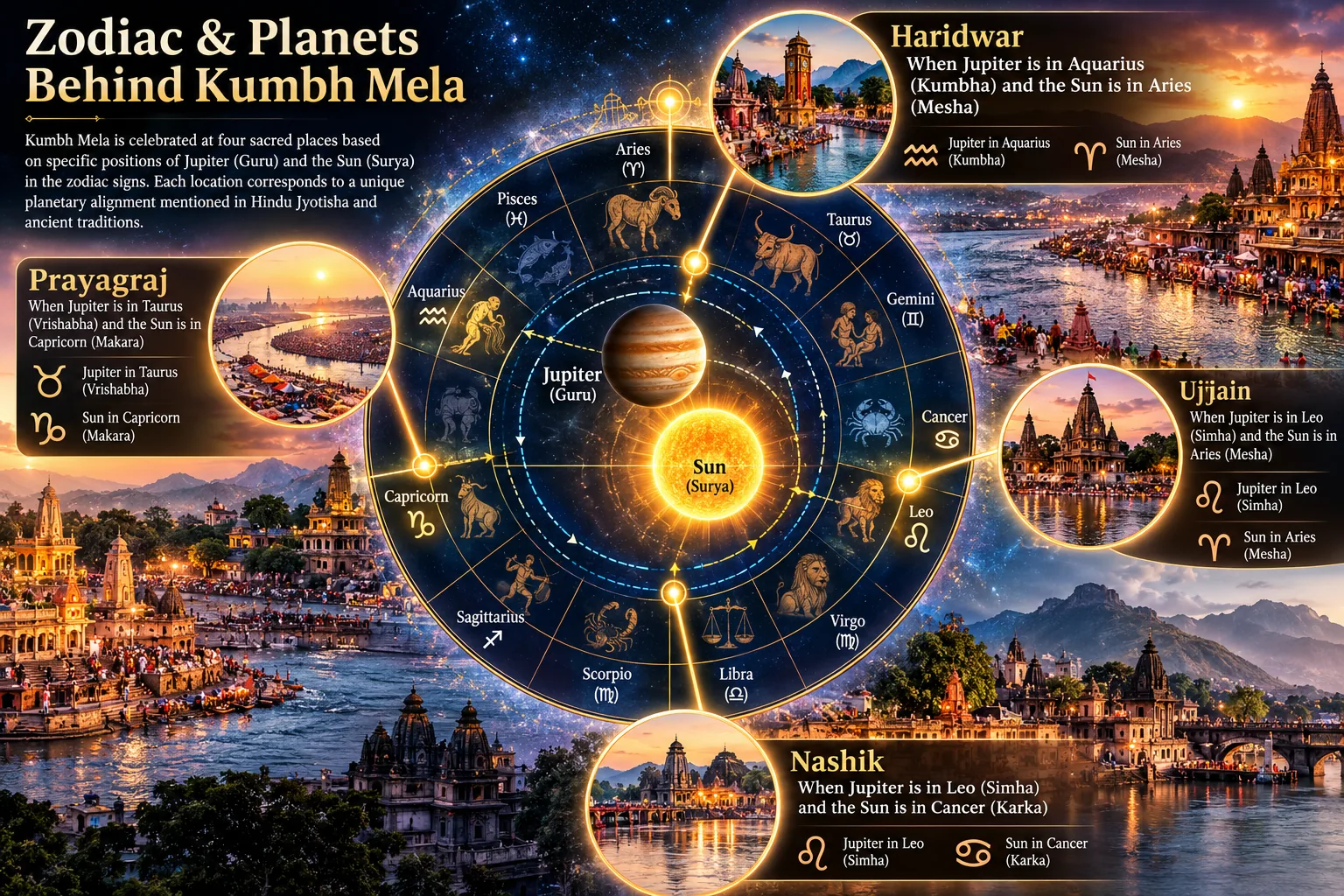
AwarenessSpirituality
Zodiac signs that decide Kumbh location
K
Kumbh AdminOctober 1, 20266 min readKumbh Mela is held at four sacred locations, and traditional Jyotisha connects each location with specific zodiac positions of Jupiter and the Sun. Understanding these planetary combinations helps explain why Kumbh is associated with Prayagraj, Haridwar, Ujjain, and Nashik.
Zodiac Signs That Decide Kumbh Location
Kumbh Mela is celebrated at four sacred places in India: Prayagraj, Haridwar, Ujjain, and Nashik. But why does the Kumbh take place at different locations, and how are these locations connected with the planets?
According to traditional Hindu Jyotisha and Kumbh traditions, the timing and location of Kumbh are associated with particular zodiac signs (Rashis) occupied by Jupiter (Brihaspati) and the Sun (Surya).
The planetary positions do not work as a simple modern astronomical formula. Rather, they form part of a traditional calendrical and Jyotisha framework used to identify auspicious periods for the festival.
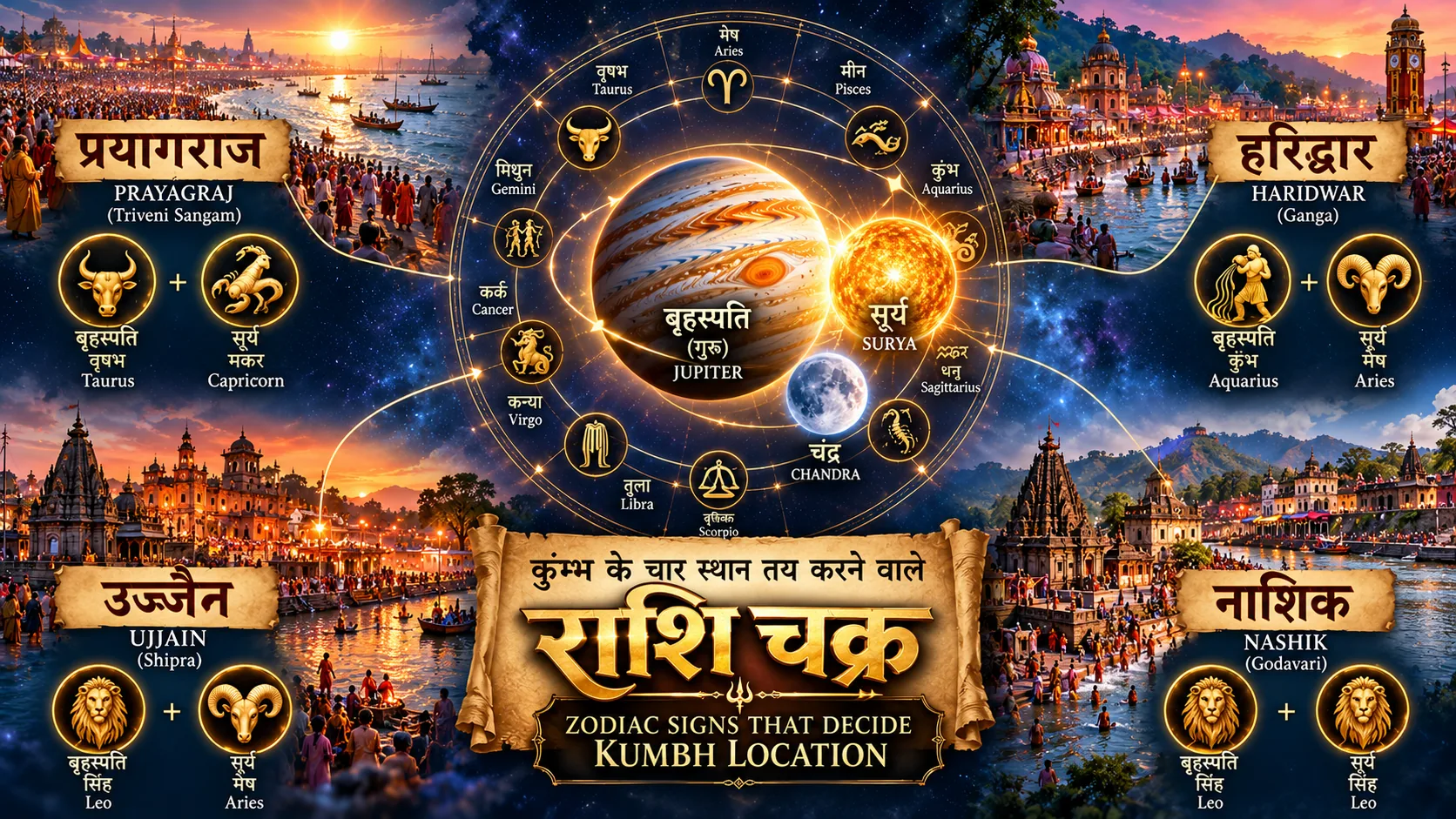
The Four Kumbh Locations and Their Zodiac Associations
| Kumbh Location | Jupiter (Brihaspati) | Sun (Surya) |
|---|---|---|
| Prayagraj | Taurus (Vrishabha) | Capricorn (Makara) |
| Haridwar | Aquarius (Kumbha) | Aries (Mesha) |
| Ujjain | Leo (Simha) | Aries (Mesha) |
| Nashik | Leo (Simha) | Leo (Simha) |
These combinations are traditionally associated with the four major Kumbh locations.
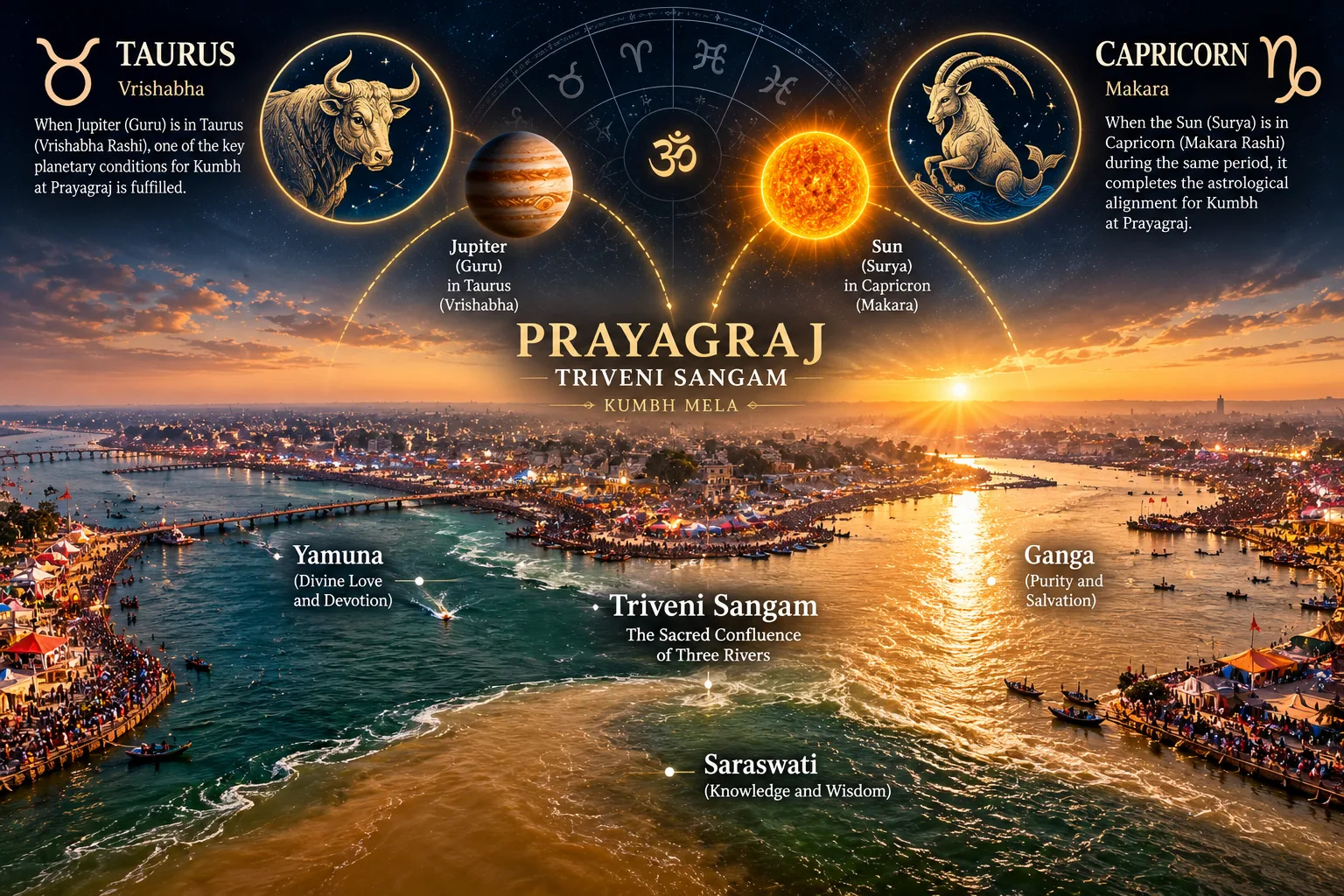
1. Prayagraj — Jupiter in Taurus and Sun in Capricorn
Prayagraj is located at the sacred Triveni Sangam, where the Ganga, Yamuna, and the traditionally believed Saraswati meet.
Traditional Kumbh calculations associate the Prayagraj Kumbh with:
- Jupiter in Taurus (Vrishabha)
- Sun in Capricorn (Makara)
Capricorn is associated with Makara Sankranti, an important solar transition in the Hindu calendar. The combination of the Sun's position, Jupiter's position, and the traditional lunar calendar contributes to identifying the auspicious Kumbh period at Prayagraj.
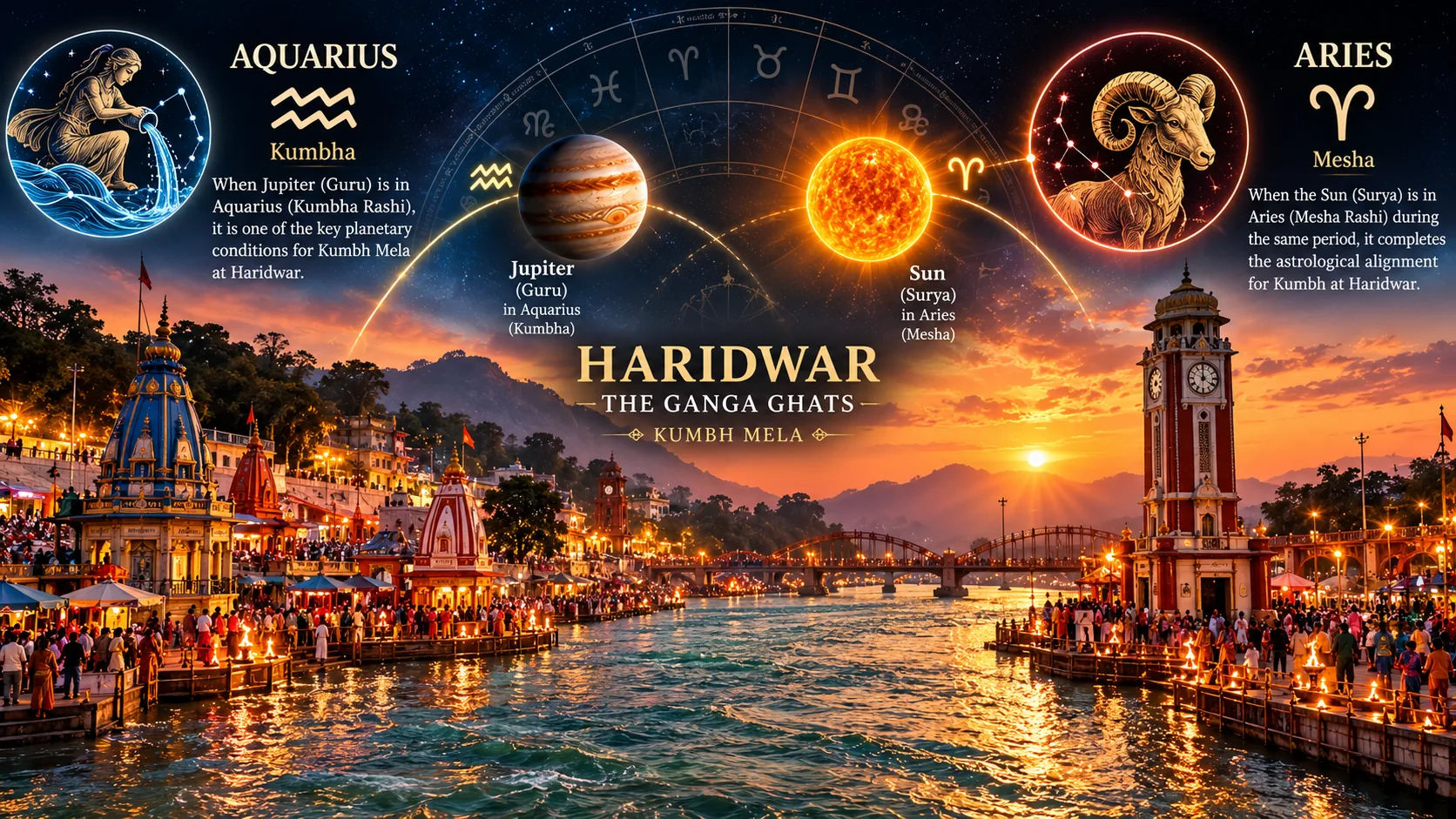
2. Haridwar — Jupiter in Aquarius and Sun in Aries
Haridwar is one of the most important pilgrimage centres on the Ganga and is traditionally associated with Kumbh when:
- Jupiter is in Aquarius (Kumbha)
- Sun is in Aries (Mesha)
The name Kumbha itself means a pot or pitcher and is also the Sanskrit name associated with the zodiac sign Aquarius.
The movement of Jupiter into Aquarius therefore has particular significance in the traditional Kumbh framework.
The Sun's movement into Aries, known as Mesha Sankranti, forms another important part of the calendrical timing.
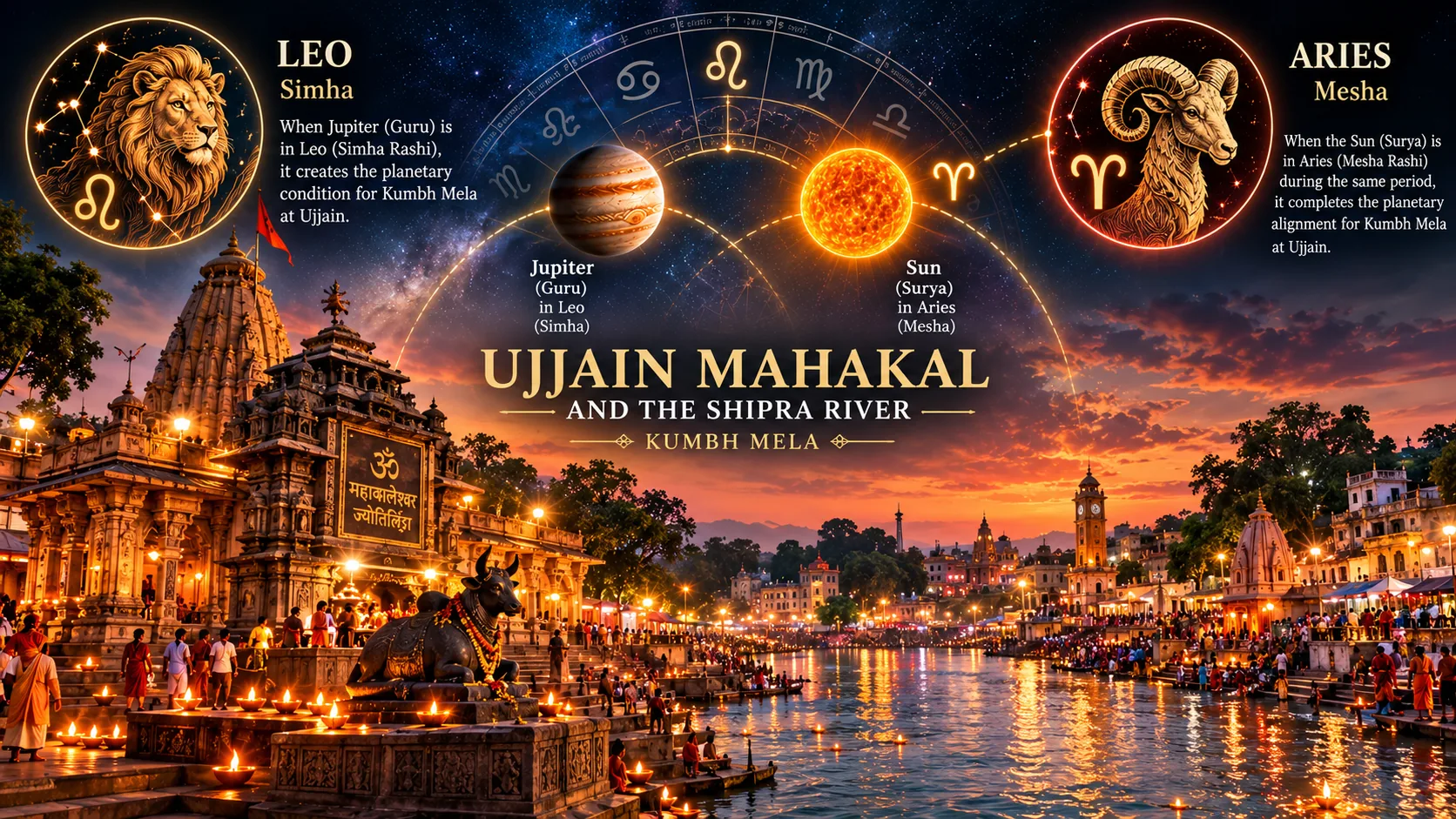
3. Ujjain — Jupiter in Leo and Sun in Aries
Ujjain hosts the Simhastha Kumbh, a name derived from Simha, meaning Leo.
Its traditional planetary association is:
- Jupiter in Leo (Simha)
- Sun in Aries (Mesha)
The connection with Leo is especially important because Jupiter's presence in Simha Rashi gives the festival its traditional name, Simhastha.
Ujjain's sacred identity is also closely connected with Lord Shiva and the Mahakaleshwar Jyotirlinga, making the city an important pilgrimage centre.
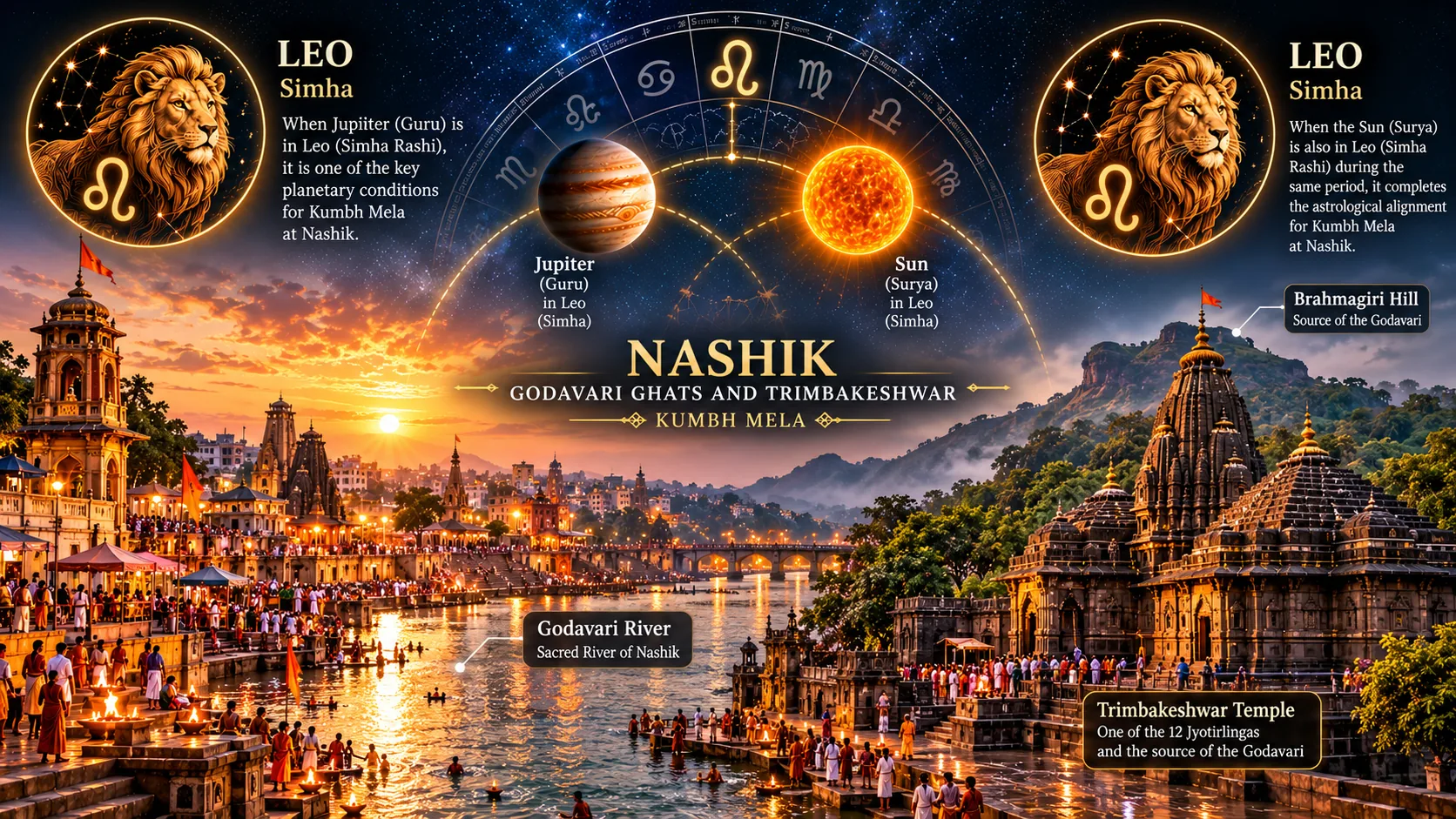
4. Nashik — Jupiter in Leo and Sun in Leo
Nashik, also known as Trimbak-Nashik in the context of the pilgrimage region, hosts another Kumbh traditionally associated with the Leo zodiac sign.
The traditional association is:
- Jupiter in Leo (Simha)
- Sun in Leo (Simha)
Because both Jupiter and the Sun are associated with Leo in this traditional description, the Nashik Kumbh is also commonly connected with the term Simhastha.
The sacred Godavari River and the nearby Trimbakeshwar region are central to the religious significance of the festival.
Why Is Jupiter So Important?
Among the planets used in the traditional Kumbh framework, Jupiter (Brihaspati) has a particularly important role.
Jupiter takes approximately 12 years to complete one cycle through the zodiac. This approximate twelve-year cycle is closely connected with the traditional recurring pattern of Kumbh celebrations.
The four Kumbh locations therefore become part of a larger cycle involving:
Jupiter → Zodiac Sign → Solar Position → Lunar Calendar → Auspicious Kumbh Period
This is why Kumbh is not simply scheduled on a fixed date every twelve years.
The Role of the Sun
The Sun (Surya) provides an important solar reference in traditional Hindu calendrical calculations.
Different zodiac positions of the Sun correspond to different periods of the solar year.
For Kumbh traditions, the Sun's position is considered together with Jupiter and other calendrical factors rather than being treated independently.
For example:
- Sun in Capricorn is associated with the Prayagraj tradition.
- Sun in Aries is associated with Haridwar and Ujjain traditions.
- Sun in Leo is associated with the Nashik tradition.
What About the Moon?
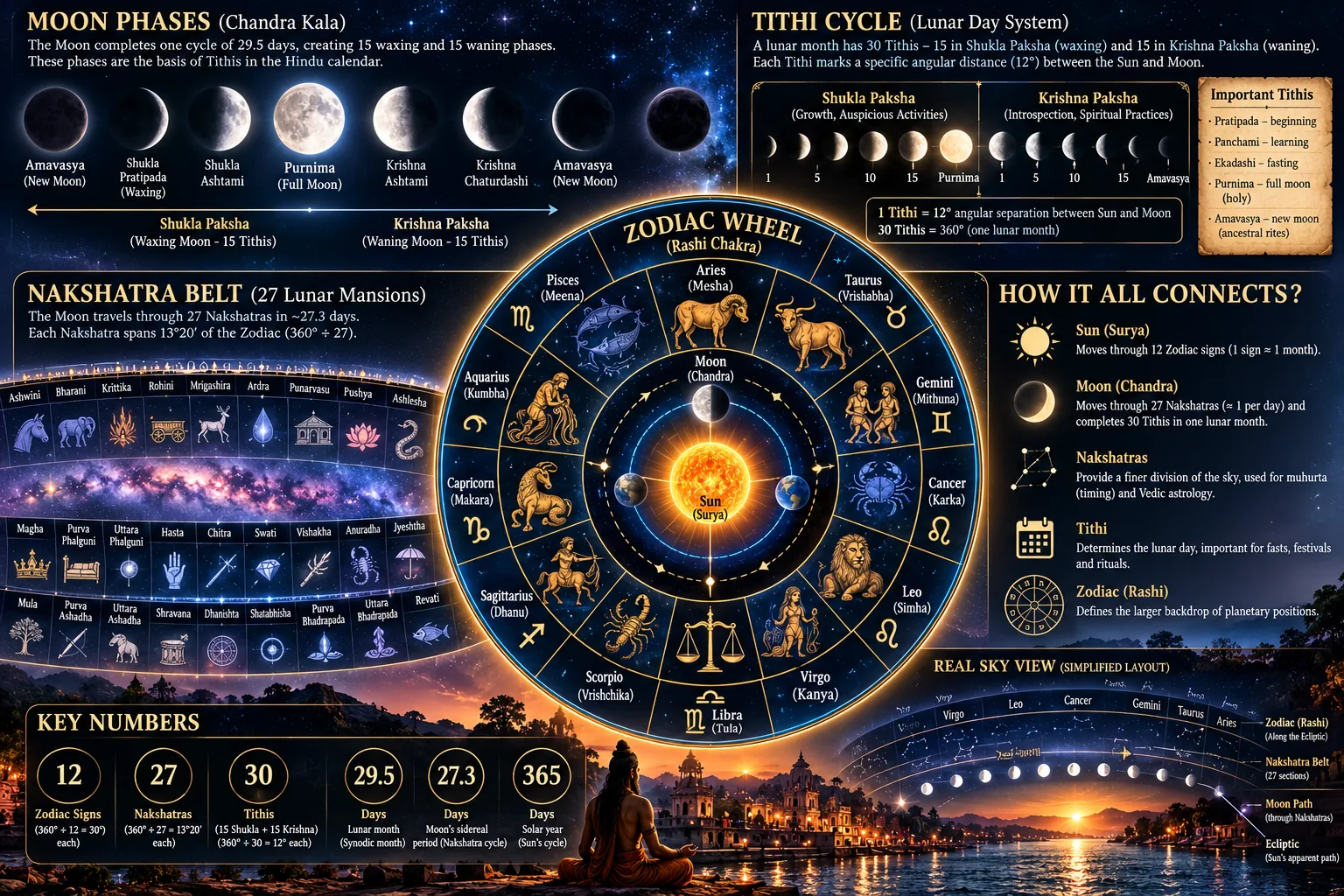
The Moon also plays an important role in determining the exact dates within a Kumbh period.
While Jupiter provides an important long-cycle framework and the Sun provides a solar reference, the lunar calendar helps determine specific dates such as:
- Amavasya
- Purnima
- Tithis
- Nakshatras
- Important Snan dates
This is why the exact dates of important bathing occasions can change from one Kumbh cycle to another.
A Simple Way to Understand It
The traditional system can be simplified as:
Jupiter → Determines the long-cycle framework
Sun → Helps identify the solar period
Moon → Helps determine lunar dates and important bathing occasions
Hindu Calendar → Combines these astronomical and calendrical factors
Traditional Kumbh Calculations → Identify the sacred period and location
This means that the location of Kumbh should not be understood as being decided by a single planet or a single zodiac sign.
Why Are There Four Kumbh Locations?
The four locations are connected with different combinations of sacred geography, mythology, traditional Jyotisha, and calendrical calculations.
The four major locations are:
- Prayagraj — Triveni Sangam
- Haridwar — Ganga
- Ujjain — Shipra
- Nashik — Godavari
Each location has its own religious traditions and its own association with particular planetary configurations.
The astronomical framework therefore works together with the sacred geography and mythology of each pilgrimage centre.
Zodiac Signs Behind the Four Kumbh Locations
A simple summary is:
| Location | Jupiter | Sun | Traditional Identity |
|---|---|---|---|
| Prayagraj | Taurus | Capricorn | Kumbh at Triveni Sangam |
| Haridwar | Aquarius | Aries | Kumbh on the Ganga |
| Ujjain | Leo | Aries | Simhastha on the Shipra |
| Nashik | Leo | Leo | Simhastha on the Godavari |
These associations are part of the traditional Jyotisha and calendrical understanding of Kumbh Mela.
Astronomy, Jyotisha and Kumbh Tradition
It is important to distinguish between modern astronomy and traditional Jyotisha.
Modern astronomy studies the physical positions and movements of celestial bodies using scientific observation and mathematical models.
Jyotisha is a traditional Indian system that connects celestial positions with calendars, auspicious timings, and religious practices.
Kumbh timing belongs to this broader traditional calendrical and Jyotisha framework.
The festival's dates therefore represent a combination of astronomical cycles, traditional calculations, religious calendars, sacred geography, and mythology.
The Deeper Meaning of the Zodiac Connection
For devotees, the planetary alignment is more than a calculation of dates.
The movement of Jupiter, the Sun, and the Moon represents the relationship between cosmic time and sacred time.
When the traditional calculations identify an auspicious period, millions of pilgrims gather at the corresponding sacred river to perform Kumbh Snan, prayers, meditation, charity, and other religious practices.
In this way, the Kumbh tradition brings together three dimensions:
Cosmos — the movement of celestial bodies
Calendar — the calculation of sacred time
Pilgrimage — the journey to a sacred river
The zodiac signs therefore form one part of a much larger system through which Kumbh connects the heavens, time, and sacred geography.
Enhance Your Pilgrimage Experience
Mobile App
Read Kumbh Guides on Mobile
Download the Divya Kripa to read all 19 guides offline, receive real-time snan alerts, and access GPS-enabled navigation on the ground.
Download AppAI Assistant
Personalized Planner & Chatbot
Access your Kumbh Planner AI Assistant to receive tailored ritual advice, customized itineraries, and instant answers to spiritual questions.
Try AI PlannerRelated Articles



Loading discussion & reviews...