All Blog Posts
HistoryFestival
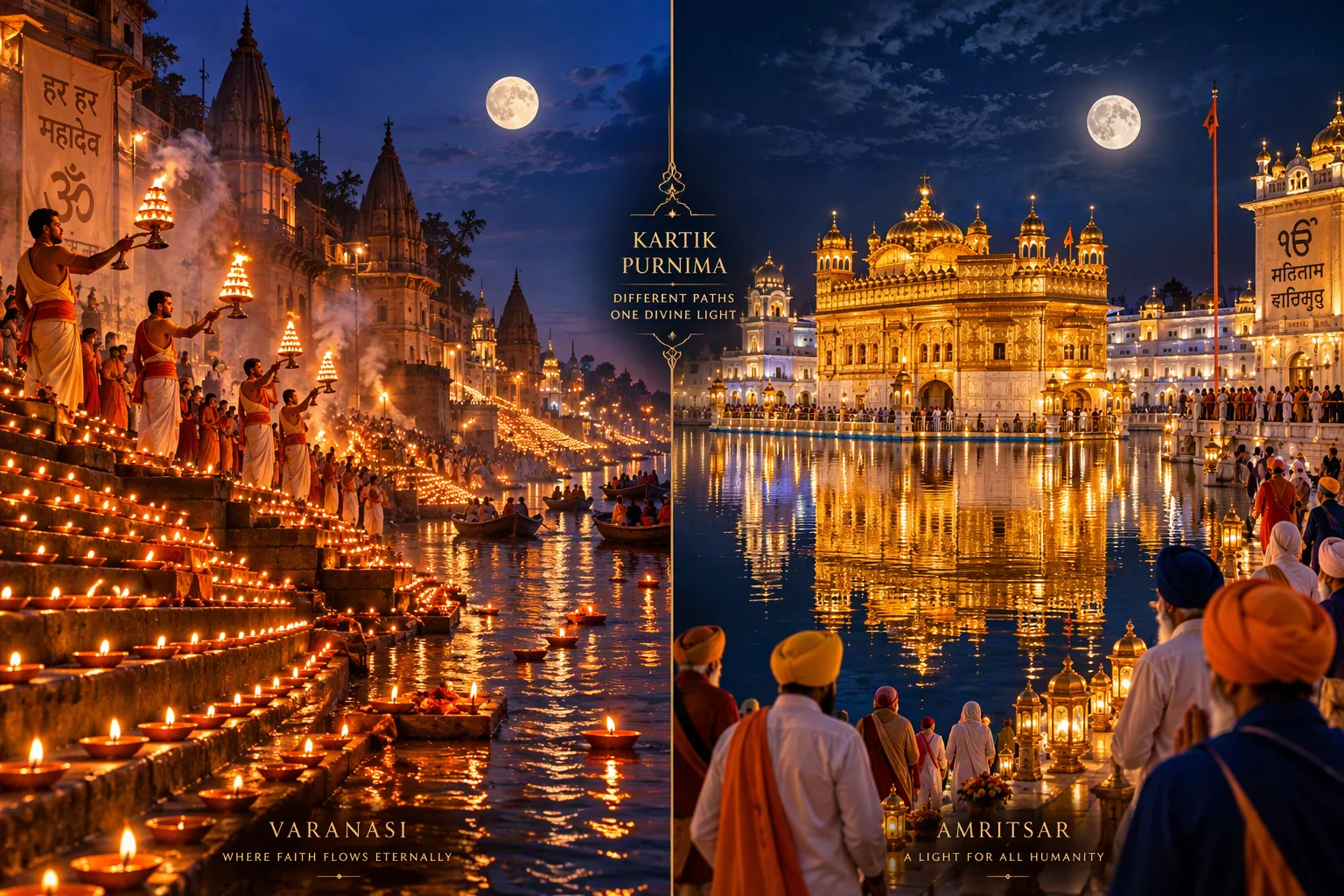
Golden Temples & Flaming Ghats: When India Celebrates One Moon with Two Souls on Guru Nanak Jayanti
K
Kumbh AdminNovember 23, 20265 min readOne full moon, two breathless spectacles: while millions of earthen lamps turn Varanasi into a river of flame, the Golden Temple glows in golden silence with selfless Langar. Step inside India’s most visually stunning night!
The Night India Lights Up in Two Different Languages
Step outside on the full moon night of Kartik Purnima, and you will witness an extraordinary cultural phenomenon found nowhere else on earth.
Stand on the northern riverbanks of the sacred Ganga, and the world is alive with fire and thunderous devotion. Millions of earthen lamps carpet miles of stone steps as priests hoist roaring brass lamps into the night sky for Dev Deepawali, honoring the gods who descended to celebrate Lord Shiva’s triumph over Tripurasura.
Travel six hundred miles northwest to Punjab, and the very same moonlight reveals an entirely different kind of awe.
Here, surrounded by the tranquil waters of the sacred Amrit Sarovar, the Golden Temple (Harmandir Sahib) in Amritsar floats like an island of pure golden light. There are no warrior bugles or conch shells. Instead, the cool autumn night is carried by the hypnotic cadence of unbroken Gurbani Kirtan, the sound of thousands walking barefoot around marble pathways, and the comforting aroma of steaming lentils and fresh rotis rising from the world’s largest free community kitchen.
This is the convergence of Dev Deepawali and Guru Nanak Jayanti (Gurpurab)—two timeless spiritual streams flowing beneath one single full moon.
The Dawn Walkers: The Soul of Prabhat Pheris
Long before the sun touches the horizon on Kartik Purnima, residential lanes across northern towns awaken to a quiet, rhythmic pulse.
These are the Prabhat Pheris—early morning walking processions that begin in the crisp, quiet hours of Amrit Vela (between 4:00 AM and 5:30 AM). Wrapped in simple shawls against the November chill, small groups of devotees navigate neighborhood lanes singing devotional hymns, kept in step only by the chime of brass cymbals (chimta) and the steady thump of a handheld dholak.
"Pavan Guru, Paani Pita, Maata Dharat Mahat..."
(Air is the Guru, Water the Father, and Earth is the Great Mother.)
In our era of screen notifications and frantic morning commutes, the Prabhat Pheri feels like stepping through a portal into timeless India. It reminds every seeker that devotion isn’t reserved for massive temple complexes—it starts by stepping out of your front door into the morning mist and singing alongside neighbors.
This pre-dawn awakening mirrors the sacred dawn dips along the sacred journey of the Godavari River, where bathers gather in early morning fog during sacred ritual baths across India's holiest rivers.
Langar: The Radical Architecture of Pure Equality
If you want to understand the revolutionary heart of Guru Nanak Dev Ji’s teachings, don't look at theological textbooks. Walk directly into a Langar hall.
Over five centuries ago, when rigid feudal hierarchies dictated who could sit together, who could share water, and who was cast out, Guru Nanak instituted a simple, non-negotiable practice: a kitchen where everyone—emperor, merchant, soldier, and laborer—sits on the exact same woven floor mat (Pangat) and eats the exact same warm meal (Sangat).
On Gurpurab at the Golden Temple:
- More than 100,000 pilgrims are served a hot, wholesome vegetarian meal in a single 24-hour cycle—free of cost.
- Hundreds of voluntary caretakers (sevadars) peel sacks of vegetables, roll thousands of chapatis, wash brass plates in continuous rhythm, and stir massive cauldrons of simmering lentils.
- There are no VIP sections. A corporate executive sits shoulder-to-shoulder with a weary wanderer, both receiving warm rotis into cupped hands from volunteers who bow as they serve.
This profound spirit of selfless service (Nishkam Seva) mirrors the ancient hospitality seen across the monastic camps of the 13 sacred Akharas of the Kumbh Mela, who run massive community feeding operations whenever pilgrims assemble on holy riverbanks.
Deepotsav vs. Prakash: The Flame on the River and the Flame Within
What makes Kartik Purnima unforgettable is the visual contrast between the two paths celebrated under its glow:
- The River Ghats of Kashi & Nashik celebrate Deepotsav—the cosmic fire on water. Thousands of tiny earthen lamps drift across river currents, illuminating the dark and celebrating divine courage, much like the rituals detailed in our complete guide to Dev Diwali dates and celebrations.
- The Sarovars of the Gurudwaras celebrate Prakash Utsav—the awakening of inner divine light. Guru Nanak did not ask people to abandon the world or retreat into forest caves. He taught that real enlightenment is found in three everyday duties: honest labor (Kirat Karo), selfless sharing (Vand Chhako), and constant mindful remembrance of the Divine (Naam Japo).
One lights up the physical waters of our sacred geography; the other lights up human conscience.
How Kumbh Pilgrims Can Experience the Full Splendor of Both
For travelers and spiritual seekers preparing for the upcoming Nashik-Trimbakeshwar Simhastha Kumbh 2027, this full moon serves as an annual reminder of the living diversity of Indian spirituality.
If you find yourself near the riverfront, float an earthen lamp on the water during evening Pradosh Kaal twilight. And if your path takes you near a Gurudwara, cover your head, leave your shoes at the entrance, sit on the floor of the Langar hall, and accept a meal with folded hands. In doing both, you experience the complete soul of this land under a single autumn moon.
Frequently Asked Questions (FAQs)
Q1: Why do Guru Nanak Jayanti and Dev Deepawali fall on the same day?
Both festivals follow the traditional Indian lunar calendar and occur on the full moon day of the Kartik month (Kartik Purnima). While Sikhs celebrate the birth of Guru Nanak Dev Ji, Hindu traditions celebrate Lord Shiva's victory over the demon Tripurasura.
Q2: Can visitors from any faith visit a Gurudwara and eat Langar during Gurpurab?
Yes. Every Gurudwara and Langar hall is open to all people without distinction of religion, caste, or nationality. Visitors only need to cover their head with a scarf or handkerchief, remove their shoes, and follow basic hygiene.
Q3: What is the significance of the Deepmala at the Golden Temple on Gurpurab?
On Gurpurab night, the entire Golden Temple complex in Amritsar is illuminated with thousands of traditional ghee lamps, candles, and warm golden lighting known as Deepmala, creating a mirror-like reflection across the sacred Amrit Sarovar.
Q4: When do Prabhat Pheris begin before Guru Nanak Jayanti?
Prabhat Pheris generally commence 10 to 15 days before Kartik Purnima. Small processions set out each morning between 4:00 AM and 5:30 AM singing devotional hymns (shabads) through neighborhoods before concluding on the day of Gurpurab.
Pilgrim Resources
Enhance Your Pilgrimage Experience
Mobile App
Download AppRead Kumbh Guides on Mobile
Download Divya Kripa to read all official guides offline, receive real-time snan alerts, and access GPS-enabled navigation on the ground.
AI Assistant
Try AI PlannerPersonalized Planner & Guide
Access your Kumbh Planner AI Assistant to receive tailored ritual advice, customized itineraries, and instant answers to spiritual questions.
More Stories Ritual
 Culture
 History
Related Articles
Dev Diwali 2026 Live: 11 Lakh Diyas, 2,100 Drones, & Cosmic Grandeur Light Up Varanasi Tonight!
Nov 24, 2026Can’t Make It to the Ghats? Here’s How to Bring the Magic of Dev Diwali Straight into Your Living Room
Nov 24, 2026The Sacred Tear of Shiva & One Cosmic Moon: Why Kartik Purnima Awakens the Soul Across India
Nov 23, 2026Loading discussion & reviews...