All Blog Posts
CultureHeritageHistory
All 13 Akhadas of Kumbh Mela: Names, Traditions and Religious Significance
K
Kumbh AdminOctober 7, 20268 min readDiscover all 13 traditionally recognised akhadas of Kumbh Mela, including Juna, Niranjani, Mahanirvani, Nirmohi, Nirvani, and Nirmal Akhada. Learn about Shaiva, Vaishnava, Udasin, and Nirmal traditions, the role of Naga Sadhus, and why akhadas are central to the sacred bathing ceremonies of Kumbh Mela.
What Are Akhadas in Kumbh Mela?
When people visit Kumbh Mela, one of the most remarkable sights is the gathering of sadhus, saints, monks, and ascetics belonging to different religious orders.
These organised communities are known as akhadas or akhāṛās. Each has its own spiritual lineage, leadership, customs, and traditions.
Akhadas play an important role in preserving religious teachings, training ascetics, organising spiritual gatherings, and participating in major Kumbh ceremonies.
They are especially visible during the traditional processions and sacred bathing occasions known today as Amrit Snan.
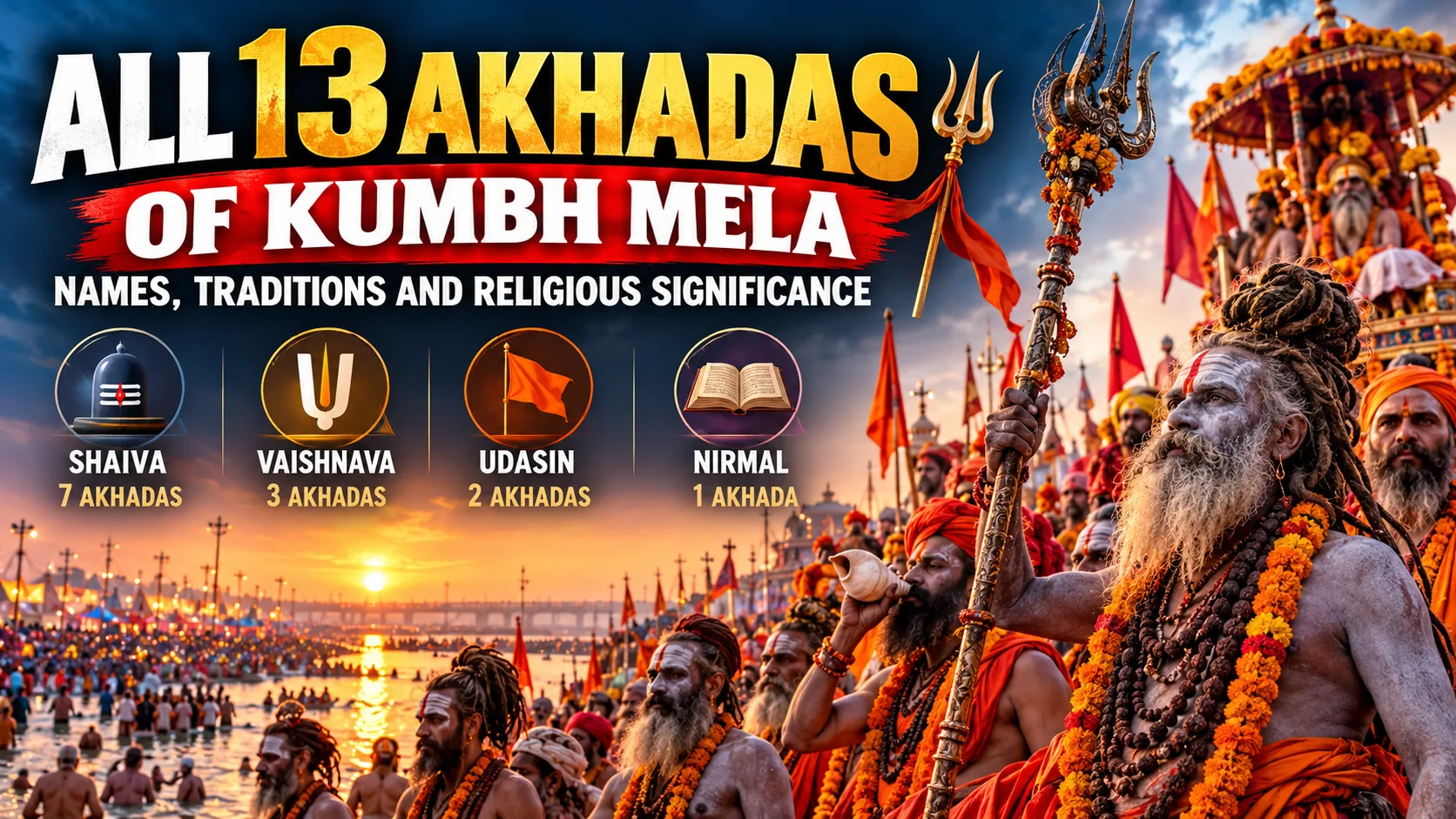
The Akhil Bharatiya Akhara Parishad recognises 13 traditional akhadas associated with the Kumbh tradition. These are commonly grouped into Shaiva, Vaishnava, Udasin, and Nirmal traditions.
The Complete List of 13 Akhadas
The following is the commonly recognised list of 13 traditional akhadas associated with Kumbh Mela.
Shaiva Akhadas: Traditions Associated with Lord Shiva
Shaiva akhadas are associated with Hindu ascetic traditions centred on Lord Shiva. Several are known for their Naga Sadhus, renunciants who follow demanding forms of spiritual discipline.
1. Shri Panchdashnam Juna Akhada
Juna Akhada is widely known for its large community of Naga Sadhus and its prominent presence at Kumbh Mela. Its ascetics follow the Dashnami Sannyasa tradition associated with Shaiva renunciation.
The akhada participates in major religious processions, initiations, and sacred bathing ceremonies.
2. Shri Panchayati Akhada Niranjani
Niranjani Akhada is an important Shaiva monastic order with a long-standing presence at major Kumbh gatherings.
It maintains its own spiritual hierarchy, religious practices, and community of ascetics. Its members participate in the ceremonial activities that form an important part of Kumbh Mela.
3. Shri Panchayati Akhada Mahanirvani
Mahanirvani Akhada is a prominent Shaiva akhada associated with ascetic discipline, spiritual study, and religious traditions centred on liberation.
Its participation in major bathing processions makes it one of the recognised orders visitors may encounter during Kumbh Mela.
4. Shri Panch Atal Akhada
Atal Akhada is another traditional Shaiva order. It has its own lineage and leadership structure and participates in religious ceremonies alongside other Shaiva akhadas.
Its identity forms part of the broader diversity of ascetic traditions represented at Kumbh.
5. Shri Panchdashnam Avahan Akhada
Avahan Akhada belongs to the Dashnami Shaiva tradition. It preserves its own religious customs and ascetic practices and participates in important Kumbh ceremonies.
6. Shri Taponidhi Anand Akhada Panchayati
Commonly called Anand Akhada, this order is associated with Shaiva renunciation and the wider Dashnami ascetic tradition.
Its members participate in the religious gatherings and ceremonies organised during major Kumbh events.
7. Shri Panchdashnam Panchagni Akhada
Panchagni Akhada is a recognised Shaiva ascetic order. Its name is associated with the traditional concept of panchagni tapasya, a demanding form of austerity described in Hindu religious traditions.
Its distinct lineage contributes to the variety of spiritual practices found among Kumbh's ascetic communities.
Vaishnava Akhadas: Traditions Associated with Lord Vishnu
Vaishnava akhadas follow traditions centred on Lord Vishnu and his forms, including Lord Rama and Lord Krishna.
They are also associated with the Bairagi ascetic tradition and have an important role in the religious life of Kumbh Mela.
8. Shri Panch Nirmohi Ani Akhada
Nirmohi Akhada is a prominent Vaishnava religious order associated with devotion to Lord Rama and other Vaishnava traditions.
It has its own religious leadership and monastic customs and participates in pilgrimage gatherings and ceremonial activities.
9. Shri Panch Nirvani Ani Akhada
Nirvani Akhada is a traditional Vaishnava order whose members follow devotional and ascetic practices within their religious lineage.
It is one of the three recognised Vaishnava akhadas commonly listed in the Kumbh tradition.
10. Shri Panch Digambar Ani Akhada
Digambar Ani Akhada is another recognised Vaishnava order. It maintains its own lineage, leadership, and traditions of renunciation and devotion.
Together, Nirmohi, Nirvani, and Digambar represent the three traditionally recognised Vaishnava akhadas associated with Kumbh Mela.
Udasin Akhadas: Traditions of Renunciation
Udasin traditions have a distinctive religious history and emphasise detachment, spiritual discipline, and religious learning. Their historical development has connections with the wider spiritual traditions of northern India.
11. Shri Panchayati Akhada Bada Udasin
Bada Udasin Akhada is a major Udasin order with established religious centres and a recognised place in Kumbh traditions.
Its members participate in religious gatherings and preserve the teachings and customs associated with their lineage.
12. Shri Panchayati Akhada Naya Udasin
Naya Udasin Akhada is a separate recognised order within the Udasin tradition.
Although it shares a broad spiritual heritage with Bada Udasin, it maintains its own organisational identity and religious practices.
The Nirmal Tradition
13. Shri Panchayati Akhada Nirmal
Nirmal Akhada is associated with the Nirmal tradition, which has historical connections with Sikh religious learning and Sanskritic scholarship.
Its presence among the recognised akhadas reflects the diverse historical traditions represented in the wider Kumbh gathering.
Understanding the Four Broad Traditions
The 13 akhadas are commonly described through four broad groupings. The precise classification of Nirmal and Udasin traditions can vary between sources, so the groupings below are a useful general guide rather than a complete account of every lineage.
| Tradition | Number commonly listed | General association |
|---|---|---|
| Shaiva | 7 | Lord Shiva and Shaiva ascetic traditions |
| Vaishnava | 3 | Lord Vishnu and his forms |
| Udasin | 2 | Udasin traditions of renunciation and spiritual learning |
| Nirmal | 1 | Nirmal tradition, historically connected with Sikh learning |
These communities have distinct histories and customs. They should not be treated as identical simply because they participate in the same religious gathering.
What Is the Role of Naga Sadhus?
Naga Sadhus are among the most widely recognised ascetics associated with Kumbh Mela.
Many belong to Shaiva akhadas and follow forms of renunciation that involve giving up ordinary household life in pursuit of spiritual discipline.
Their appearance may include sacred ash, traditional religious symbols, and minimal clothing. Some also practise traditional martial disciplines.
During Kumbh Mela, Naga Sadhus may participate in ceremonial processions, initiation rituals, and sacred bathing events according to their akhada's traditions.
Not every sadhu is a Naga Sadhu, and not every akhada member follows the same practices.
Why Are Akhadas Important During Kumbh Mela?
Akhadas are not simply groups that gather for a religious festival. They are institutions that preserve particular spiritual lineages and practices.
Their importance includes:
- Preserving religious traditions: Passing teachings and customs from one generation of ascetics to the next.
- Spiritual guidance: Providing instruction and leadership within their communities.
- Initiation and renunciation: Conducting ceremonies through which individuals enter particular ascetic traditions.
- Participating in Amrit Snan: Taking part in organised ceremonial bathing processions.
- Maintaining community identity: Preserving each order's lineage, leadership, and customs.
The order and timing of ceremonial bathing are determined through the arrangements for a particular Kumbh. They can vary by location and event, so visitors should consult the relevant Mela administration for the current programme.
Where Can You See Akhadas During Kumbh Mela?
Akhadas participate in the major Kumbh gatherings at Prayagraj, Haridwar, Ujjain, and Nashik–Trimbakeshwar, subject to each event's arrangements.
The way their camps and bathing ceremonies are organised differs between locations.
At Prayagraj, visitors may encounter akhada camps and processions within the designated Mela area. At Nashik–Trimbakeshwar, the traditional arrangement distinguishes between Vaishnava bathing ceremonies at Nashik and other ascetic traditions associated with Trimbakeshwar.
For the 2027 Nashik–Trimbakeshwar Simhastha, visitors should check official announcements for the confirmed programme, camp locations, and access restrictions.
Always follow crowd-management instructions and respect the privacy of ascetics during personal religious practices.
Conclusion: Thirteen Akhadas, Distinct Traditions
The 13 traditionally recognised akhadas represent a range of religious lineages, ascetic practices, and spiritual institutions.
From the Shaiva traditions associated with Juna and Niranjani to the Vaishnava orders of Nirmohi, Nirvani, and Digambar, and the Udasin and Nirmal traditions, each has its own place within the broader Kumbh tradition.
Understanding the akhadas adds another dimension to visiting Kumbh Mela. Beyond the crowds and sacred bathing ceremonies, they reveal the diversity of India's long-standing ascetic and monastic traditions.
Stay Connected with Kumbh Connect
Planning to visit Kumbh Mela 2027? Learn more about the akhadas, sacred bathing traditions, pilgrimage destinations, and travel preparations through Kumbh Connect.
Visit https://kumbhconnect.com to explore our Kumbh guides and stay connected as new information becomes available.
Discover the traditions. Understand the akhadas. Stay connected with Kumbh Connect.
Frequently Asked Questions
How many traditional akhadas are recognised at Kumbh Mela?
Thirteen traditional akhadas are commonly recognised by the Akhil Bharatiya Akhara Parishad.
Which is the most famous akhada at Kumbh Mela?
Juna Akhada is particularly well known for its Naga Sadhus and prominent participation in major Kumbh gatherings. However, each akhada has its own history and significance.
Are all akhadas Shaiva?
No. The traditional list includes Shaiva, Vaishnava, Udasin, and Nirmal traditions.
Are Naga Sadhus members of all akhadas?
No. Naga Sadhus are especially associated with certain Shaiva ascetic orders. The practices of individual akhadas differ.
Do all 13 akhadas bathe at the same place?
Not necessarily. Bathing locations and ceremonial arrangements depend on the particular Kumbh. At Nashik–Trimbakeshwar, traditional bathing arrangements distinguish between Nashik and Trimbakeshwar.
Can visitors enter akhada camps?
Access depends on the camp, event rules, and security arrangements. Visitors should follow posted instructions and seek permission before entering restricted areas or photographing people.
Enhance Your Pilgrimage Experience
Mobile App
Read Kumbh Guides on Mobile
Download the Divya Kripa to read all 19 guides offline, receive real-time snan alerts, and access GPS-enabled navigation on the ground.
Download AppAI Assistant
Personalized Planner & Chatbot
Access your Kumbh Planner AI Assistant to receive tailored ritual advice, customized itineraries, and instant answers to spiritual questions.
Try AI Planner