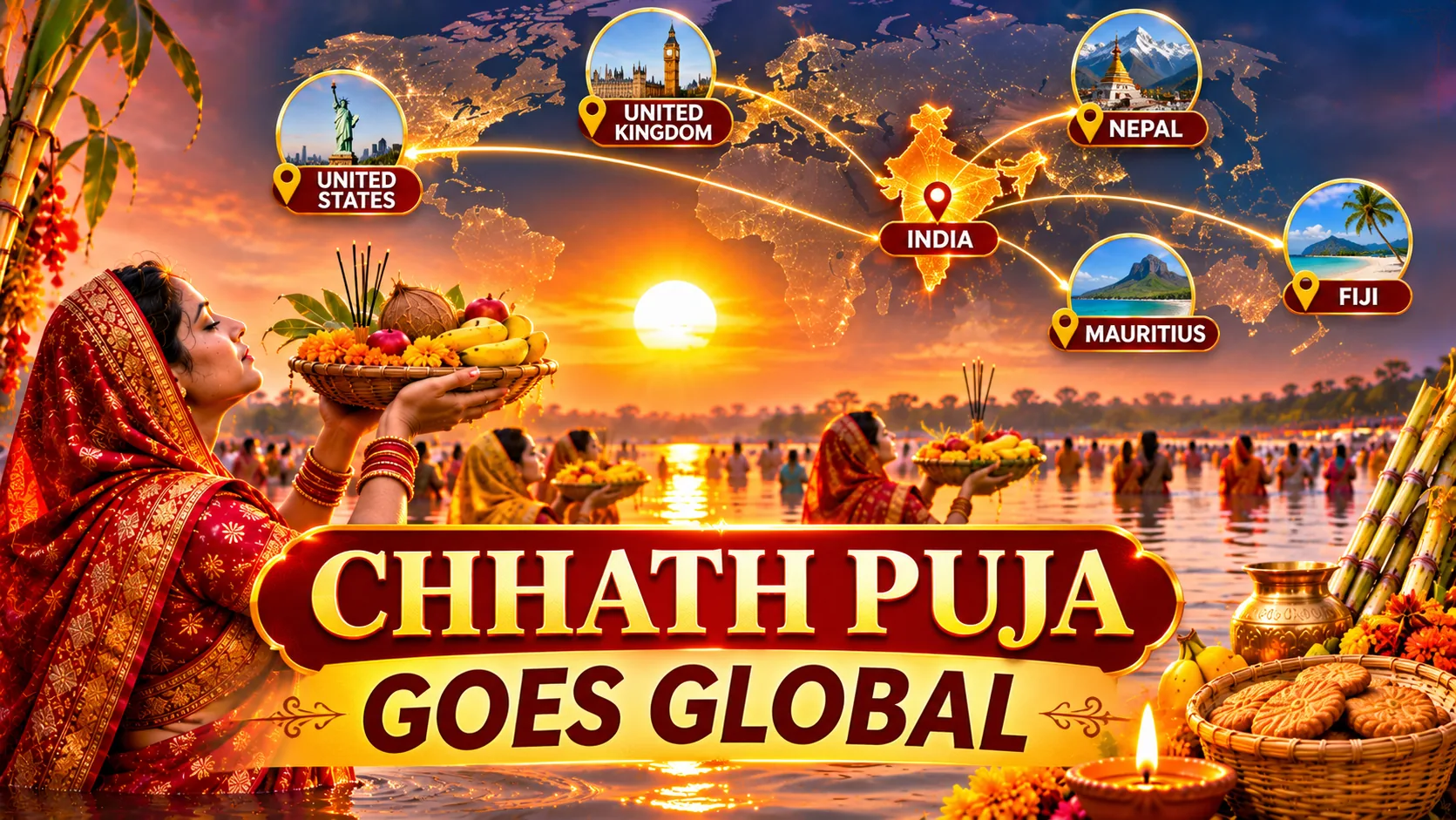
All Blog PostsPatna , the capital of Bihar, is known for its large Chhath gatherings along the banks of the Ganga.
Varanasi offers one of the most distinctive settings for Chhath Puja.
AwarenessNews
Chhath Puja Across India and Around the World: Where and How Is It Celebrated?
K
Kumbh AdminNovember 15, 202614 min readChhath Puja may have its strongest cultural roots in Bihar and eastern Uttar Pradesh, but its celebrations now reach far beyond these regions. From the ghats of Patna and Varanasi to riverbanks in Nepal, Mauritius, Fiji, the United Kingdom and the United States, discover how communities across India and the world celebrate the festival dedicated to Surya Dev and Chhathi Maiya.
Chhath Puja may have its strongest cultural roots in Bihar and eastern Uttar Pradesh, but its devotion has travelled far beyond these regions. Today, the festival is celebrated across India and by Indian communities living in countries around the world.
From the crowded banks of the Ganga in Patna and Varanasi to the ponds of Janakpur in Nepal, and from the shores of Mauritius to community gatherings in the United States and the United Kingdom, Chhath Puja brings people together through a shared tradition of worshipping Surya Dev and Chhathi Maiya.
The festival has a particularly close connection with the people of Bihar, Jharkhand, eastern Uttar Pradesh, and the Terai region of Nepal. Over generations, migration has carried these traditions to major Indian cities and international destinations.
Although the central rituals remain familiar, the places where devotees gather, the arrangements for offerings, and some local customs differ according to geography and community traditions.
So, how is Chhath Puja celebrated in different parts of India? How did it reach countries far away from its traditional homeland? And how do devotees preserve the festival when they are thousands of kilometres away from the Ganga?
1. Bihar: Where Chhath Puja Is Part of Everyday Cultural Identity
Bihar is widely regarded as the cultural heartland of Chhath Puja. The festival has an especially strong place in the religious and social life of the state.
In many households, preparations begin several days before the four-day observance. Families clean their homes, prepare traditional Prasad, arrange bamboo baskets, and make plans to visit nearby rivers or Chhath Ghats.
Patna: The Ganga Becomes a Centre of Devotion
During the festival, riverfront areas transform into places of collective worship. Families arrive carrying Daura and Soop filled with fruits, sugarcane, coconuts, Thekua, and other offerings.
Devotees gather in the water to offer Sandhya Arghya to the setting Sun and return the following morning for Usha Arghya.
The ghats become especially vibrant with traditional Chhath songs, devotional prayers, and the participation of entire families.
Aurangabad: The Famous Deo Sun Temple
Deo, in Aurangabad district, is an important destination for devotees of Surya Dev.
The famous Deo Surya Mandir attracts pilgrims during Chhath, and the surrounding area becomes an important centre of religious activity.
The temple is particularly known for its association with Sun worship and its distinctive architectural traditions.
For many devotees, visiting Deo during Chhath is a deeply meaningful religious experience.
Rural Bihar: Traditions Passed Down Through Generations
In villages across Bihar, Chhath Puja is often a community-wide celebration.
Families prepare traditional food, clean local ponds and riverbanks, and participate in rituals together.
Traditional Chhath Geet are especially important in rural communities. These songs describe the devotion of mothers, the blessings of Chhathi Maiya, and the importance of family and nature.
In many villages, the festival is not simply a religious event but an important part of local cultural identity.
2. Eastern Uttar Pradesh: Chhath Along the Sacred Ganga
Eastern Uttar Pradesh, commonly known as Purvanchal, is another major region where Chhath Puja is celebrated with great devotion.
The festival is particularly popular in Varanasi, Gorakhpur, Ballia, Ghazipur, Deoria, Azamgarh, and surrounding districts.
Varanasi: Chhath at the Ghats of the Ganga
The city's historic riverfront becomes a place of devotion as families gather along the Ganga to offer prayers to Surya Dev.
The riverbanks, which are already central to the city's religious life, take on a special significance during the festival.
Devotees arrange their offerings near the water, stand in the river during Arghya, and sing traditional devotional songs.
The combination of the ancient ghats, the flowing Ganga, and the setting Sun creates a particularly memorable atmosphere.
Gorakhpur and Other Purvanchal Cities
In Gorakhpur and neighbouring districts, Chhath is celebrated at rivers, ponds, lakes, and specially prepared community ghats.
Local administrations and community organisations often arrange lighting, cleaning, safety measures, and access for devotees.
Families living in cities frequently return to their ancestral villages to celebrate the festival.
A Shared Tradition Across the Ganga Plains
Although some local food preparations and devotional songs differ, the central observance remains similar across Purvanchal.
The four days of Nahay Khay, Kharna, Sandhya Arghya, and Usha Arghya continue to define the festival.
3. Jharkhand: Chhath Celebrations Around Rivers, Lakes and Reservoirs
Jharkhand has a strong Chhath tradition, particularly in Ranchi, Dhanbad, Bokaro, Jamshedpur, Hazaribagh, and other urban and rural areas.
The festival brings together communities from different cultural backgrounds while preserving its connection with the traditions of Bihar and eastern Uttar Pradesh.
Ranchi: Chhath at the City's Water Bodies
Ranchi celebrates Chhath Puja at several lakes, ponds, and reservoirs.
Hatania Talab and other traditional water bodies become important gathering points for devotees.
Families prepare offerings at home and visit nearby ghats for the evening and morning Arghya.
Jamshedpur, Dhanbad and Bokaro
Industrial cities such as Jamshedpur, Dhanbad, and Bokaro have significant Chhath celebrations.
Workers and families from Bihar, Jharkhand, and eastern Uttar Pradesh participate in the festival.
Community organisations help arrange Chhath Ghats, making it possible for people to observe traditional rituals even when they live far from their ancestral villages.
The Cultural Importance of Chhath in Jharkhand
Chhath Puja brings together urban and rural communities.
Traditional food, devotional songs, bamboo offerings, and collective cleaning of water bodies remain important parts of the celebration.
4. Nepal: Chhath Puja Across the Terai and Mithila Regions
Chhath Puja is not limited to India. It is also one of the important Hindu festivals in Nepal, particularly in the southern Terai region.
The cultural connection between Bihar, eastern Uttar Pradesh, and Nepal is particularly strong in the Mithila and Madhesh regions.
The festival is celebrated with devotion in places such as Janakpur, Birgunj, Biratnagar, and other communities across the Nepalese plains.
Janakpur: Chhath in the Land of Sita
Janakpur, traditionally associated with Goddess Sita, is an important centre of Hindu religious and cultural traditions.
During Chhath Puja, the city's ponds and water bodies become gathering places for devotees.
Two particularly well-known locations are:
- Ganga Sagar: A sacred pond in Janakpur where devotees gather for Chhath rituals.
- Dhanush Sagar: Another important religious water body associated with the city's devotional traditions.
Families gather with traditional offerings and perform Sandhya and Usha Arghya.
Chhath in Nepal's Madhesh Region
Across the Madhesh region, Chhath is an important community celebration.
The festival is observed with traditional songs, fasting, bamboo baskets, and offerings to the setting and rising Sun.
Because of the shared cultural heritage between Nepal's Terai and neighbouring Indian regions, many rituals and food traditions are similar.
Chhath Puja therefore represents an important cultural connection between communities on both sides of the India–Nepal border.
5. Chhath Puja Beyond Its Traditional Regions in India
Migration has played a major role in spreading Chhath Puja across India.
People from Bihar, Jharkhand, and eastern Uttar Pradesh have moved to different cities for education, employment, and business.
They have carried their religious traditions with them and established community celebrations in places where Chhath was previously less common.
Delhi: Large Community Gatherings and Temporary Ghats
Delhi has become one of the major centres of Chhath celebrations outside eastern India.
The city has a large population of people originally from Bihar and Purvanchal.
During the festival, temporary and permanent Chhath Ghats are arranged along the Yamuna and at designated ponds and artificial water bodies.
Community organisations and government authorities make arrangements for devotees to perform both evening and morning offerings.
Mumbai: Chhath Along the Coast and at Community Water Bodies
Mumbai has a significant population of people from Bihar and eastern Uttar Pradesh.
Chhath is celebrated at designated beaches, lakes, ponds, and other community arrangements.
Juhu Beach and other suitable locations have hosted gatherings of devotees.
For families living away from their ancestral homes, these gatherings provide an opportunity to maintain their religious traditions and celebrate with their community.
Kolkata: A Festival Connecting Communities
Kolkata has long-standing cultural and migration connections with Bihar and eastern Uttar Pradesh.
Chhath Puja is observed at various riverbanks, ponds, and community ghats across the city.
The festival brings together families who maintain traditional fasting, food preparation, and devotional songs.
Madhya Pradesh, Gujarat and Maharashtra
Chhath celebrations have also become increasingly visible in cities such as Bhopal, Indore, Surat, Ahmedabad, and Pune.
Community organisations arrange local gathering spaces where devotees can offer Arghya.
These celebrations demonstrate how a festival with strong regional origins can become part of the cultural life of cities across India.
6. Chhath Puja Around the World: How Indian Communities Preserve the Festival Abroad
Chhath Puja has travelled beyond India through migration, particularly among communities with ancestral connections to Bihar and eastern Uttar Pradesh.
There are two important historical and social connections behind its international spread.
First, descendants of Indian indentured labourers carried Bhojpuri and related cultural traditions to countries such as Mauritius, Fiji, Suriname, Guyana, and Trinidad and Tobago during the nineteenth and early twentieth centuries.
Second, more recent migration for education, employment, and business has helped establish Chhath celebrations in countries across Europe, North America, Asia, and the Middle East.
Mauritius: A Long-Standing Tradition of Indian Heritage
Mauritius has a particularly important connection with Chhath Puja.
The island nation has a large population with Indian ancestry, including descendants of migrants from Bihar and eastern Uttar Pradesh.
Over generations, these communities have preserved Hindu festivals, traditional songs, food, and religious practices.
Chhath Puja is celebrated at suitable water bodies and community gathering places.
Devotees arrange traditional offerings, observe fasting, and offer Arghya to the setting and rising Sun.
The festival is an important expression of the cultural heritage of the Indian-origin population.
Fiji: Preserving Bhojpuri Traditions Across Generations
Fiji has a long history of Indian migration dating back to the indentured labour period.
Many descendants of Indian migrants maintain traditions associated with their ancestral regions.
Chhath Puja is observed by sections of the Hindu community, particularly those with connections to Bihar and eastern Uttar Pradesh.
Community celebrations, devotional songs, and traditional offerings help preserve the festival across generations.
Suriname: Chhath Among the Indo-Surinamese Community
Suriname has a significant population of Indian origin, many of whose ancestors migrated from northern India during the nineteenth century.
Hindu religious traditions have remained an important part of community life.
Chhath Puja is celebrated by devotees who observe fasting and offer prayers to the Sun.
Its presence in Suriname demonstrates how a regional Indian festival has become part of a wider international cultural heritage.
Trinidad and Tobago: Chhath in the Caribbean
Trinidad and Tobago also has a substantial population of Indian ancestry.
Hindu festivals, religious gatherings, and traditional celebrations remain important within parts of the community.
Chhath Puja is observed by devotees who preserve its central rituals and adapt the arrangements to local conditions.
United States: Chhath Across American Cities
The United States has become an important destination for Indian students, professionals, and families.
People from Bihar and eastern Uttar Pradesh have established Chhath celebrations in several American cities.
Community gatherings have been reported in New Jersey, California, Texas, Washington, and other locations.
Where suitable rivers, lakes, or designated water bodies are available, devotees arrange spaces for Sandhya and Usha Arghya.
Community associations also organise traditional Prasad preparation and devotional gatherings.
For many families, celebrating Chhath thousands of kilometres away from Bihar is a way of remaining connected to their childhood, hometowns, and cultural roots.
United Kingdom: Chhath Celebrations Among Indian Communities
The United Kingdom has a large Indian-origin population, including communities from Bihar and eastern Uttar Pradesh.
Chhath Puja is observed in cities such as London, Birmingham, and Leicester.
Devotees arrange suitable community locations near water bodies and organise traditional offerings and prayers.
Local community organisations play an important role in coordinating gatherings and preserving the festival.
United Arab Emirates: Chhath Away from Home
The United Arab Emirates is another destination for Indian professionals and workers from eastern India.
Chhath celebrations are organised by sections of the Indian community in cities such as Dubai and Abu Dhabi.
Because of local conditions and venue requirements, arrangements may take place at approved community venues and suitable water bodies.
For devotees living abroad, these gatherings provide an opportunity to continue their religious observances while remaining connected to their families and traditions.
Other Countries Where Chhath Is Celebrated
Chhath Puja is also observed by Indian-origin communities in several other countries, including:
- Canada
- Australia
- New Zealand
- Singapore
- Malaysia
- Japan
- South Africa
- Sri Lanka
- Guyana
- The Netherlands
The size and organisation of celebrations vary from one country and community to another. In some places, large public gatherings take place, while in others, families observe the festival in smaller community groups.
7. What Remains the Same Wherever Chhath Is Celebrated?
Although Chhath Puja is observed in different countries and geographical settings, its central religious traditions remain remarkably consistent.
A devotee celebrating in Patna follows the same essential sequence of rituals as a devotee celebrating in Mauritius or London.
The Four Days Remain Central
The traditional observance follows four stages:
| Day | Ritual | Main activity |
|---|---|---|
| First day | Nahay Khay | Ritual bathing, cleaning and traditional food |
| Second day | Kharna | Day-long fast and evening Prasad |
| Third day | Sandhya Arghya | Offering prayers to the setting Sun |
| Fourth day | Usha Arghya | Offering prayers to the rising Sun |
Traditional Prasad Remains Important
Thekua, bananas, coconuts, sugarcane, rice preparations, and seasonal fruits remain important offerings.
Families abroad may face difficulties finding certain traditional ingredients, but they often make arrangements through Indian grocery stores and community networks.
Devotional Songs Preserve Cultural Identity
Chhath Geet are an essential part of the festival.
These songs are passed down through generations and express devotion to Surya Dev and Chhathi Maiya.
Even when celebrated thousands of kilometres away, the familiar songs help recreate the atmosphere of traditional Chhath gatherings.
The Sun and Water Remain at the Centre
Whether the festival takes place beside the Ganga, a village pond, a lake in the United States, or an approved coastal location in Mauritius, the central act remains the offering of Arghya to the Sun.
This connection with sunlight and water is one of the defining characteristics of Chhath Puja.
Frequently Asked Questions About Chhath Puja Around the World
1. Which Indian states celebrate Chhath Puja?
Chhath Puja is particularly popular in Bihar, Jharkhand, Uttar Pradesh, and parts of West Bengal. It is also celebrated in Delhi, Maharashtra, Madhya Pradesh, Gujarat, Uttarakhand, and other states by communities that follow the tradition.
2. Is Chhath Puja celebrated outside India?
Yes. Chhath Puja is celebrated in Nepal, Mauritius, Fiji, Suriname, Trinidad and Tobago, the United States, the United Kingdom, Canada, Australia, and several other countries.
3. Why is Chhath Puja popular in Nepal?
The Terai region of Nepal shares deep cultural, linguistic, and religious connections with Bihar and eastern Uttar Pradesh. Chhath is particularly important in the Madhesh and Mithila regions.
4. How did Chhath Puja reach Mauritius and Fiji?
The festival travelled with Indian migrants, particularly those who went to Mauritius and Fiji during the indentured labour period. Their descendants preserved religious practices, traditional songs, and festivals associated with their ancestral regions.
5. Where is Chhath Puja celebrated in Delhi?
Chhath Puja is celebrated at designated Yamuna riverfront locations, ponds, and temporary community ghats across Delhi. Government authorities and community organisations arrange facilities for devotees.
6. Do people abroad follow all four days of Chhath Puja?
Many devotees abroad follow the traditional four-day observance of Nahay Khay, Kharna, Sandhya Arghya, and Usha Arghya. The arrangements may vary depending on local facilities and community traditions.
7. Is Chhath Puja being considered for UNESCO recognition?
Yes. India's Ministry of Culture announced a multinational nomination initiative for Chhath Mahaparva for UNESCO's 2026–27 Intangible Cultural Heritage cycle, involving partner countries. This is a nomination initiative, not confirmation that the festival has already been inscribed on UNESCO's list.
The Simple Answer
Chhath Puja is celebrated across India and around the world because generations of devotees have carried this religious tradition beyond its original cultural heartland.
In Bihar, it is deeply connected with the Ganga and the cultural identity of local communities. In eastern Uttar Pradesh, the ghats of Varanasi and other cities become important centres of worship. In Jharkhand, devotees gather around lakes and rivers, while in Nepal, the festival is an important part of the religious life of the Terai and Mithila regions.
Beyond South Asia, Indian-origin communities in Mauritius, Fiji, Suriname, Trinidad and Tobago, the United States, the United Kingdom, and other countries continue to observe the festival.
The locations may change, but the central traditions remain the same: fasting, preparing Prasad, worshipping Surya Dev, seeking blessings from Chhathi Maiya, and offering Arghya to the setting and rising Sun.
Chhath Puja is no longer limited by geography. It is a living cultural tradition that connects people across countries, generations, and communities through a shared expression of faith, gratitude, and devotion.
Pilgrim Resources
Enhance Your Pilgrimage Experience
Mobile App
Download AppRead Kumbh Guides on Mobile
Download Divya Kripa to read all official guides offline, receive real-time snan alerts, and access GPS-enabled navigation on the ground.
AI Assistant
Try AI PlannerPersonalized Planner & Guide
Access your Kumbh Planner AI Assistant to receive tailored ritual advice, customized itineraries, and instant answers to spiritual questions.
More Stories Awareness
 Culture
 Ritual
Related Articles
Smart Crowd Management at Kumbh Mela: How Digital Twins Could Transform Crowd Safety and Planning
Nov 20, 2026Why Do We Worship Lord Ganesha Along with Goddess Lakshmi During Diwali? The Story and Spiritual Significance
Nov 12, 202631 October 2026 – Nashik Kumbh Dhwajarohan and Simhastha Begins
Oct 31, 2026Loading discussion & reviews...