All Blog Posts
EngagementAwarenessNews
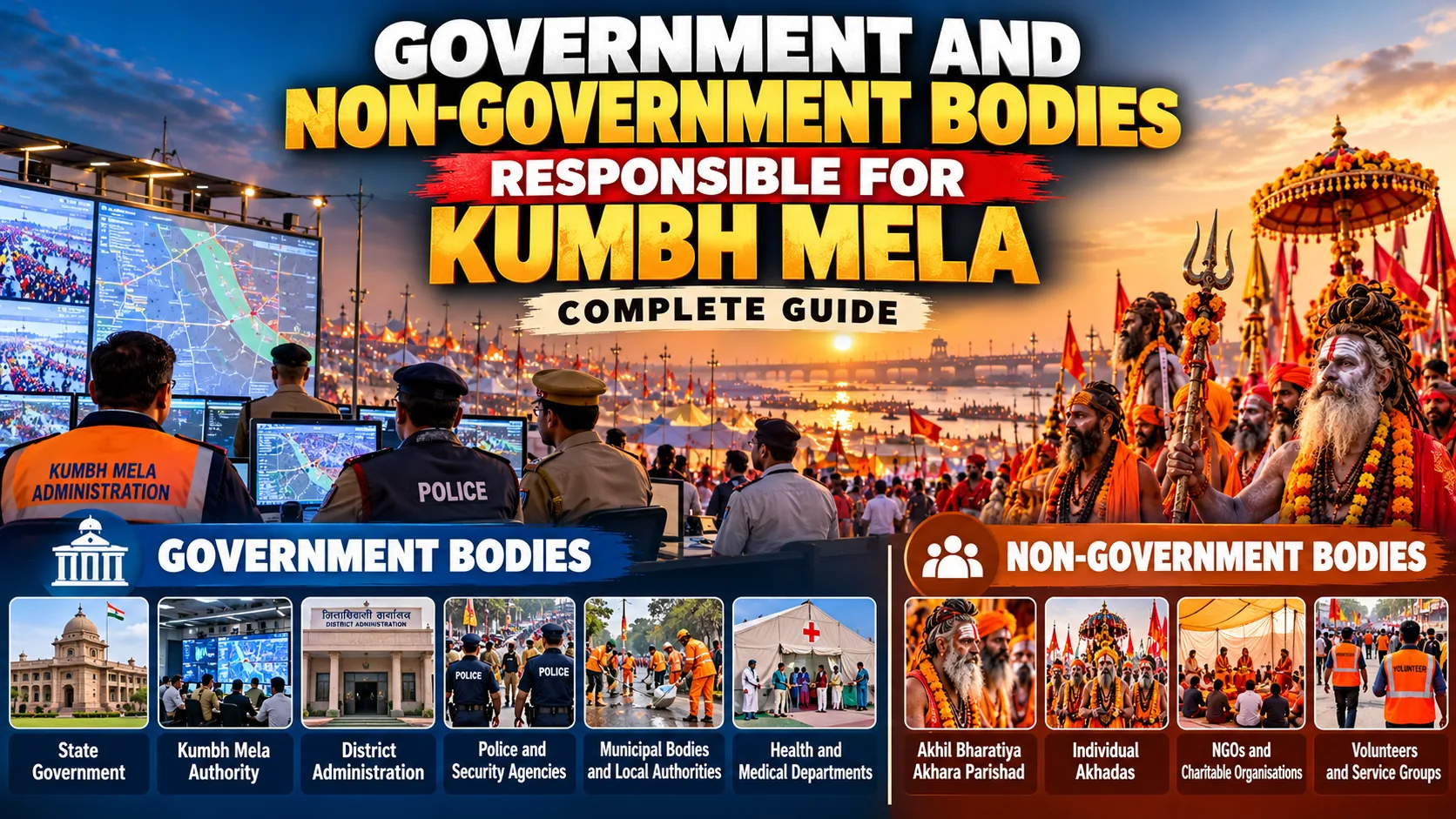
Government and Non-Government Bodies Responsible for Kumbh Mela: Complete Guide
K
Kumbh AdminOctober 9, 202612 min readWho organises Kumbh Mela, manages crowd safety, provides medical services, and coordinates religious ceremonies? Discover the roles of government authorities, police, municipal bodies, the Akhil Bharatiya Akhara Parishad, individual akhadas, NGOs, volunteers, and charitable organisations involved in organising India's major Kumbh gatherings.
Who Is Responsible for Organising Kumbh Mela?
Kumbh Mela is one of the world's largest religious gatherings. Organising an event of this scale requires coordination between government departments, religious institutions, charitable organisations, service providers, and millions of pilgrims.
No single organisation manages every aspect of Kumbh Mela.
Government bodies primarily manage public administration, infrastructure, security, sanitation, healthcare, and emergency services. Non-government bodies contribute religious leadership, spiritual activities, charitable services, volunteer support, and community assistance.
Understanding these responsibilities helps visitors recognise who manages different aspects of the gathering and where to look for official information.
1. Government Bodies Responsible for Kumbh Mela
Government agencies are responsible for organising the public infrastructure and services needed for the gathering. The exact administrative structure varies by state and Kumbh location.
A. State Government
The relevant state government provides the main administrative framework for organising Kumbh Mela within its jurisdiction.
Its responsibilities may include:
- Approving development plans and budgets.
- Establishing dedicated Kumbh authorities or committees.
- Coordinating different government departments.
- Approving major infrastructure projects.
- Reviewing security, transport, healthcare, and crowd-management plans.
- Monitoring preparedness and implementation.
For example, the Government of Maharashtra has established a dedicated authority for Nashik–Trimbakeshwar Simhastha Kumbh Mela 2027.
B. Kumbh Mela Authority or Mela Administration
A dedicated Mela authority, where established, coordinates preparations and operations across the event area.
Its work may include:
- Developing the Mela layout and temporary settlements.
- Coordinating roads, bridges, bathing areas, and public facilities.
- Arranging water supply, sanitation, and waste-management services.
- Coordinating with police, health departments, municipal bodies, and other agencies.
- Supporting the organisation of public facilities for pilgrims.
- Monitoring the implementation of approved projects.
The name and legal powers of the authority differ between locations.
For example, Prayagraj has the Prayagraj Mela Authority, while Nashik and Trimbakeshwar have the Nashik–Trimbakeshwar Kumbh Mela Authority (NTKMA).
C. District Administration
The district administration helps coordinate government services within the affected district.
The District Magistrate or Collector and other district officials may work with the Mela administration on land, public services, emergency planning, local coordination, and implementation of government directions.
Their involvement is particularly important when the event affects areas beyond the main bathing grounds, including nearby roads, towns, and transport routes.
D. Police and Security Agencies
Crowd safety is a major responsibility during Kumbh Mela, especially on important bathing days.
Police and other authorised security agencies may be responsible for:
- Managing crowds and controlling access to restricted areas.
- Regulating traffic and implementing diversions.
- Protecting pilgrims and maintaining public order.
- Monitoring sensitive locations.
- Coordinating missing-person assistance and emergency responses.
- Supporting security arrangements for major processions.
Specialised units may also be deployed according to local requirements. Their responsibilities and deployment vary by event.
E. Municipal Corporations and Local Bodies
Municipal corporations, municipal councils, panchayats, and other relevant local bodies provide essential civic services in their jurisdictions.
Their work can include:
- Cleaning roads and public spaces.
- Collecting and disposing of waste.
- Maintaining public toilets and drainage systems.
- Supporting water supply and sewage management.
- Repairing local roads and civic infrastructure.
- Maintaining street lighting and other public facilities.
For Nashik–Trimbakeshwar, the Nashik Municipal Corporation and Trimbakeshwar Municipal Council have important local roles, alongside the wider Kumbh authority.
F. Health and Medical Departments
Large gatherings require extensive healthcare and emergency medical arrangements.
Government health agencies may organise:
- Temporary medical centres and hospitals.
- Ambulance services and emergency referrals.
- First-aid facilities.
- Public-health surveillance.
- Disease prevention and sanitation coordination.
- Medical support for vulnerable pilgrims.
The availability and locations of facilities can change during the event. Visitors should follow official health advisories and emergency instructions.
G. Fire Services and Disaster Management Agencies
Fire and disaster-management teams help prepare for emergencies that may arise during a large gathering.
Their responsibilities can include fire prevention, rescue operations, emergency response planning, incident coordination, and assistance during flooding or other hazardous conditions.
The National Disaster Response Force or other specialised agencies may be deployed when required, depending on the event's risk assessment and government arrangements.
H. Public Works, Water, Electricity, and Transport Departments
Several infrastructure agencies work together to make the event accessible and functional.
| Government body or service | Typical responsibility |
|---|---|
| Public Works Department | Roads, bridges, and public infrastructure |
| Water resources department | River-related coordination and water management within its mandate |
| Water supply agencies | Drinking-water infrastructure and distribution |
| Electricity distribution companies | Power supply, connections, and electrical infrastructure |
| Transport departments | Transport planning and traffic coordination |
| Indian Railways and relevant railway authorities | Railway services, station management, and passenger arrangements |
| Pollution-control authorities | Environmental compliance and pollution monitoring |
| Tourism departments | Visitor information and tourism infrastructure, within their programmes |
Not every agency has the same role at every Kumbh. Responsibilities depend on jurisdiction, project approvals, and the arrangements made for the particular event.
I. Central Government Agencies
The central government may support Kumbh-related activities through relevant ministries and agencies.
Depending on the project and local requirements, this support can include tourism infrastructure, railway services, disaster response, heritage conservation, and other approved programmes.
For example, the Archaeological Survey of India and state heritage departments may undertake conservation work at protected monuments near a Kumbh destination. Such work is distinct from the day-to-day management of the Mela.
2. Non-Government Bodies Involved in Kumbh Mela
Non-government bodies contribute to the spiritual, social, and charitable aspects of Kumbh Mela. Some have long-standing religious roles, while others provide services during the gathering.
They do not automatically have the legal authority of government agencies. Their activities depend on their own organisational responsibilities, permissions, and arrangements with the authorities.
A. Akhil Bharatiya Akhara Parishad
The Akhil Bharatiya Akhara Parishad (ABAP) is an important representative body for recognised akhadas.
It helps represent shared concerns of akhadas and coordinates on certain matters involving religious traditions and participation in Kumbh.
Its role can include:
- Representing recognised akhadas in discussions.
- Facilitating coordination among religious orders.
- Discussing ceremonial arrangements and shared concerns.
- Communicating matters affecting the ascetic community.
The Parishad is not the government authority responsible for roads, public health, policing, or the entire Mela administration.
B. Individual Akhadas
Individual akhadas maintain their own religious identities, leadership, and traditions.
Their responsibilities can include:
- Preserving spiritual teachings and religious customs.
- Organising their members' participation in ceremonies.
- Conducting religious discourses and devotional activities.
- Managing their camps and internal arrangements.
- Guiding ascetics and carrying out traditional initiation practices.
Their participation is particularly visible during major processions and Amrit Snan.
C. Religious Institutions, Temples, and Trusts
Temples, maths, ashrams, and religious trusts may contribute to the pilgrimage experience.
Depending on their resources and arrangements, they may organise prayer gatherings, religious instruction, accommodation, food distribution, or assistance for devotees.
Some institutions operate independently, while others coordinate with local authorities or service organisations.
D. NGOs and Charitable Organisations
Non-governmental organisations and charitable groups may provide additional assistance during Kumbh Mela.
Their work can include:
- Distributing food and drinking water.
- Providing clothing or essential supplies.
- Supporting vulnerable people and families.
- Offering educational or public-awareness activities.
- Assisting with sanitation or environmental initiatives.
- Helping pilgrims access designated assistance services.
The services available depend on the organisation and the event. Visitors should check the identity and credibility of an organisation before donating money or sharing personal information.
E. Seva Groups and Community Organisations
Religious service groups, community associations, and other volunteer organisations may organise seva—voluntary service—during the gathering.
Activities may include food distribution, helping pilgrims navigate designated areas, supporting elderly visitors, and assisting with community facilities.
These groups supplement public services; they do not replace authorised emergency, medical, or security personnel.
F. Volunteers and Local Community Groups
Volunteers can help visitors navigate the gathering and access appropriate services.
Depending on their training and assigned duties, they may assist with information desks, queues, lost-and-found facilities, language support, and general visitor guidance.
Volunteers should follow the instructions of the relevant organisers and refer medical emergencies, security incidents, and other serious matters to authorised personnel.
G. Private Service Providers and Businesses
Private companies also contribute to the practical functioning of Kumbh Mela.
Examples include accommodation operators, transport providers, food businesses, sanitation contractors, technology providers, and event-service companies.
Some work directly under government contracts, while others operate independently subject to applicable rules and permissions.
Private businesses should not be confused with government departments or officially authorised services unless their status has been verified.
3. Government vs Non-Government Bodies: What's the Difference?
| Area of work | Government bodies | Non-government bodies |
|---|---|---|
| Overall public administration | Lead or coordinate under the applicable legal framework | Participate through approved or agreed activities |
| Roads and public infrastructure | Plan, fund, construct, or maintain through relevant agencies | May provide contracted services or specific support |
| Public security | Police and authorised security agencies | Encourage safe conduct and report concerns |
| Healthcare and emergencies | Public health services and authorised emergency agencies | May provide approved charitable or supplementary assistance |
| Religious ceremonies | Coordinate public arrangements and safety | Akhadas and religious institutions conduct their own religious activities |
| Spiritual guidance | Not generally their primary function | Saints, akhadas, maths, ashrams, and religious teachers |
| Food and charitable service | May provide or coordinate public relief services | NGOs, trusts, religious groups, and volunteers may provide additional support |
| Environmental services | Authorities and designated agencies oversee compliance and public systems | NGOs, volunteers, and service groups may support approved initiatives |
The distinction is not always absolute: a non-government organisation may deliver a service under a government contract, and government bodies may coordinate with religious organisations. The important question is who has legal responsibility for a particular service and who is authorised to provide it.
4. How These Bodies Work Together During Kumbh Mela
A gathering as large as Kumbh Mela requires coordination across many different organisations.
For example, preparing for a major bathing day may involve several parallel activities:
- The Mela administration coordinates the overall event plan and public facilities.
- Police and security agencies manage crowd movement, traffic, and restricted areas.
- Health departments prepare medical facilities and emergency response arrangements.
- Municipal and infrastructure agencies maintain sanitation, water supply, roads, and electricity.
- Akhadas organise their own religious processions and participation in ceremonial bathing.
- Charitable organisations and volunteers provide approved support services to pilgrims.
These responsibilities overlap in practice, so regular communication and clear instructions are essential.
For visitors, the safest approach is to follow official announcements for travel, traffic, bathing arrangements, medical assistance, and emergencies. Religious and charitable organisations can provide additional support, but their services should be verified independently.
5. Who Organises Nashik–Trimbakeshwar Simhastha Kumbh Mela 2027?
For readers preparing for the 2027 gathering, Nashik–Trimbakeshwar has a dedicated administrative structure.
The Nashik–Trimbakeshwar Kumbh Mela Authority (NTKMA) is the designated body for coordinating preparations for Simhastha Kumbh Mela 2027.
Its work involves coordination across relevant departments, including planning and infrastructure, public services, transport, sanitation, safety, and pilgrim facilitation.
Other bodies involved in preparation include the Nashik district administration, Nashik city and rural police, local municipal bodies, health agencies, public works and water-related departments, transport authorities, and other designated agencies.
Religious organisations and akhadas have their own roles in preparing their camps and coordinating their participation in religious ceremonies.
For current official information, consult the Nashik–Trimbakeshwar Kumbh Mela Authority and its published announcements.
Conclusion: Kumbh Mela Is a Shared Responsibility
Kumbh Mela depends on the work of many organisations with different responsibilities.
Government authorities coordinate public administration, infrastructure, security, healthcare, and essential services. Akhadas and religious institutions preserve spiritual traditions and organise religious activities. NGOs, charitable trusts, community groups, volunteers, and private service providers contribute additional support.
These roles are complementary, but they are not interchangeable. Knowing which body is responsible for a service can help pilgrims find accurate information and respond appropriately when assistance is needed.
Stay Connected with Kumbh Connect
Want to understand how Kumbh Mela is organised and how to prepare for your pilgrimage?
Visit https://kumbhconnect.com for guides about Kumbh traditions, akhadas, pilgrimage destinations, travel planning, and event-related information.
Stay informed about the organisations, services, and arrangements that help pilgrims prepare for Kumbh Mela 2027.
Know the system. Plan your journey. Stay connected with Kumbh Connect.
Frequently Asked Questions
Which government body organises Kumbh Mela?
The responsible authority depends on the location. Prayagraj has the Prayagraj Mela Authority, while Nashik–Trimbakeshwar has the Nashik–Trimbakeshwar Kumbh Mela Authority. Other departments support the event within their respective responsibilities.
What is the role of the Akhil Bharatiya Akhara Parishad?
It represents recognised akhadas and helps coordinate certain shared religious and organisational matters. It does not manage all public services or replace the Mela administration.
Do NGOs manage Kumbh Mela?
No. NGOs and charitable organisations may provide supplementary services, such as food distribution, volunteer assistance, or public-awareness activities. Overall public administration remains with the designated government authorities.
Who is responsible for safety and crowd management?
Police and other authorised government agencies are responsible for public security and crowd management, working with the Mela administration and relevant departments.
Who provides food and accommodation for pilgrims?
Government arrangements, religious institutions, charitable groups, and private service providers may all contribute. Availability, eligibility, cost, and access vary, so visitors should verify specific arrangements before relying on them.
Where can I find official information for Nashik Kumbh Mela 2027?
Visit the official Nashik–Trimbakeshwar Kumbh Mela Authority website for published information and announcements.
Enhance Your Pilgrimage Experience
Mobile App
Read Kumbh Guides on Mobile
Download the Divya Kripa to read all 19 guides offline, receive real-time snan alerts, and access GPS-enabled navigation on the ground.
Download AppAI Assistant
Personalized Planner & Chatbot
Access your Kumbh Planner AI Assistant to receive tailored ritual advice, customized itineraries, and instant answers to spiritual questions.
Try AI PlannerRelated Articles
Loading discussion & reviews...