All Blog Posts

CultureAwarenessSpirituality
Planetary Alignments (Jupiter, Sun, Moon) Behind Kumbh Dates
K
Kumbh AdminOctober 20, 20268 min readDiscover how Jupiter, the Sun, and the Moon influence the traditional timing of Kumbh Mela. Learn why Jupiter's 12-year cycle, solar positions, lunar dates, and Hindu calendrical traditions determine when and where sacred Kumbh Snan occasions take place.
Introduction: Why Does Kumbh Mela Happen on Specific Dates?
Kumbh Mela does not begin on an arbitrary date.
Its timing is traditionally determined through a combination of astronomical positions, Hindu calendrical calculations, and Jyotisha traditions.
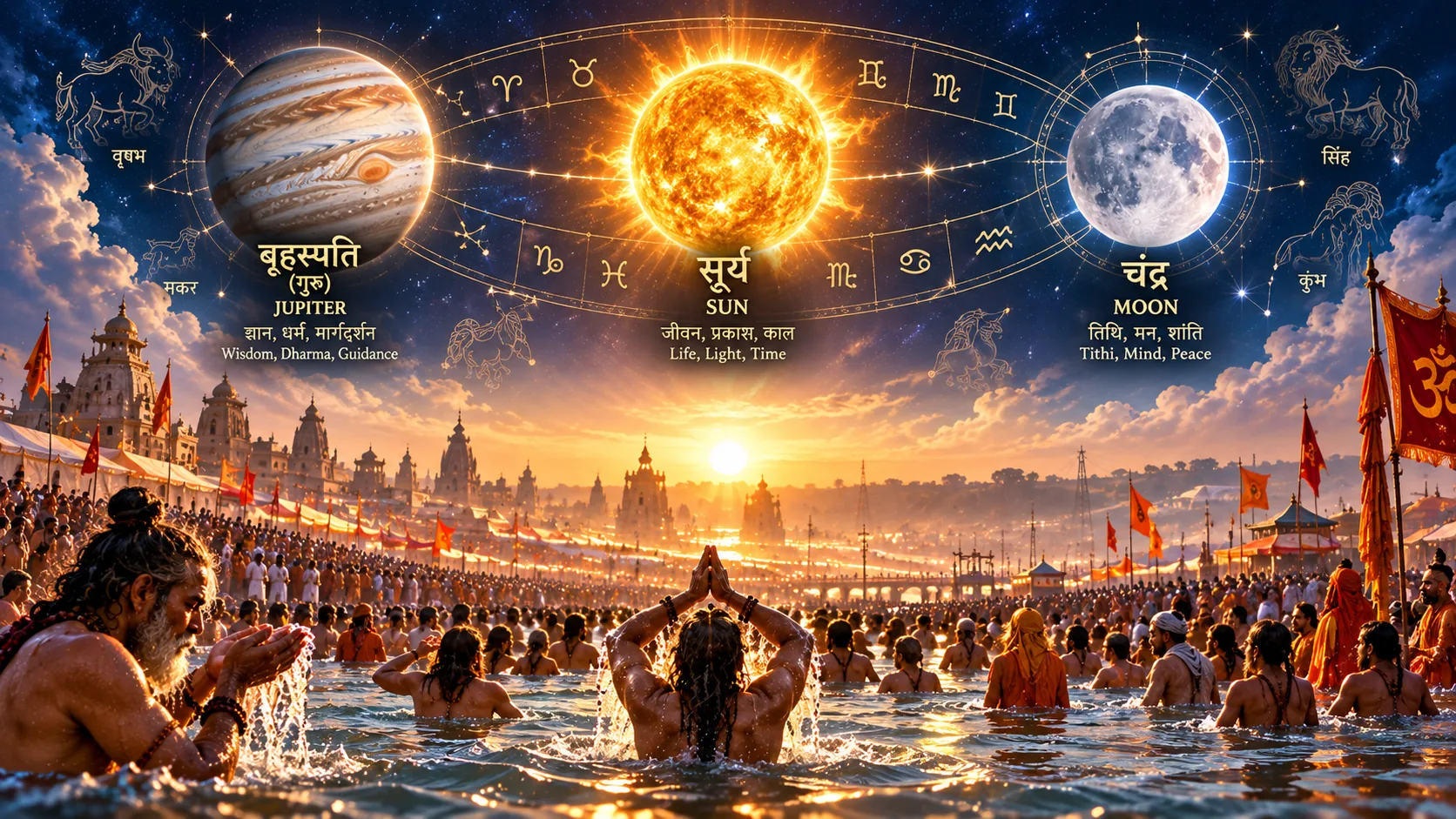
Three celestial bodies are especially important:
- Jupiter (Brihaspati)
- Sun (Surya)
- Moon (Chandra)
But why are these celestial bodies connected with Kumbh?
- How do Jupiter, Sun, and Moon influence Kumbh dates?
- Why does Kumbh return to a location roughly every 12 years?
- Why are some bathing days considered more auspicious than others?
- How are the four Kumbh locations connected with planetary positions?
The answer lies in the traditional relationship between celestial cycles, sacred time, and pilgrimage.
The Three Celestial Forces Behind Kumbh Timing
Jupiter (Brihaspati)
Jupiter is known in Hindu tradition as Brihaspati, the Guru of the Devas.
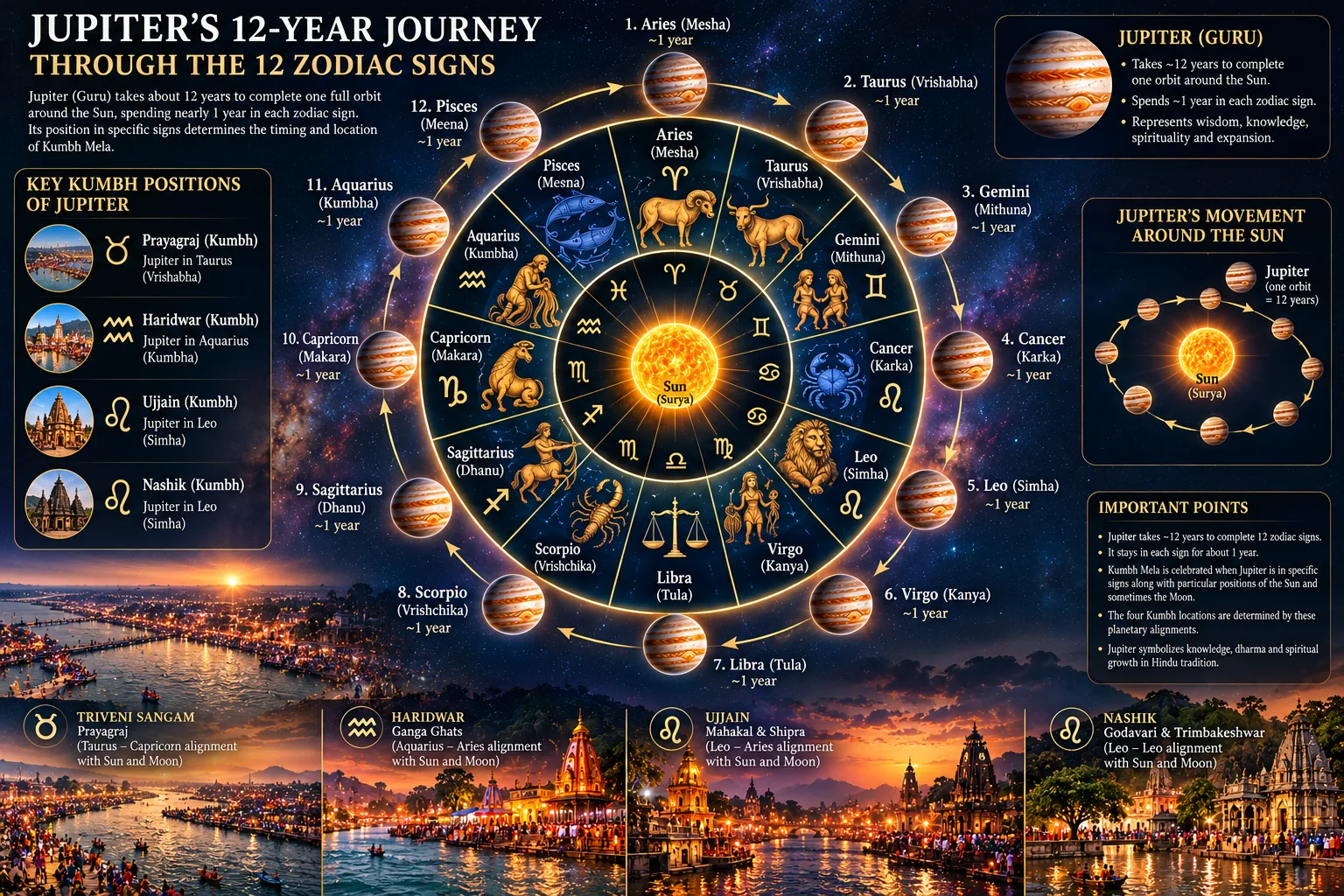
It is particularly important in Kumbh traditions because Jupiter takes approximately 12 years to complete its journey through the zodiac.
This long cycle is closely connected with the recurring Kumbh tradition.
Jupiter is traditionally associated with:
- Wisdom
- Knowledge
- Dharma
- Spiritual guidance
- Learning
Because of its slow movement, Jupiter provides the long-term celestial framework for Kumbh timing.
Sun (Surya)
The Sun completes its apparent journey through the zodiac in approximately one year.
In traditional Kumbh calculations, the Sun's position in a particular zodiac sign is considered alongside Jupiter's position to identify the relevant Kumbh period.
The Sun is traditionally associated with:
- Life and vitality
- Light
- Cosmic order
- Time
- Spiritual illumination
Moon (Chandra)
The Moon moves much more quickly and plays an important role in the Hindu lunar calendar.
Its position helps determine:
- Tithi
- Amavasya
- Purnima
- Nakshatra
- Other important religious dates
This makes the Moon especially important when determining the exact Snan dates within a broader Kumbh period.
The Simplest Way to Understand Kumbh Timing
A useful way to remember the system is:
Jupiter → Long-term cycle
Sun → Solar period
Moon → Lunar date
Together with the Hindu calendar:
Jupiter + Sun + Moon + Calendar = Traditional Kumbh Timing
This is a simplified explanation. Traditional calculations can involve additional astronomical and calendrical factors.
Why Jupiter Is So Important
The approximate 12-year cycle of Jupiter is one of the most important concepts behind the recurring Kumbh tradition.
Jupiter moves slowly through the zodiac, spending roughly a year in each sign.
After approximately 12 years, it returns to a similar position in the zodiac.
This helps explain why a major Kumbh traditionally returns to a particular pilgrimage center after a long interval.
The basic cycle can be understood as:
Jupiter moves through the zodiac
↓
A prescribed Jupiter position is reached
↓
Solar and lunar conditions are considered
↓
A Kumbh period is identified
↓
Important Snan dates are observed
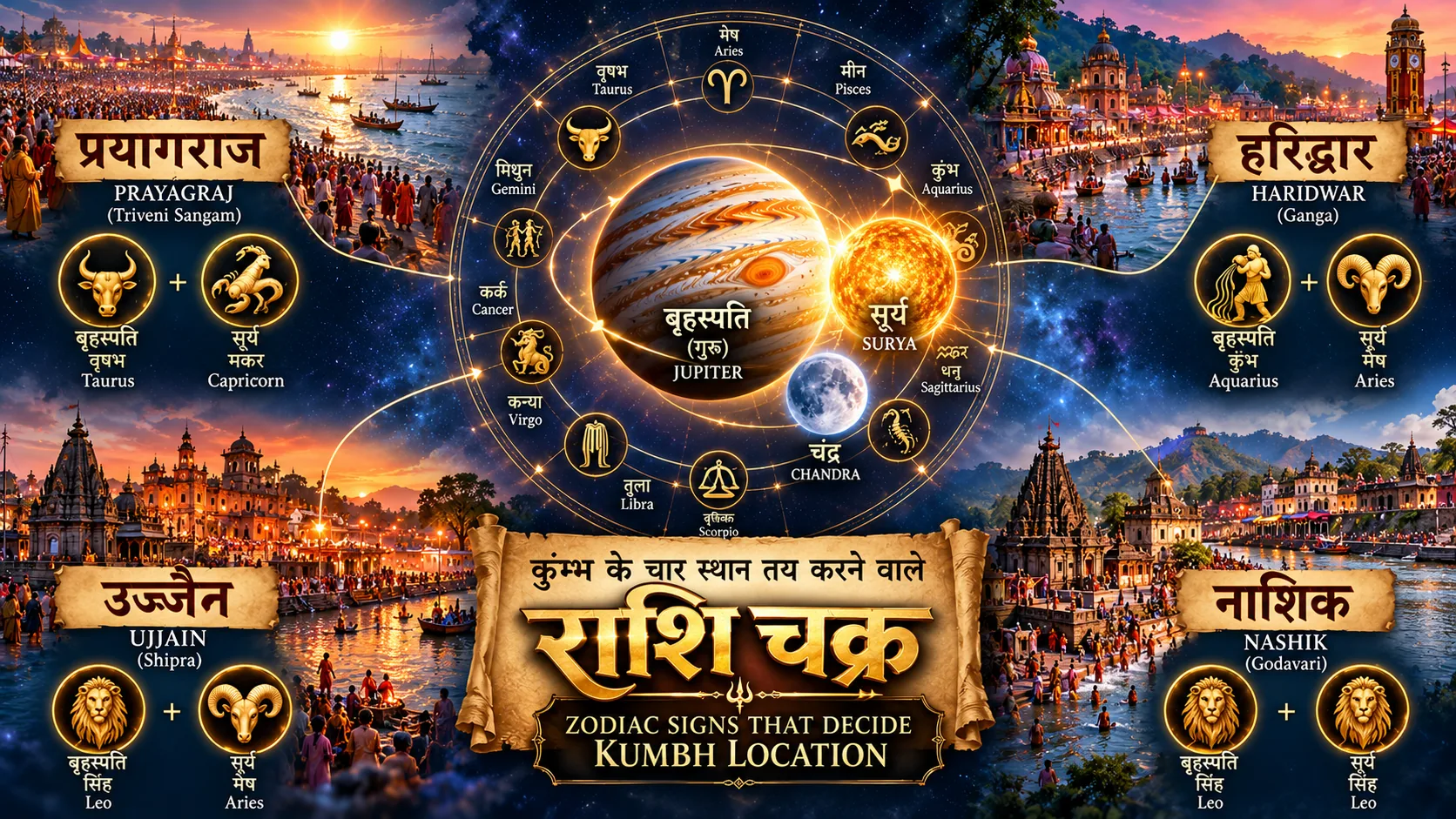
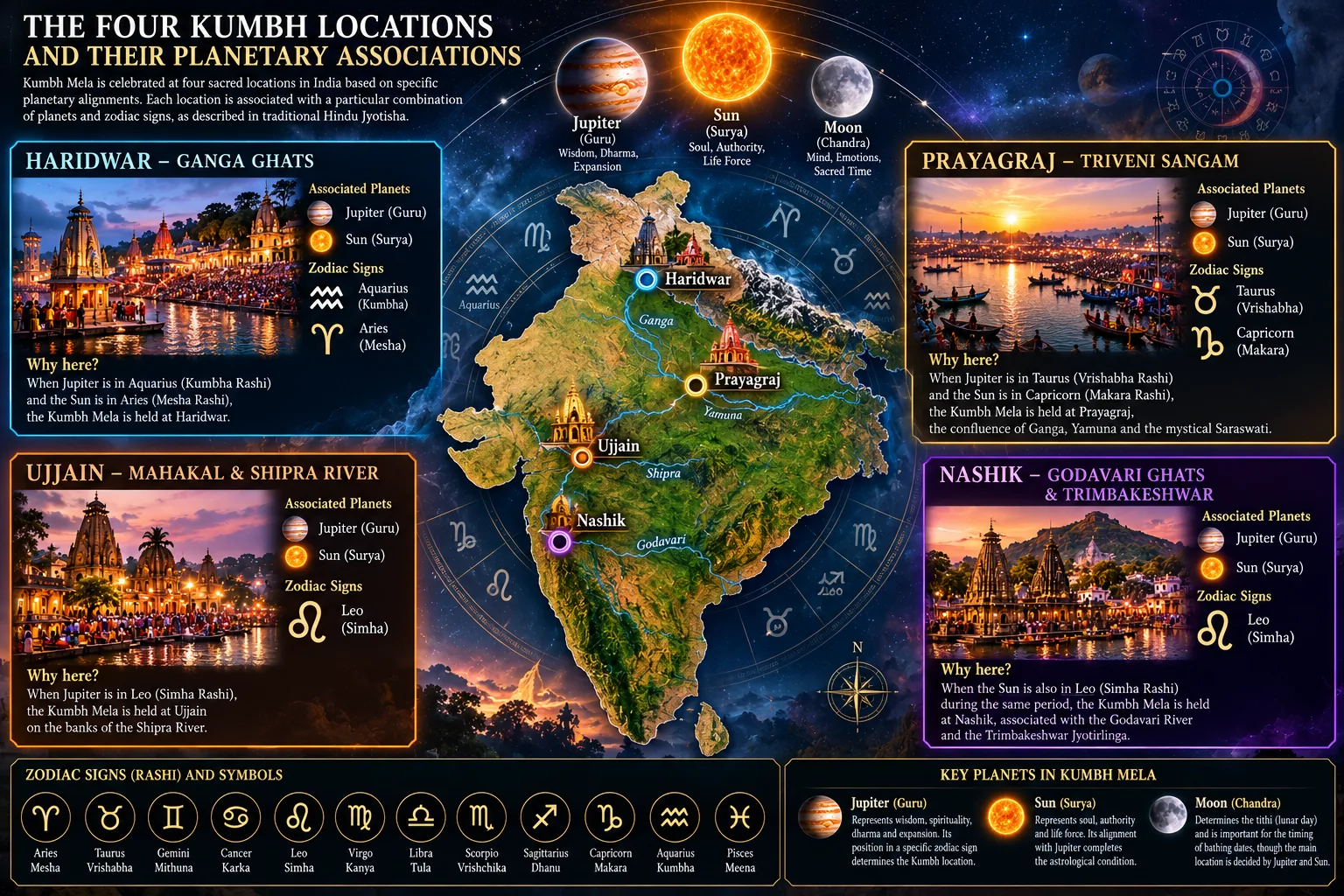
Traditional Planetary Associations of the Four Kumbh Locations
Different Kumbh traditions are associated with different combinations of Jupiter and the Sun.
| Kumbh Location | Traditional Jupiter Position | Traditional Solar Position |
|---|---|---|
| Prayagraj | Taurus (Vrishabha) | Capricorn (Makara) |
| Haridwar | Aquarius (Kumbha) | Aries (Mesha) |
| Ujjain | Leo (Simha) | Aries (Mesha) |
| Nashik | Leo (Simha) | Leo (Simha) |
These combinations form part of the traditional astrological framework associated with the four Kumbh centers.
The exact festival dates are then determined using the religious calendar and additional lunar conditions.
Prayagraj Kumbh
Prayagraj has a distinctive place in the Kumbh tradition because of the Triveni Sangam, where the Ganga, Yamuna, and traditionally believed Saraswati are said to meet.
Traditional Kumbh calculations associate Prayagraj with:
Jupiter → Taurus
Sun → Capricorn
The Kumbh period also overlaps with the sacred Magh season, during which bathing at the Sangam has special religious importance.
Important lunar dates further determine major Snan occasions.
Haridwar Kumbh
Haridwar is traditionally associated with:
Jupiter → Aquarius
Sun → Aries
Aquarius is called Kumbha in Sanskrit, meaning a pot or pitcher.
This creates a particularly strong symbolic connection between:
Kumbha → Aquarius → Jupiter → Kumbh
Haridwar's sacred identity is also deeply connected with the Ganga, making celestial timing and sacred geography part of a larger religious tradition.
Ujjain Simhastha
Ujjain's Kumbh is commonly known as Simhastha.
The traditional association is:
Jupiter → Leo
Sun → Aries
The word Simhastha comes from Simha, meaning Leo.
Ujjain's identity is also strongly connected with:
- The Shipra River
- Mahakaleshwar
- Shaiva traditions
- Ancient pilgrimage practices
Thus, astronomical tradition and religious identity come together in the Simhastha celebration.
Nashik Kumbh
Nashik's Kumbh is traditionally associated with:
Jupiter → Leo
Sun → Leo
Because Jupiter enters the sign of Leo, the gathering is also connected with the Simhastha tradition.
Nashik's sacred significance additionally comes from:
- The Godavari River
- Panchavati
- Ramayana traditions
- Long-standing pilgrimage practices
The planetary configuration therefore forms one part of a much larger sacred landscape.
What Role Does the Moon Play?
Jupiter and the Sun help identify the broader period, but the Moon becomes especially important when determining the specific bathing dates.
The Hindu lunar calendar uses several concepts.
Tithi
A tithi is a lunar day used in the Hindu calendar.
Amavasya
Amavasya is the new-moon day and is associated with several important ritual observances.
Purnima
Purnima is the full-moon day and is also considered significant for pilgrimage and religious practices.
Nakshatra
The Moon's position relative to the traditional nakshatras, or lunar constellations, can also be part of religious calendrical calculations.
Because of this, the broader Kumbh period and the exact Snan dates are determined through different layers of calendrical calculation.
Why Are Some Snan Dates More Important Than Others?
Kumbh does not have only one important bathing day.
Instead, the festival period contains several auspicious bathing occasions.
These can be associated with:
- Solar transitions
- Full-moon dates
- New-moon dates
- Specific lunar configurations
- Other important religious observances
This is why Kumbh calendars contain multiple major Snan dates rather than a single day.
The 12-Year Cycle: Mythology Meets the Sky
The number 12 has a special place in the Kumbh tradition.
Mythological Connection
According to the traditional Amrit story, the struggle between the Devas and Asuras continued for 12 divine days.
These are traditionally connected symbolically with 12 human years.
Celestial Connection
Jupiter takes approximately 12 years to travel through the zodiac.
These two ideas come together within the traditional understanding of Kumbh.
12 divine days
↓
12 symbolic human years
↓
Jupiter's approximately 12-year zodiac cycle
↓
Recurring Kumbh tradition
This is one of the strongest examples of how mythology and celestial time are woven together in the Kumbh narrative.
Is Kumbh Timing Astronomy or Astrology?
Both concepts need to be distinguished.
Astronomy
Astronomy deals with the observable and calculable movements of celestial bodies.
The positions of Jupiter, the Sun, and Moon can be mathematically calculated.
Astrology
The traditional use of those positions to determine auspicious religious periods belongs to Jyotisha and Hindu calendrical traditions.
So:
The celestial movement is observable.
Its religious interpretation is traditional astrology.
This distinction helps explain how Kumbh combines actual celestial cycles with centuries-old religious practices.
A Simple Way to Remember Kumbh Timing
Think of Kumbh timing as a three-layer celestial clock:
Jupiter
The long-cycle framework
Sun
The solar period
Moon
The lunar timing
Together with the Hindu calendar:
Jupiter + Sun + Moon + Hindu Calendar → Traditional Kumbh Timing
The exact calculations can be more complex, but this model makes the basic relationship easy to understand.
The Deeper Meaning of Celestial Timing
The celestial system is not only about calculating dates.
For devotees, it can also reinforce the idea that human life exists within a larger cosmic order.
The movement of celestial bodies becomes a reminder of:
- The passage of time
- The cycles of nature
- The relationship between the individual and the cosmos
- The importance of spiritually meaningful moments
- The continuity of ancient traditions
In this interpretation, Kumbh is not simply scheduled.
It is aligned with sacred time.
Final Reflection
The planetary alignments behind Kumbh dates reveal a fascinating relationship between the sky and the sacred.
At the center are three celestial forces:
Jupiter → The long-cycle framework
Sun → The solar rhythm
Moon → The lunar timing
Together with the Hindu calendar and location-specific traditions, they help determine the periods considered auspicious for Kumbh and its sacred baths.
The result is a tradition in which a pilgrimage on Earth is connected with a rhythm observed in the heavens.
Kumbh is therefore not just a festival on a calendar—it is a celebration traditionally timed through the relationship between celestial cycles, sacred time, and pilgrimage.
Photo Gallery
Visual highlights & moments from this story
1 / 3 Photos
Gallery
Planetary alignments (jupiter, sun, moon) behind kumbh dates
A digital illustration depicting the Kumbh Snan, showing a holy man bathing in a river at sunrise with images of deities above and spiritual text explaining the sacred ritual.
Page 1 of 3
Enhance Your Pilgrimage Experience
Mobile App
Read Kumbh Guides on Mobile
Download the Divya Kripa to read all 19 guides offline, receive real-time snan alerts, and access GPS-enabled navigation on the ground.
Download AppAI Assistant
Personalized Planner & Chatbot
Access your Kumbh Planner AI Assistant to receive tailored ritual advice, customized itineraries, and instant answers to spiritual questions.
Try AI Planner