All Blog Posts
HistoryRituals
What Are the Responsibilities of Akhadas at Kumbh Mela? Roles, Rituals and Traditions
K
Kumbh AdminOctober 8, 20267 min readWhat responsibilities do akhadas have at Kumbh Mela? Discover how these traditional religious orders preserve spiritual teachings, organise ascetic communities, participate in Amrit Snan, guide devotees, and help maintain the religious traditions of one of India's largest pilgrimage gatherings.
What Are the Responsibilities of Akhadas at Kumbh Mela?
When millions of pilgrims gather for Kumbh Mela, the event requires more than bathing ghats and temporary settlements. It also brings together religious institutions that preserve centuries-old spiritual traditions.
Among the most important are the akhadas—organised communities of Hindu ascetics, saints, monks, and spiritual practitioners.
Their responsibilities extend beyond participating in ceremonial processions. Akhadas maintain religious lineages, guide their members, conduct spiritual activities, and coordinate their participation in important Kumbh rituals.
But what do these responsibilities involve, and who manages the practical arrangements for the wider gathering?
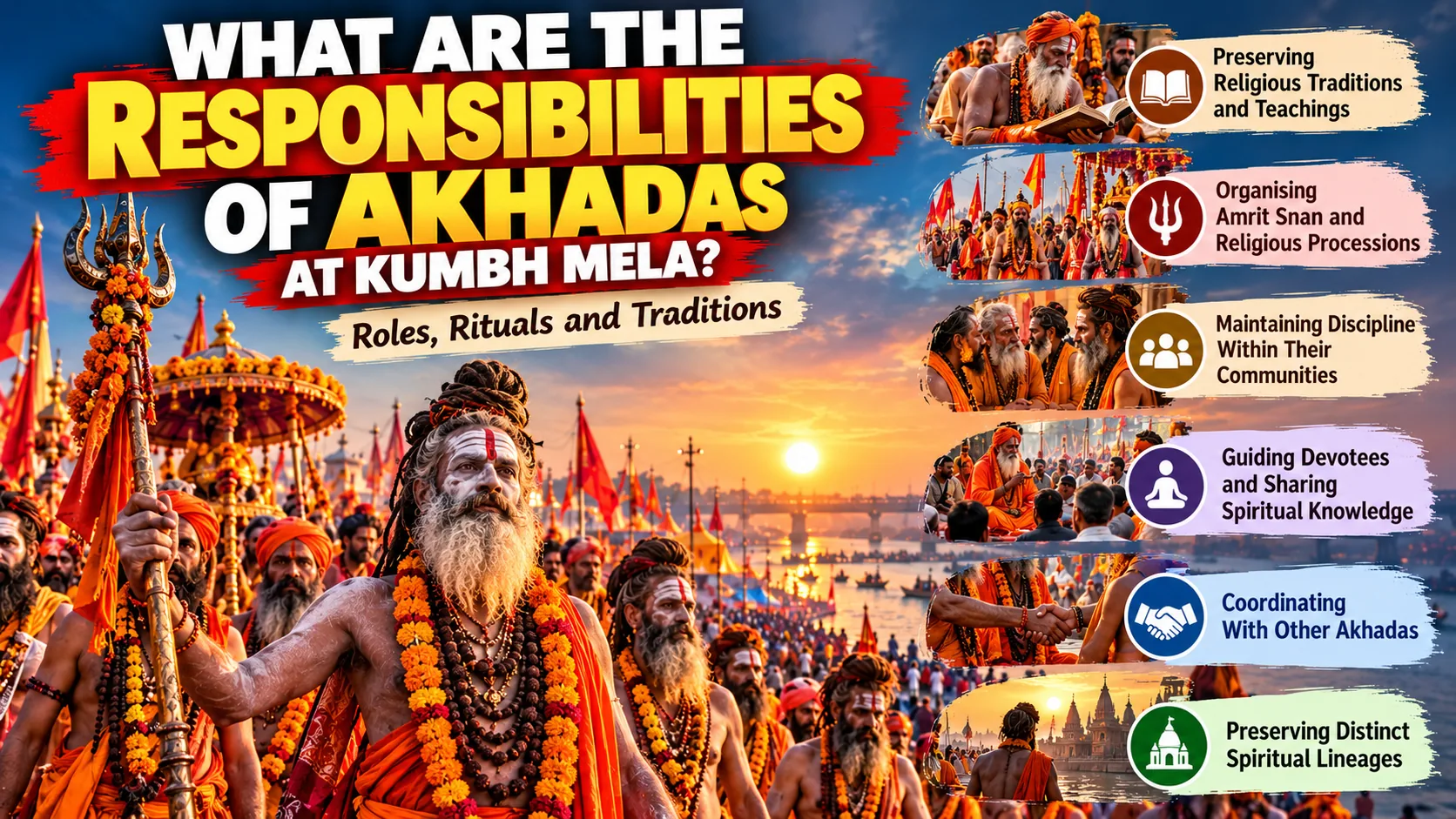
1. Preserving Religious Traditions and Teachings
One of the central responsibilities of an akhada is to preserve and pass on its religious tradition.
Different akhadas follow distinct spiritual lineages, practices, and systems of religious learning. Their teachers and senior ascetics help younger members understand the teachings and disciplines associated with their order.
Their activities may include:
- Studying Hindu scriptures and religious philosophy.
- Conducting spiritual discourses and devotional gatherings.
- Preserving traditional rituals and ceremonies.
- Passing teachings from experienced ascetics to newer members.
Through these activities, akhadas help maintain the diversity of religious traditions represented at Kumbh Mela.
2. Organising Amrit Snan and Religious Processions
Amrit Snan is among the most prominent ceremonial events associated with Kumbh Mela.
Akhadas participate in organised processions and sacred bathing according to the programme established for the particular gathering.
Their responsibilities can include coordinating their members, preparing ceremonial processions, observing customary order, and following arrangements agreed upon with other religious groups and the Mela administration.
The processions allow visitors to witness the distinct customs and identities of different akhadas.
The sequence, timing, routes, and bathing arrangements can vary between Kumbh locations and individual events. They should not be assumed to be identical at Prayagraj, Haridwar, Ujjain, and Nashik–Trimbakeshwar.
3. Maintaining Discipline Within Their Communities
Akhadas have their own leadership structures and internal rules.
Senior religious leaders guide their members in matters involving spiritual practice, conduct, ceremonies, and community discipline.
Depending on the tradition, these responsibilities may involve:
- Guiding ascetics in their religious practices.
- Maintaining customary rules within the akhada.
- Organising participation in religious events.
- Supporting the training and initiation of new members.
- Resolving internal disagreements through established leadership.
The exact rules differ between akhadas. Their internal organisation is separate from the legal authority of government agencies and the Mela administration.
4. Guiding Devotees and Sharing Spiritual Knowledge
Kumbh Mela brings together people who may have travelled long distances seeking spiritual guidance.
Akhada camps can provide opportunities for devotees to listen to religious discourses, meet spiritual teachers, and learn about different Hindu traditions.
Depending on the camp and programme, activities may include:
- Spiritual discussions and religious lectures.
- Prayer and devotional gatherings.
- Guidance on religious customs and practices.
- Opportunities to learn about ascetic life and renunciation.
Not every akhada provides the same services, and access to individual camps depends on their rules and arrangements.
For visitors, these interactions can offer a deeper understanding of the spiritual traditions behind Kumbh Mela.
5. Coordinating With Other Akhadas
Kumbh Mela brings together religious orders with different histories, customs, and leadership structures. Coordinating their participation is therefore important.
The Akhil Bharatiya Akhara Parishad (ABAP) serves as a representative and coordinating body for recognised akhadas. It has played an important role in discussions concerning ceremonial arrangements, relations between akhadas, and issues affecting the wider ascetic community.
Coordination may involve:
- Discussing ceremonial bathing arrangements.
- Representing akhadas in discussions with the authorities.
- Addressing disagreements between participating groups.
- Communicating decisions concerning shared religious events.
Individual akhadas retain their own leadership and identity. The Parishad's role should not be confused with the government's responsibility for running the entire Mela.
6. Preserving Distinct Spiritual Lineages
The akhadas are not one uniform organisation. They represent different religious traditions and communities.
Shaiva akhadas are associated with traditions centred on Lord Shiva. Vaishnava akhadas follow devotional traditions centred on Lord Vishnu and his forms. Udasin and Nirmal traditions have their own distinct histories and practices.
Each order preserves its own lineage, religious customs, and organisational identity.
This diversity is an important part of Kumbh Mela. The gathering brings different communities together without erasing their individual traditions.
7. Supporting Ascetics and Community Welfare
Akhadas also maintain communities of ascetics who need places to stay, opportunities for religious practice, and support for their daily activities.
Depending on their resources and arrangements, an akhada may organise accommodation for its members, food, religious supplies, and facilities for gatherings during Kumbh.
Some religious institutions also undertake charitable or community-service activities, although the nature and scale of these efforts vary.
These internal arrangements help ascetics participate in the gathering while continuing their religious practices.
8. What Responsibilities Belong to the Mela Administration?
It is important to distinguish the responsibilities of religious akhadas from those of the government and the Mela administration.
Akhadas organise their religious activities and coordinate the participation of their communities. The administration manages public infrastructure and the wider operation of the event.
| Responsibility | Primary role |
|---|---|
| Religious teachings and internal practices | Individual akhadas and their spiritual leaders |
| Internal organisation of ascetics | Individual akhadas |
| Coordination among recognised akhadas | Akhil Bharatiya Akhara Parishad and relevant representatives |
| Public roads, bridges, and bathing infrastructure | Government and Mela administration |
| Public security and crowd management | Police, security agencies, and Mela authorities |
| Public sanitation and waste management | Government departments and designated service teams |
| Emergency response and public health arrangements | Relevant government and emergency agencies |
Akhadas and religious representatives may coordinate with the authorities and encourage responsible conduct among their members and visitors. However, they do not replace the public agencies responsible for safety, sanitation, infrastructure, and emergency services.
9. Why Are Akhadas Important for Kumbh Mela 2027?
As pilgrims prepare for the upcoming Kumbh-related gatherings, understanding the role of akhadas can make the experience more meaningful.
At Nashik–Trimbakeshwar Simhastha in 2027, as at other Kumbh locations, religious orders form an important part of the gathering's ceremonial and spiritual identity.
Visitors interested in seeing processions or attending religious discourses should check the official programme, local access arrangements, and announcements from the relevant authorities.
Respect the instructions of camp organisers, avoid restricted areas, and seek permission before photographing people or private religious activities.
Conclusion: Akhadas Preserve the Spiritual Heart of Kumbh Mela
Akhadas help sustain Kumbh Mela's religious traditions by preserving spiritual teachings, guiding ascetics, organising ceremonies, and coordinating participation in major bathing events.
Their role is distinct from that of the Mela administration, which is responsible for the infrastructure, security, sanitation, and public services required by a gathering of this scale.
Together, religious institutions, public authorities, service organisations, and pilgrims contribute to the functioning of Kumbh Mela.
Understanding these responsibilities helps visitors see the event not only as a vast pilgrimage, but also as a meeting of religious traditions, institutions, and communities.
Stay Connected with Kumbh Connect
Want to understand the traditions behind Kumbh Mela 2027?
Visit https://kumbhconnect.com to explore guides about akhadas, Naga Sadhus, sacred bathing ceremonies, pilgrimage destinations, and travel planning.
Continue learning about the people and traditions that make Kumbh Mela significant.
Understand the traditions. Explore the sacred destinations. Stay connected with Kumbh Connect.
Frequently Asked Questions
What is the main responsibility of an akhada at Kumbh Mela?
Akhadas preserve religious traditions, guide their members, conduct spiritual activities, and organise participation in ceremonial events such as Amrit Snan.
Who coordinates the different akhadas?
The Akhil Bharatiya Akhara Parishad represents and coordinates recognised akhadas on certain shared matters. Individual akhadas retain their own leadership structures.
Do akhadas manage the entire Kumbh Mela?
No. The Mela administration and government agencies manage public infrastructure, security, sanitation, traffic, and emergency arrangements. Akhadas primarily manage their religious communities and activities.
Do akhadas provide spiritual guidance to visitors?
Some organise religious discourses, prayer gatherings, and opportunities to meet spiritual teachers. Activities and visitor access vary by akhada and camp.
What role do akhadas play during Amrit Snan?
They coordinate the participation of their members in ceremonial processions and sacred bathing according to the arrangements for the particular Kumbh.
Are all akhadas responsible for the same activities?
No. Their traditions, internal rules, religious practices, and organisational arrangements differ.
Enhance Your Pilgrimage Experience
Mobile App
Read Kumbh Guides on Mobile
Download the Divya Kripa to read all 19 guides offline, receive real-time snan alerts, and access GPS-enabled navigation on the ground.
Download AppAI Assistant
Personalized Planner & Chatbot
Access your Kumbh Planner AI Assistant to receive tailored ritual advice, customized itineraries, and instant answers to spiritual questions.
Try AI PlannerRelated Articles



Loading discussion & reviews...