All Blog Posts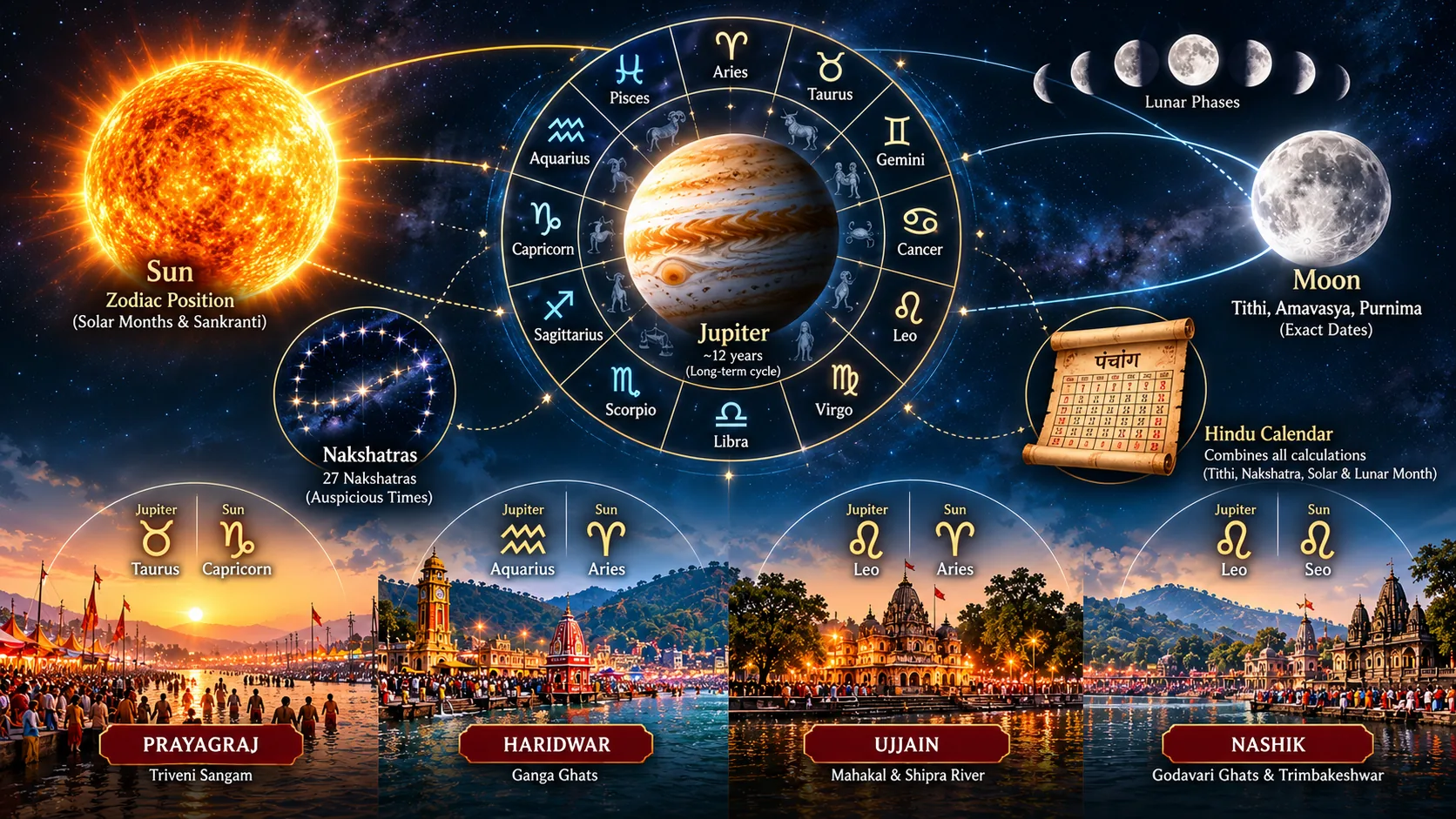
CultureSpirituality
How Kumbh dates are calculated and fixed
K
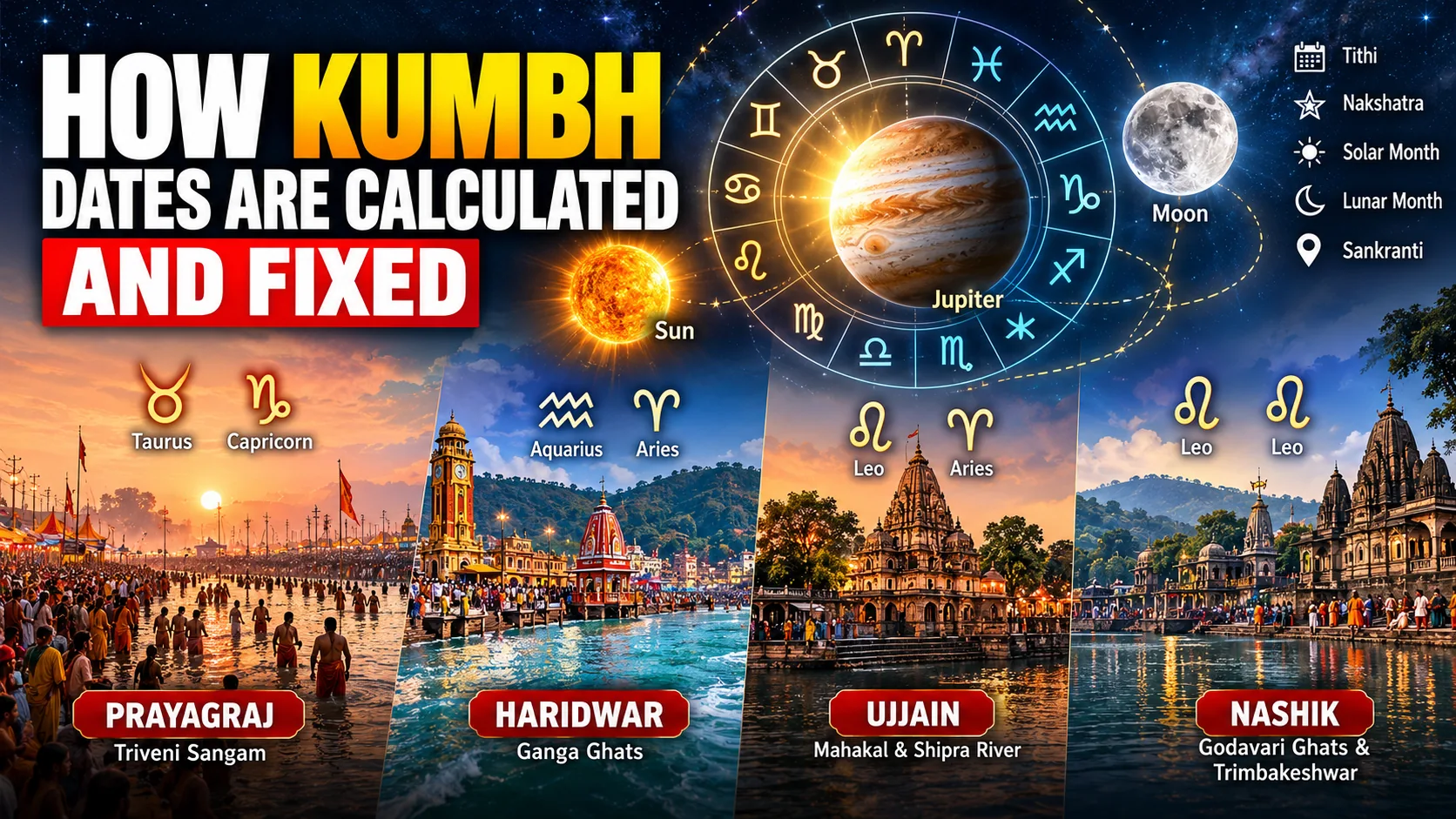
Kumbh AdminOctober 21, 20268 min readKumbh Mela dates are not fixed like an annual festival. They are traditionally determined through a combination of Jupiter's zodiac position, the Sun's position, lunar dates, Hindu calendrical calculations, and established pilgrimage traditions. These factors help identify the year, period, and important Snan dates of each Kumbh.
How Kumbh Dates Are Calculated and Fixed
Kumbh Mela is one of the largest religious gatherings in the world, but unlike festivals celebrated on the same date every year, its dates follow a complex traditional calendar.
The dates of Kumbh are traditionally determined through a combination of Jupiter's movement, the Sun's zodiac position, lunar calculations, tithis, nakshatras, and the Hindu calendar.
This is why Kumbh does not simply occur on a fixed Gregorian date every 12 years.
Why Kumbh Does Not Have a Fixed Date
Many festivals follow a particular date in the Gregorian calendar. Kumbh is different.
Its timing is connected to the movements of celestial bodies and the traditional Hindu lunisolar calendar.
The broad cycle is influenced by Jupiter's approximately 12-year journey through the zodiac, while the exact period and important bathing dates depend on additional solar and lunar calculations.
A simplified way to understand the process is:
Jupiter → Long-term cycle
Sun → Solar position
Moon → Lunar dates and tithis
Hindu Calendar → Combines the calculations
Traditional Kumbh system → Determines the appropriate period and Snan dates
Step 1: Jupiter Establishes the Long-Term Cycle
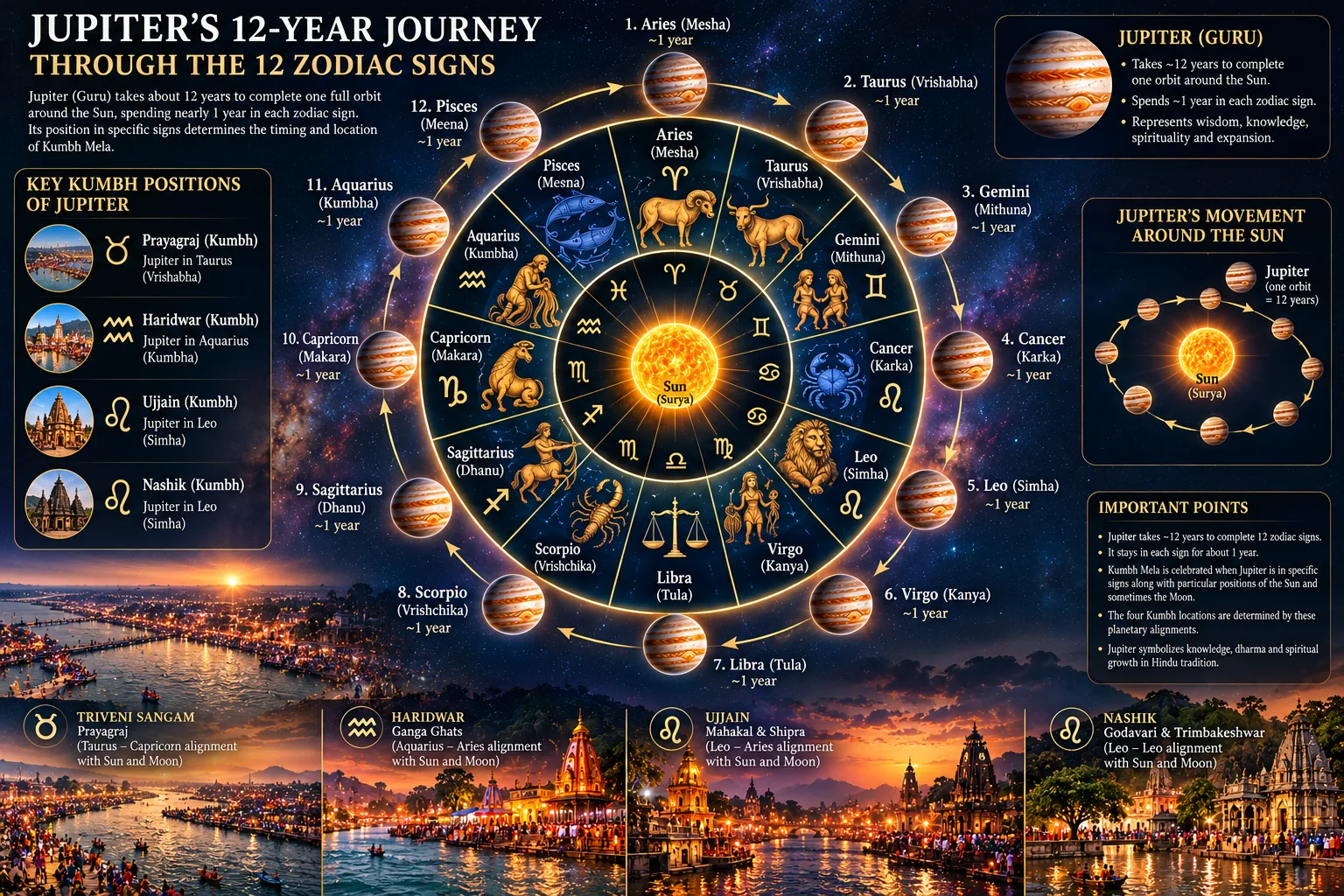
Jupiter, known as Brihaspati in Hindu tradition, is one of the most important planets in traditional Kumbh calculations.
Jupiter takes approximately 12 years to travel through the twelve zodiac signs.
This creates the broad recurring cycle associated with Kumbh.
As Jupiter moves from one zodiac sign to another, different traditional combinations become relevant to the four Kumbh locations.
The approximate cycle can be understood as:
12 zodiac signs → approximately 12 years → recurring Jupiter cycle
However, Kumbh should not be understood as simply "every 12 years." The actual timing depends on the complete traditional calendrical framework.
Step 2: The Sun's Zodiac Position Is Considered
The position of the Sun (Surya) is another important factor.
The Sun moves through the zodiac during the year, creating the traditional solar months and important transitions known as Sankranti.
For Kumbh traditions, the Sun's position is considered together with Jupiter's position.
For example, traditional associations include:
| Kumbh Location | Jupiter | Sun |
|---|---|---|
| Prayagraj | Taurus (Vrishabha) | Capricorn (Makara) |
| Haridwar | Aquarius (Kumbha) | Aries (Mesha) |
| Ujjain | Leo (Simha) | Aries (Mesha) |
| Nashik | Leo (Simha) | Leo (Simha) |
These planetary combinations form part of the traditional framework used for associating Kumbh with its four pilgrimage locations.
Step 3: The Lunar Calendar Determines Specific Dates
The broad planetary configuration identifies the relevant period, but the exact bathing dates require lunar calculations.
The Moon is used in the Hindu lunisolar calendar to determine:
- Tithi
- Amavasya
- Purnima
- Nakshatra
- Other important lunar-calendar positions
This is why a Kumbh period can contain several different important Snan dates.
A major bathing occasion may fall on Amavasya, Purnima, or another traditionally significant tithi.
Step 4: Tithi Helps Fix the Exact Day
A tithi is a lunar day used in the traditional Hindu calendar.
Tithis are not exactly the same as a 24-hour civil day because they are calculated from the changing angular relationship between the Sun and Moon.
This means that determining the correct Gregorian date for a particular religious observance requires astronomical calculations.
For example, if a traditionally important Snan is associated with a particular tithi, calendar calculations determine when that tithi occurs at the relevant location.
Therefore:
Celestial positions → Tithi → Local calendar date → Snan date
Step 5: Nakshatras Add Another Layer
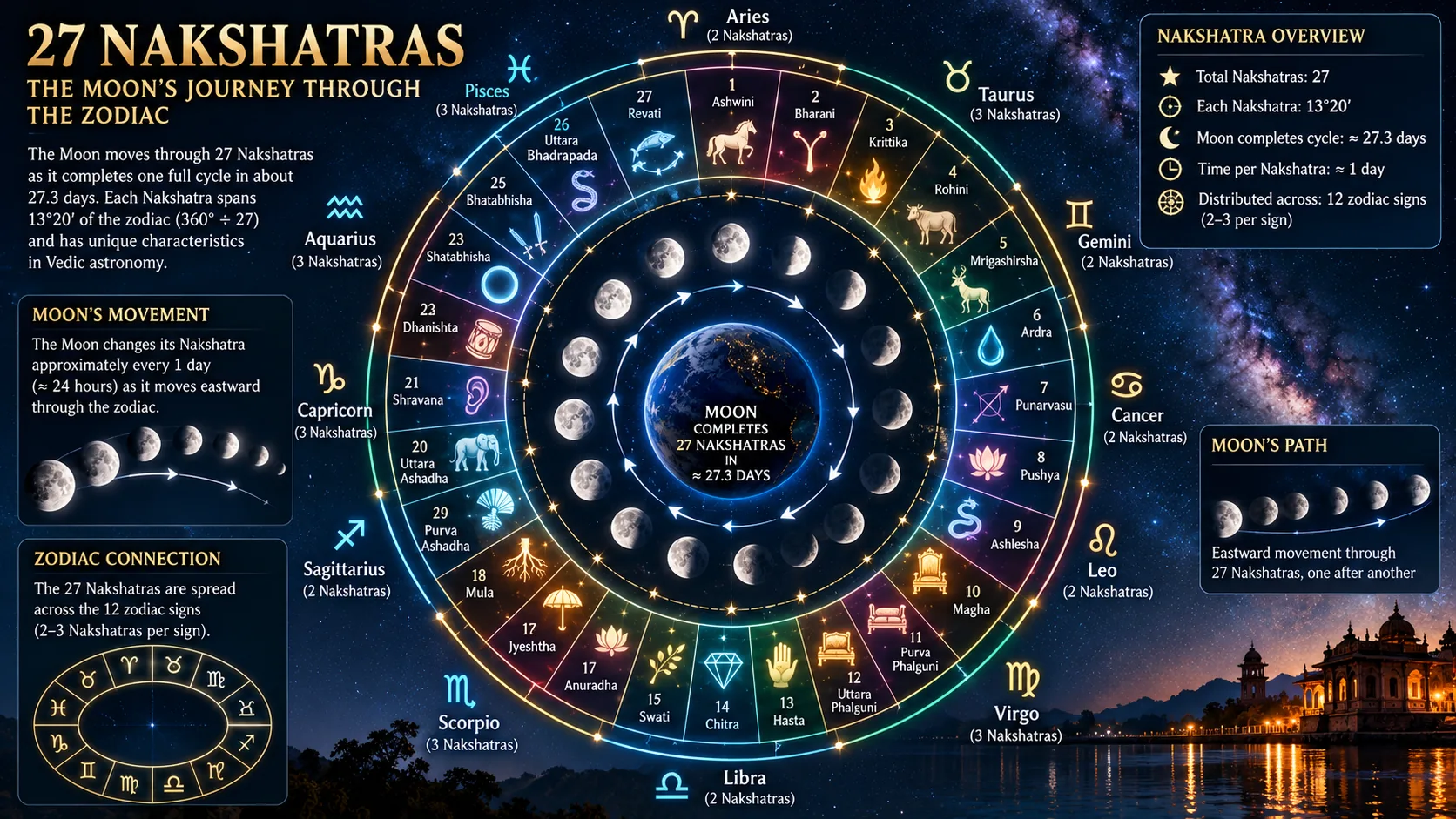
The Moon's position relative to the traditional 27 Nakshatras can also be relevant to Hindu calendrical calculations.
Nakshatras divide the ecliptic into 27 sections and are used in traditional Jyotisha for determining auspicious times.
When important lunar dates coincide with significant celestial configurations, they can become particularly important for religious observances.
This contributes to the selection of important bathing occasions during Kumbh.
Step 6: The Hindu Calendar Brings Everything Together
Kumbh calculations are not based on one astronomical event.
Traditional calendar calculations bring together several elements:
- Jupiter's zodiac position
- Sun's zodiac position
- Moon's position
- Tithi
- Nakshatra
- Solar month
- Lunar month
- Sankranti
- Local sunrise and sunset
- Traditional rules associated with the particular Kumbh location
Together, these calculations identify the appropriate period for the festival and its major bathing occasions.
Step 7: Local Sunrise Can Affect the Observance
Religious calendars often use local sunrise as an important reference point.
A tithi may begin on one civil date and end on another. Therefore, simply looking at a standard astronomical timestamp is not enough to determine the religious date.
The calendar calculation considers the relevant location and the rules for observing the particular tithi.
This is one reason why Kumbh dates need to be calculated rather than simply copied from a repeating 12-year cycle.
Step 8: The Major Snan Dates Are Identified
Once the broader Kumbh period is established, important bathing dates are identified.
These may include traditionally significant occasions such as:
- Makar Sankranti
- Mauni Amavasya
- Basant Panchami
- Maghi Purnima
- Mahashivratri
The exact importance and inclusion of particular dates varies according to the Kumbh being held and the traditional calendar for that year.
For millions of pilgrims, these dates represent especially important opportunities to perform Kumbh Snan.
Why Do Kumbh Dates Sometimes Shift?
Kumbh dates can appear to move significantly when viewed through the Gregorian calendar.
This happens because the traditional system is not based exclusively on the Gregorian calendar.
Instead, it follows celestial cycles and the Hindu lunisolar calendar.
For example:
Gregorian calendar → fixed solar civil calendar
Hindu calendar → lunisolar system
Because the two systems operate differently, an important Kumbh observance can occur on different Gregorian dates in different cycles.
Why the 12-Year Cycle Is Only an Approximation
It is common to hear that Kumbh occurs every 12 years.
This is useful for understanding the broad cycle, but it is not the complete calculation.
Jupiter's orbital period and its apparent movement through the zodiac do not correspond to exactly twelve Gregorian years.
Additionally, the Hindu calendar contains lunar and solar adjustments.
Therefore, the actual Kumbh timing requires a combination of:
Jupiter's cycle + Solar positions + Lunar calculations + Hindu calendar rules
rather than simply adding 12 years to the previous festival.
A Simple Example of the Calculation
Imagine that the traditional system identifies a particular year as suitable for Kumbh at a specific location because the required Jupiter-Sun relationship occurs.
The process can then be simplified as:
1. Identify Jupiter's position
Jupiter reaches the zodiac sign associated with the particular Kumbh tradition.
2. Check the Sun's position
The Sun reaches the corresponding zodiac position required by the traditional calculation.
3. Calculate the lunar dates
Astronomical calculations determine tithis, Amavasya, Purnima and other relevant lunar events.
4. Apply the Hindu calendar
The relevant lunar and solar months are identified.
5. Determine important Snan dates
The traditionally significant bathing occasions are calculated for the location.
6. Convert the dates to the civil calendar
The resulting dates are expressed in the Gregorian calendar so that pilgrims, authorities, and visitors can plan for the event.
Who Actually Fixes the Final Dates?
The astronomical positions provide the basis for traditional calendar calculations, but the final publicly announced Kumbh schedule is established through the relevant religious authorities, traditional scholars, Panchang calculations, and local administration according to the traditions governing that Kumbh.
Different traditions and calendars can sometimes use slightly different methods or interpretations.
Therefore, the officially announced schedule is the practical reference for pilgrims.
Kumbh Dates Are a Combination of Science, Calendar and Tradition
It is useful to separate three different ideas.
Astronomy
Astronomy provides the measurable positions and movements of celestial bodies such as Jupiter, the Sun, and the Moon.
Traditional Jyotisha
Jyotisha interprets celestial positions within a traditional Indian calendrical and religious framework.
Hindu Calendar
The Panchang converts these astronomical relationships into practical dates based on tithi, nakshatra, solar and lunar months, and other calendar elements.
Kumbh timing emerges from the interaction of all three within the established religious tradition.
The Complete Kumbh Date Cycle
The entire process can be remembered through this simple sequence:
Jupiter's Cycle
↓
Zodiac Combination
↓
Sun's Position
↓
Moon's Position
↓
Tithi and Nakshatra
↓
Hindu Lunisolar Calendar
↓
Important Snan Dates
↓
Official Kumbh Schedule
This is why Kumbh dates are not simply chosen by counting twelve years from the previous celebration.
The Deeper Meaning of Kumbh Timing
For devotees, the calculation of Kumbh dates represents more than calendar mathematics.
The festival is traditionally understood as a meeting point between cosmic time and sacred time.
The movement of planets establishes the larger cycle. The Sun and Moon help define the calendar. Sacred traditions identify auspicious periods. Finally, millions of pilgrims gather at the sacred rivers for bathing, prayer, meditation, charity, and spiritual practice.
In this sense, Kumbh transforms the movement of time into a sacred occasion.
The date on the calendar is therefore only the visible result of a much larger traditional system connecting the cosmos, the calendar, sacred geography, mythology, and pilgrimage.
Enhance Your Pilgrimage Experience
Mobile App
Read Kumbh Guides on Mobile
Download the Divya Kripa to read all 19 guides offline, receive real-time snan alerts, and access GPS-enabled navigation on the ground.
Download AppAI Assistant
Personalized Planner & Chatbot
Access your Kumbh Planner AI Assistant to receive tailored ritual advice, customized itineraries, and instant answers to spiritual questions.
Try AI PlannerRelated Articles



Loading discussion & reviews...