All Blog Posts
EngagementAwareness
Maha Kumbh vs Purna vs Ardh timing - Rare Alignments and Maha Kumbh Significance
K
Kumbh AdminOctober 24, 20269 min readKumbh Mela is not a single festival that simply repeats every 12 years. The traditions of Ardh Kumbh, Purna Kumbh, and Maha Kumbh describe different cycles and levels of significance, with timing linked to celestial positions and the Hindu calendar. The idea of a rare 144-year Maha Kumbh is especially associated with the completion of twelve Purna Kumbh cycles.
Maha Kumbh vs Purna Kumbh vs Ardh Kumbh: Timing, Rare Alignments and Significance
Kumbh Mela follows one of the most fascinating recurring cycles in Hindu pilgrimage tradition.
You may have heard the terms:
- Ardh Kumbh
- Purna Kumbh
- Maha Kumbh
They are often used interchangeably in popular discussions, but traditionally they refer to different points in the broader Kumbh cycle.
The simplest way to understand the cycle is:
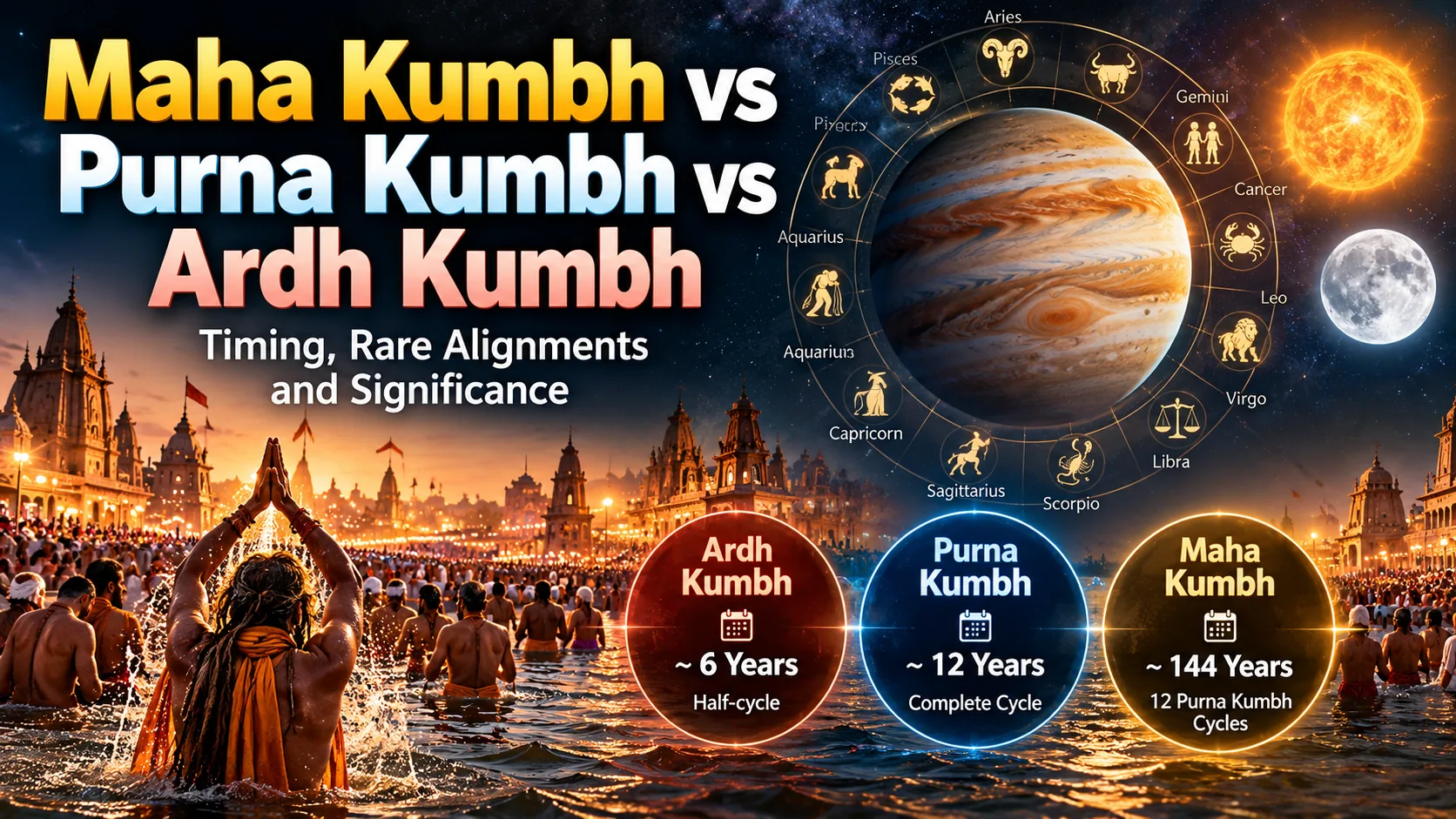
Ardh Kumbh → approximately 6 years
Purna Kumbh → approximately 12 years
Maha Kumbh → traditionally associated with 12 Purna Kumbh cycles, or approximately 144 years
However, the actual timing of Kumbh is not determined by simply counting years. The positions of Jupiter, the Sun and the Moon, together with Hindu calendrical calculations and location-specific traditions, are important in determining the festival period.
What Is Ardh Kumbh?
The word Ardh means "half."
Ardh Kumbh is traditionally associated with an interval of approximately six years within the broader Kumbh cycle.
Government sources describe Ardh Kumbh as a six-year cycle, particularly associated with Haridwar and Prayagraj. :chatgpt-content-reference{index="0"}
The six-year interval can therefore be understood as approximately half of the traditional 12-year Jupiter-linked cycle.
Simple calculation
12-year Purna Kumbh cycle ÷ 2 = approximately 6 years
Ardh Kumbh therefore represents an important midpoint in the broader Kumbh tradition.
It is still a major pilgrimage gathering, with sacred bathing, religious ceremonies, saints, akharas, spiritual discourses and millions of devotees participating.
What Is Purna Kumbh?
Purna means "complete" or "full."
A Purna Kumbh is traditionally associated with the approximately 12-year cycle.
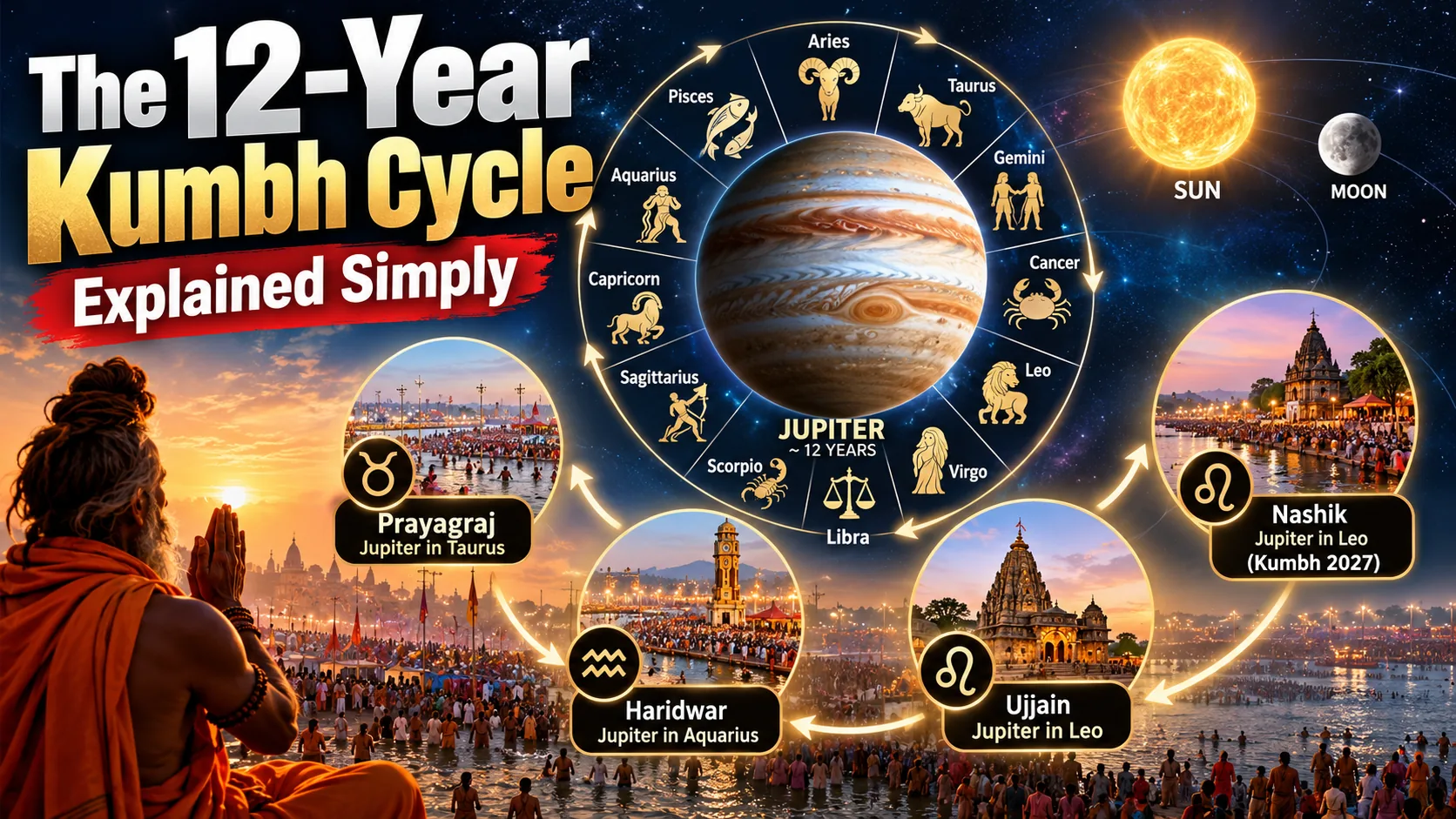
The cycle is connected with Jupiter's movement through the zodiac. Jupiter takes roughly 12 years to complete its journey through the twelve zodiac signs, making it an important marker in traditional Kumbh calculations. :chatgpt-content-reference{index="1"}
The 12-year cycle is therefore more than simply:
Previous Kumbh + 12 years
The actual period is identified through the relevant celestial configurations and Hindu calendar calculations.
The Sun, Moon and Jupiter are traditionally considered together when determining Kumbh timing. :chatgpt-content-reference{index="2"}
What Is Maha Kumbh?
The term Maha Kumbh means "Great Kumbh."
In the traditional 144-year interpretation, a Maha Kumbh represents the completion of 12 Purna Kumbh cycles.
The simplified calculation is:
1 Purna Kumbh ≈ 12 years
12 Purna Kumbhs × 12 years ≈ 144 years
This is why Maha Kumbh is traditionally described as an exceptionally rare occurrence.
A Government of India cultural publication has described Maha Kumbh in this 144-year framework. :chatgpt-content-reference{index="3"}
However, terminology around "Maha Kumbh" has not always been used uniformly. Government material has documented changes in how certain Kumbh gatherings were named, so historical and regional usage should be treated carefully. :chatgpt-content-reference{index="4"}
The Three Cycles at a Glance
| Kumbh Type | Approximate Traditional Interval | Basic Meaning |
|---|---|---|
| Ardh Kumbh | 6 years | Half-cycle |
| Purna Kumbh | 12 years | Complete major cycle |
| Maha Kumbh | 144 years | Traditional completion of 12 Purna Kumbh cycles |
The intervals are useful for understanding the traditional cycle, but they should not be treated as simple Gregorian-calendar formulas.
Why Is Jupiter Connected With the Cycle?
Jupiter, known as Brihaspati, is particularly important because of its approximately 12-year journey through the zodiac.
The zodiac contains twelve traditional signs:
Aries → Taurus → Gemini → Cancer → Leo → Virgo → Libra → Scorpio → Sagittarius → Capricorn → Aquarius → Pisces
Jupiter moves through this zodiac cycle over approximately twelve years.
This provides the broad celestial rhythm associated with Purna Kumbh.
Why Are the Sun and Moon Also Important?
Jupiter alone does not determine the complete Kumbh calendar.
Traditional Kumbh calculations also consider the Sun and Moon.
The Sun helps establish the solar position and important Sankranti periods.
The Moon is important for determining:
- Tithi
- Amavasya
- Purnima
- Nakshatra
- Other lunar-calendar dates
These calculations help identify specific auspicious bathing occasions within the broader Kumbh period.
The Government of India describes Kumbh timing as being connected with the positions of the Sun, Moon and Jupiter. :chatgpt-content-reference{index="5"}
What Makes an Alignment "Rare"?
The rarity comes from the fact that several celestial and calendrical conditions must come together within the traditional framework.
It is not simply that Jupiter returns to the same zodiac sign.
The calculations can involve:
Jupiter's zodiac position
Sun's zodiac position
Moon's position
Tithi
Nakshatra
Traditional location-specific rules
When the required conditions occur, the corresponding Kumbh period is identified.
This is why Kumbh dates cannot be predicted accurately by simply adding six or twelve years to the previous festival date.
Why Are There Four Kumbh Locations?
The Kumbh tradition is associated with four major pilgrimage centres:
Prayagraj
Located at the Triveni Sangam, where the Ganga, Yamuna and traditionally believed Saraswati meet.
Haridwar
Located on the banks of the Ganga.
Nashik–Trimbakeshwar
Associated with the sacred Godavari and the Simhastha tradition.
Ujjain
Located on the banks of the Shipra and also associated with Simhastha.
Each location has its own traditional celestial combination.
The Nashik district's official cultural information, for example, describes Kumbh as rotating among the four locations according to particular celestial alignments. :chatgpt-content-reference{index="6"}
Maha Kumbh and the 144-Year Idea
The traditional 144-year concept can be visualized as a much larger cycle.
First Purna Kumbh
Approximately 12 years after the previous major cycle.
Second Purna Kumbh
Another approximately 12 years.
Third Purna Kumbh
Another approximately 12 years.
And so on.
After twelve such cycles:
12 × 12 ≈ 144 years
The completion of this larger cycle is traditionally associated with Maha Kumbh.
Why Was Maha Kumbh 2025 Called Special?
The 2025 Prayagraj gathering was officially promoted as Maha Kumbh, and Government of India material described it as a Maha Kumbh held from 13 January to 26 February 2025. :chatgpt-content-reference{index="7"}
The 2025 event was therefore presented within the 144-year Maha Kumbh tradition.
This is an important distinction when discussing the upcoming 2027 Nashik–Trimbakeshwar Simhastha Kumbh: the two events should not be treated as the same type of Kumbh simply because both belong to the wider Kumbh tradition.
Maharashtra's official authorities are currently preparing for Simhastha Kumbh Mela 2027 in Nashik and Trimbakeshwar. :chatgpt-content-reference{index="8"}
Where Does Kumbh 2027 Fit?
The upcoming Nashik–Trimbakeshwar Simhastha Kumbh 2027 belongs to the recurring Kumbh cycle associated with Nashik and Trimbakeshwar.
Official Maharashtra government sources identify the event as Simhastha Kumbh Mela 2027 and have established the Nashik–Trimbakeshwar Kumbh Mela Authority to coordinate its preparation. :chatgpt-content-reference{index="9"}
The Nashik tradition is called Simhastha because of its association with Simha (Leo) in traditional Jyotisha.
The upcoming 2027 event should therefore be understood as part of the recurring Kumbh cycle rather than as the 144-year Maha Kumbh itself.
A Simple Timeline
The broader traditional cycle can be visualized like this:
Year 0
Purna Kumbh
↓
~6 years
Ardh Kumbh
↓
~6 more years
Purna Kumbh
↓
~12 years
Next Purna Kumbh cycle
↓
Repeated cycles
↓
12 Purna Kumbh cycles
↓
~144 years
Maha Kumbh tradition
The exact festivals and terminology vary by location and historical tradition, so this timeline is a simplified way to understand the recurring cycle.
Ardh, Purna and Maha: What Is the Difference?
The easiest way to remember the difference is:
Ardh Kumbh
Ardh = Half
Approximately six-year interval.
Purna Kumbh
Purna = Complete
Approximately twelve-year major cycle.
Maha Kumbh
Maha = Great
Traditionally associated with the completion of twelve Purna Kumbh cycles, approximately 144 years.
Is Maha Kumbh Only About the Number 144?
No.
The 144-year number explains the traditional long-cycle concept, but the spiritual significance of Maha Kumbh comes from much more than arithmetic.
Kumbh is built around:
- Sacred rivers
- Pilgrimage
- Spiritual practices
- Akharas
- Sadhus and ascetics
- Religious discourses
- Sacred bathing
- Charity
- Hindu mythology
- Celestial and calendrical traditions
The rare cycle adds another layer of significance to an already important pilgrimage tradition.
The Mythological Meaning of the Rare Cycle
The story of Kumbh is traditionally connected with Samudra Manthan, the churning of the cosmic ocean.
During the struggle over the Amrit Kalash, the pot containing the nectar of immortality, drops of Amrit are traditionally believed to have fallen at four locations:
- Prayagraj
- Haridwar
- Nashik
- Ujjain
These places subsequently became associated with the Kumbh tradition.
The 12-year and 144-year cycles therefore exist within a much larger mythological framework.
Why the 144-Year Cycle Is Symbolically Powerful
A period of approximately 144 years represents several generations.
Most people will never experience two complete 144-year cycles during their lifetime.
This gives the Maha Kumbh tradition a powerful sense of rarity and continuity.
It connects one generation with another:
Ancestors → Present generation → Future generations
A gathering becomes not merely a recurring festival but part of a much longer cultural memory.
The Complete Kumbh Cycle in One Picture
The easiest way to understand the relationship is:
Jupiter's approximately 12-year cycle
↓
Purna Kumbh
↓
Halfway point: approximately 6 years
↓
Ardh Kumbh
↓
Repeated 12-year cycles
↓
12 Purna Kumbh cycles
↓
Approximately 144 years
↓
Maha Kumbh tradition
But behind these intervals are the actual astronomical and calendrical calculations involving the Sun, Moon, Jupiter, tithi, nakshatra and location-specific traditions.
Kumbh 2027: The Next Major Focus
For people planning ahead, the next major Kumbh focus is Nashik–Trimbakeshwar Simhastha Kumbh 2027.
The Maharashtra government has established a dedicated authority and administrative framework for the 2027 event, including infrastructure, sanitation, safety, transport and pilgrim-facilitation planning. :chatgpt-content-reference{index="10"}
Understanding the difference between Ardh, Purna and Maha Kumbh helps place the 2027 Simhastha within the much larger Kumbh tradition.
The important point is that Kumbh is a repeating celestial and religious cycle, while Maha Kumbh represents the rarest and longest cycle in the traditional 144-year interpretation.
In Simple Words
If you remember only three things, remember this:
Ardh Kumbh = approximately 6 years
Purna Kumbh = approximately 12 years
Maha Kumbh = traditionally approximately 144 years
And the deeper calculation is based not simply on these numbers, but on the relationship between Jupiter, the Sun, the Moon, the Hindu calendar, sacred geography and established Kumbh traditions.
Enhance Your Pilgrimage Experience
Mobile App
Read Kumbh Guides on Mobile
Download the Divya Kripa to read all 19 guides offline, receive real-time snan alerts, and access GPS-enabled navigation on the ground.
Download AppAI Assistant
Personalized Planner & Chatbot
Access your Kumbh Planner AI Assistant to receive tailored ritual advice, customized itineraries, and instant answers to spiritual questions.
Try AI Planner