All Blog Posts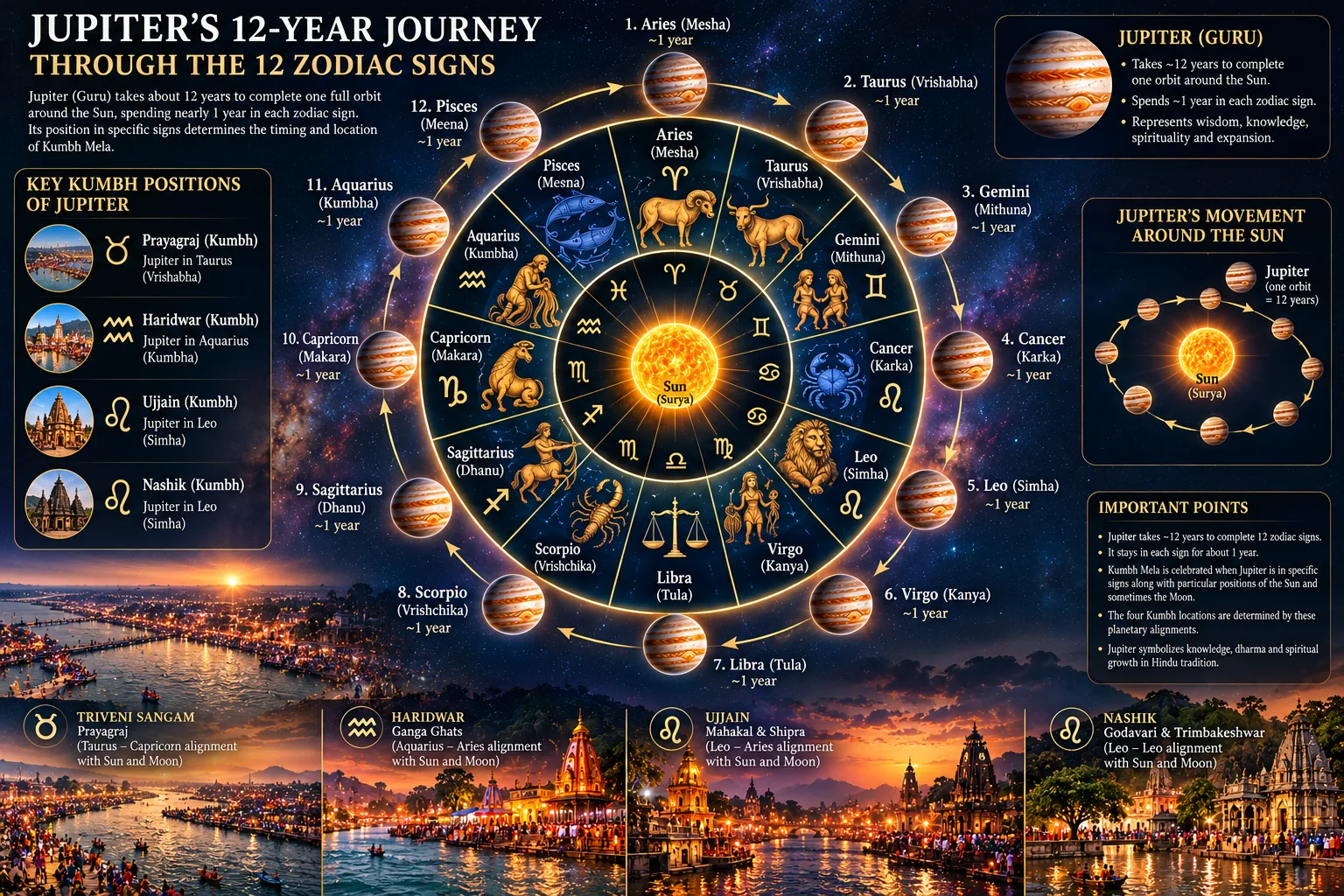
Awareness
12-year cycle explained simply
K
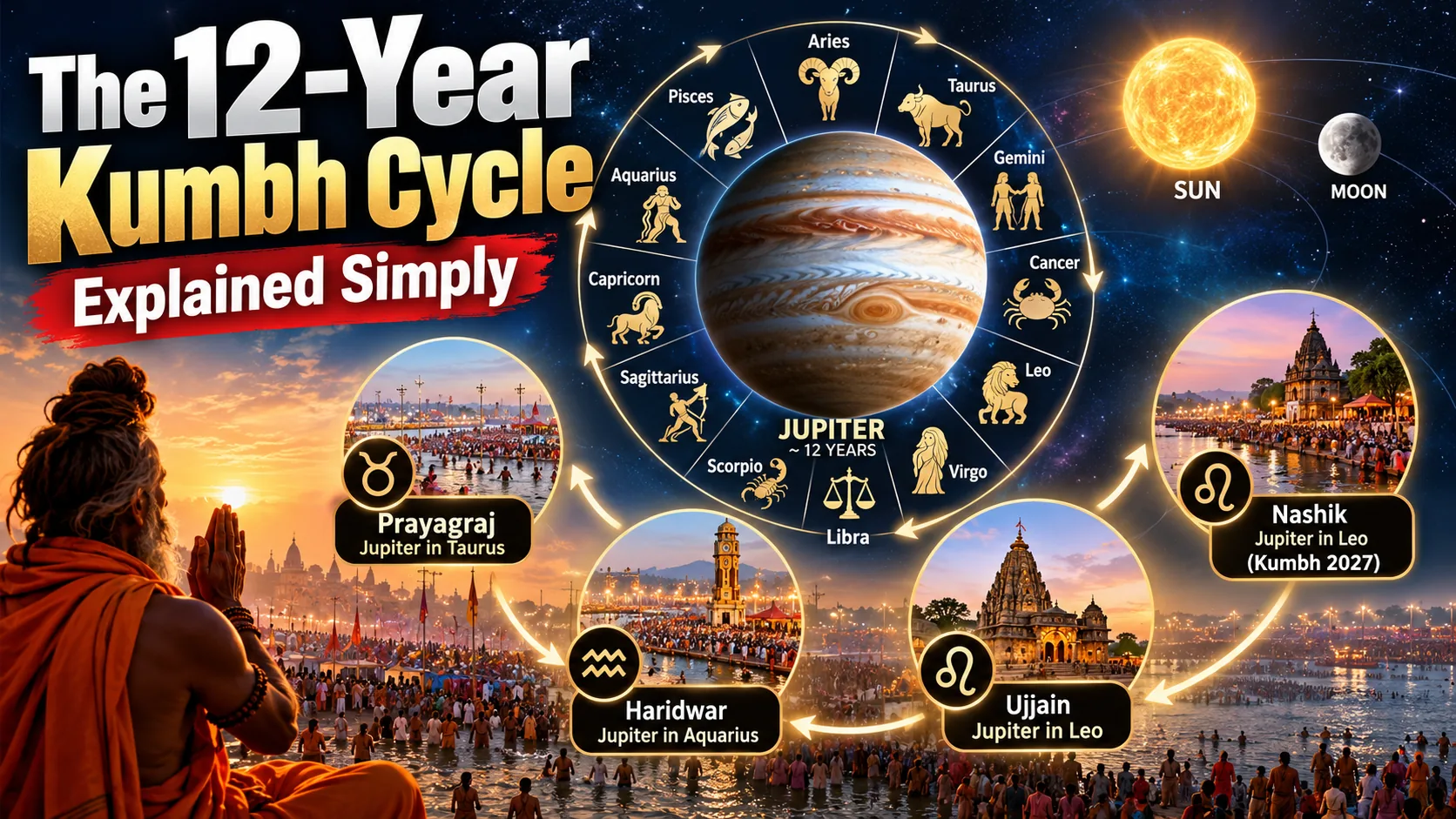
Kumbh AdminOctober 23, 20267 min readWhy does Kumbh Mela return after about 12 years? The answer begins with Jupiter, known as Brihaspati in Hindu tradition. Jupiter takes roughly 12 years to travel through the zodiac, creating the long cycle associated with Kumbh. But the 12-year cycle is more than just a planetary journey—it connects astronomy, Hindu calendars, mythology, and sacred pilgrimage.
The 12-Year Kumbh Cycle Explained Simply
One of the most fascinating things about Kumbh Mela is that it does not happen every year.
Instead, the major Kumbh cycle is traditionally associated with a period of approximately 12 years.
But why 12 years?
The simplest answer is Jupiter.
Known as Brihaspati in Hindu tradition, Jupiter takes approximately 12 years to complete its journey through the twelve zodiac signs. This long celestial cycle became closely connected with the traditional timing of Kumbh Mela.
What Is the 12-Year Cycle?
The zodiac is traditionally divided into 12 signs:
- Aries — Mesha
- Taurus — Vrishabha
- Gemini — Mithuna
- Cancer — Karka
- Leo — Simha
- Virgo — Kanya
- Libra — Tula
- Scorpio — Vrishchika
- Sagittarius — Dhanu
- Capricorn — Makara
- Aquarius — Kumbha
- Pisces — Meena
Jupiter moves through these signs over a period of roughly 12 years.
So, in a very simple way:
12 zodiac signs → Jupiter's journey → approximately 12 years
This recurring movement forms an important astronomical foundation of the traditional Kumbh cycle.
Why Is Jupiter Important to Kumbh?
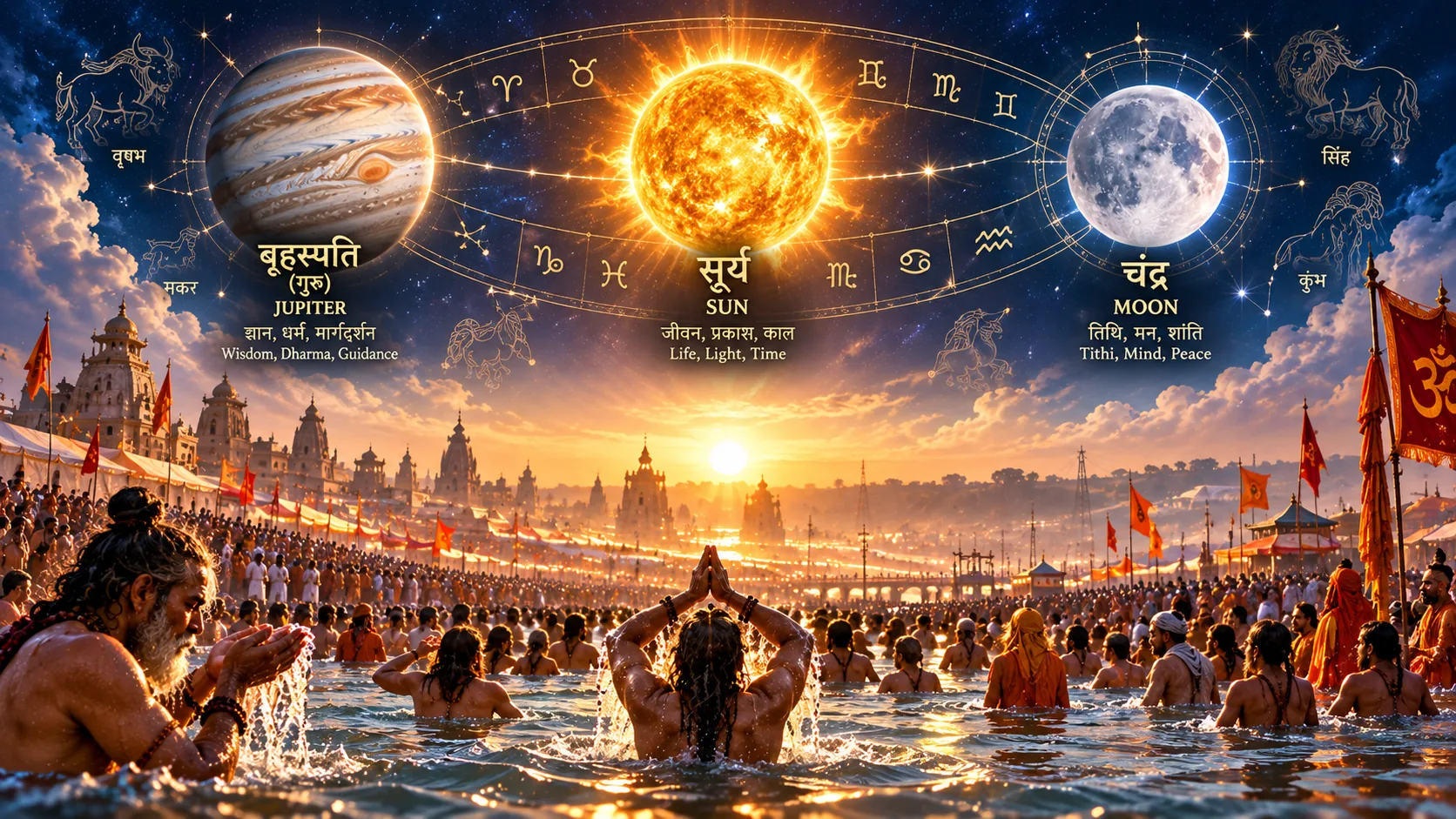
In Hindu tradition, Jupiter is called Brihaspati and is associated with wisdom, knowledge, teachers, and spiritual learning.
Its relatively long movement through the zodiac makes it useful as a marker of large cycles of time.
Traditional Kumbh calculations use Jupiter's position along with the positions of the Sun and Moon and the Hindu calendar.
Therefore, Kumbh is not simply scheduled because "12 years have passed."
Instead, the approximately 12-year cycle provides the broader framework within which the traditional calculations are made.
The Simple 12-Year Journey
Imagine Jupiter beginning at one point in the zodiac.
As it moves, it passes through the twelve zodiac signs.
A simplified representation looks like this:
Year 1 → Aries
Year 2 → Taurus
Year 3 → Gemini
Year 4 → Cancer
Year 5 → Leo
Year 6 → Virgo
Year 7 → Libra
Year 8 → Scorpio
Year 9 → Sagittarius
Year 10 → Capricorn
Year 11 → Aquarius
Year 12 → Pisces
After completing the cycle, Jupiter returns approximately to its starting region.
This is why Jupiter's movement is traditionally associated with a roughly 12-year rhythm.
Is Kumbh Held Exactly Every 12 Years?
Not necessarily.
The phrase "every 12 years" is a useful way to understand the broad Kumbh cycle, but the actual calculation is more complicated.
Jupiter's astronomical period is not exactly 12 Gregorian years.
In addition, traditional Hindu calendars combine:
- Solar movements
- Lunar movements
- Tithis
- Nakshatras
- Planetary positions
- Solar and lunar months
- Traditional rules for each Kumbh location
Therefore, the actual festival timing requires detailed calendrical calculations.
The 12-year figure should be understood as the approximate long-term cycle, not as a simple calendar rule.
Where Do the Four Kumbh Locations Fit In?
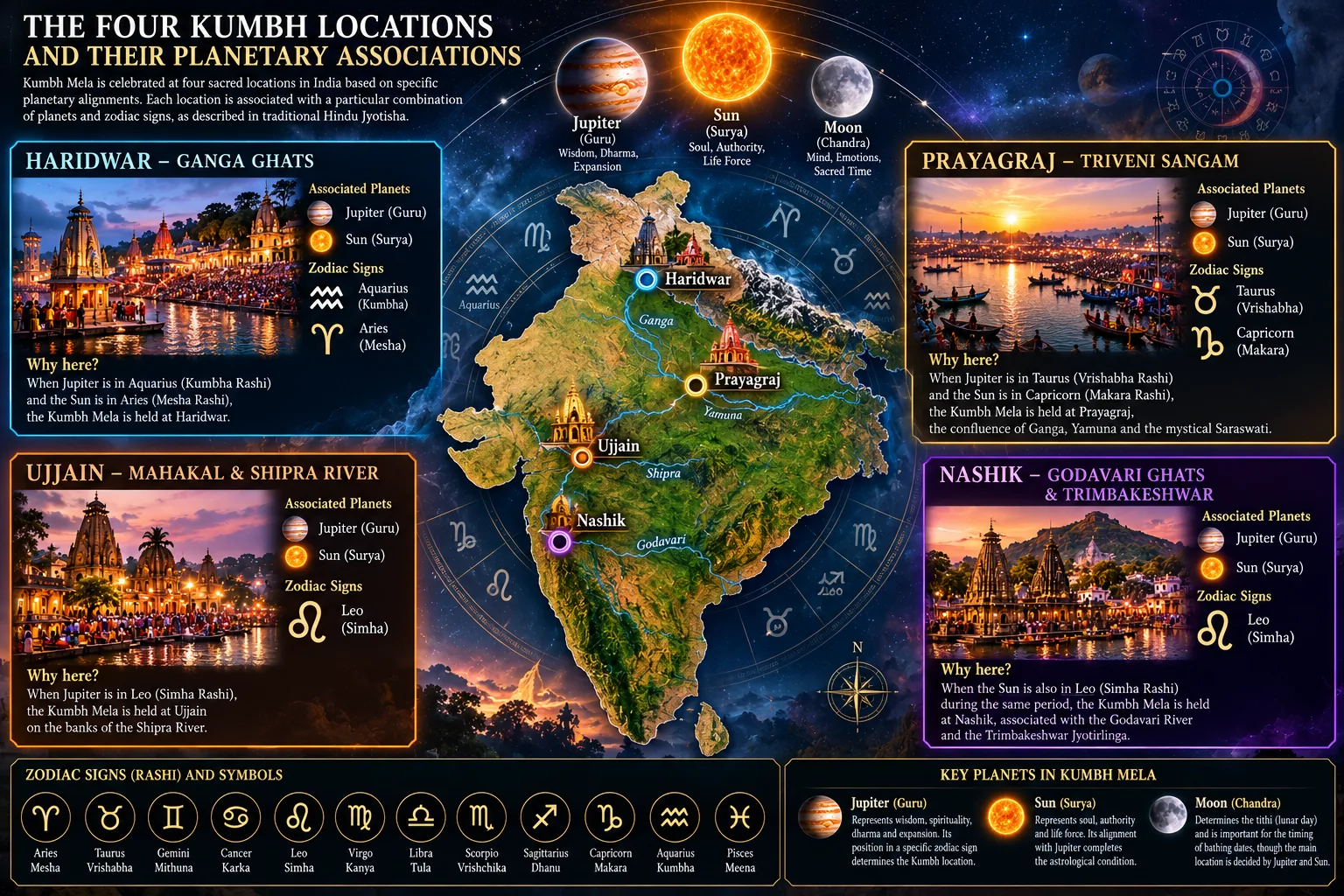
The Kumbh tradition is associated with four major pilgrimage locations:
- Prayagraj
- Haridwar
- Ujjain
- Nashik
Traditional Jyotisha associates these locations with different combinations of Jupiter and the Sun.
| Location | Traditional Jupiter Association | Traditional Sun Association |
|---|---|---|
| Prayagraj | Taurus (Vrishabha) | Capricorn (Makara) |
| Haridwar | Aquarius (Kumbha) | Aries (Mesha) |
| Ujjain | Leo (Simha) | Aries (Mesha) |
| Nashik | Leo (Simha) | Leo (Simha) |
These combinations are part of the traditional framework used to determine when a Kumbh is held at a particular location.
Why Does Kumbh 2027 Matter?
The upcoming 2027 Kumbh cycle is associated with Nashik and Trimbakeshwar, traditionally known as a Simhastha Kumbh.
The name Simhastha comes from Simha, the Sanskrit name for the zodiac sign Leo.
In the traditional framework, the Nashik Kumbh is associated with Jupiter and the Sun being connected with Simha Rashi (Leo).
This gives the 2027 Kumbh a particularly important connection with the Leo zodiac sign.
Why Does the Cycle Matter for Pilgrims?
The 12-year cycle helps explain why Kumbh is such a significant recurring pilgrimage.
A Kumbh is not an ordinary annual festival.
The long interval creates a sense of a major sacred occasion that returns after a substantial celestial cycle.
For pilgrims, this creates an opportunity to participate in:
- Sacred bathing
- Prayer
- Meditation
- Charity
- Spiritual gatherings
- Discourses
- Akhara traditions
- Religious ceremonies
The celestial cycle and the pilgrimage tradition therefore become connected.
The Mythological Connection With 12
The number 12 also appears in the traditional mythology surrounding Kumbh.
According to the story of Samudra Manthan, the gods and demons fought over the pot containing Amrit, the nectar of immortality.
Traditional accounts describe the struggle over the Amrit Kalash and associate it with a period of 12 divine days.
A traditional interpretation connects:
12 divine days → 12 human years
This provides a mythological explanation for the recurring 12-year rhythm associated with Kumbh.
The astronomical explanation and the mythological explanation are different traditions, but both contribute to the cultural meaning of the number 12 in Kumbh.
Jupiter and the 12-Year Cycle
The connection can therefore be understood at two levels.
Astronomical Level
Jupiter takes approximately 12 years to travel through the zodiac.
Mythological Level
The Kumbh tradition connects the struggle for Amrit with a period of 12 divine days, traditionally related to 12 human years.
Together, these traditions give the Kumbh cycle both a celestial explanation and a mythological meaning.
What Happens Between Two Kumbhs?
The approximately 12-year cycle does not mean that nothing happens between major Kumbh celebrations.
Other major religious gatherings and related Kumbh traditions occur at different intervals.
The broader Kumbh tradition includes:
- Purna Kumbh
- Ardh Kumbh
- Maha Kumbh traditions
- Other significant pilgrimage gatherings
Their timing and terminology depend on the specific tradition and location.
Therefore, the Kumbh tradition is better understood as a continuing cycle of pilgrimage rather than a single event that simply appears once every twelve years.
A Simple Example
Think of Jupiter as a celestial clock.
Imagine that Jupiter begins a journey through the zodiac.
It moves through:
Sign 1 → Sign 2 → Sign 3 → ... → Sign 12
After approximately 12 years, Jupiter completes the broad cycle.
When its position combines with the appropriate solar and lunar conditions required by the traditional Kumbh calculations, a new major Kumbh period can be identified.
So:
Jupiter's cycle
↓
Zodiac position
↓
Sun's position
↓
Lunar calendar
↓
Traditional Kumbh calculation
↓
Kumbh Mela
Is the 12-Year Cycle Purely Astrology?
It is important to distinguish the different concepts involved.
Modern astronomy can calculate the movement of Jupiter and other celestial bodies using mathematical models and observations.
Jyotisha is a traditional Indian system that uses celestial positions within calendrical and religious frameworks.
Kumbh timing belongs to a traditional religious and calendrical system that incorporates astronomical cycles.
Therefore, saying "Kumbh happens because of astrology alone" is an oversimplification.
The actual traditional framework involves celestial movements, calendars, religious traditions, sacred geography, and mythology.
The 12-Year Cycle in One Sentence
The simplest explanation is:
Kumbh's approximately 12-year cycle is traditionally connected with Jupiter's journey through the twelve zodiac signs, combined with the Sun, Moon, and Hindu calendrical calculations that determine the appropriate Kumbh period.
Why the 12-Year Cycle Makes Kumbh Unique
The long cycle gives Kumbh its distinctive character.
It connects:
The Sky — Jupiter, Sun and Moon
Time — the Hindu calendar and celestial cycles
Place — four sacred pilgrimage centres
Tradition — centuries of religious practices
People — millions of pilgrims gathering for sacred bathing and worship
This is why the Kumbh cycle is more than simply counting twelve years on a calendar.
It represents a traditional way of connecting cosmic cycles with sacred time and human pilgrimage.
Enhance Your Pilgrimage Experience
Mobile App
Read Kumbh Guides on Mobile
Download the Divya Kripa to read all 19 guides offline, receive real-time snan alerts, and access GPS-enabled navigation on the ground.
Download AppAI Assistant
Personalized Planner & Chatbot
Access your Kumbh Planner AI Assistant to receive tailored ritual advice, customized itineraries, and instant answers to spiritual questions.
Try AI PlannerRelated Articles



Loading discussion & reviews...